
Why Home Health Agencies Lose Money on Incomplete Visit Notes
An incomplete visit note rarely creates just one problem, it moves downstream into QA rework, billing holds, denials, and audit risk. This guide breaks down the 7 most common documentation gaps, how they drain revenue, and the workflow (frameworks, real-time QA, prompts, and clinician-reviewed AI) that helps nurses finish accurate notes the first time.
Key Takeaways
- Incomplete visit notes can delay billing, increase QA rework, and contribute to claim denials.
- A strong visit note should show what was assessed, what was done, why skilled care was required, and how the patient responded.
- Documentation should support the patient's diagnoses, Plan of Care, OASIS responses, and services billed.
- Copy-forward documentation can create inaccurate or contradictory information.
- Late documentation can increase after-hours charting and make accurate documentation harder.
- Real-time QA can identify missing or inconsistent information before a note reaches billing.
- AI can help clinicians capture and structure documentation, but human clinical review remains essential.
- Agencies should measure documentation completion, QA return rates, billing holds, and after-hours charting.
- The goal isn't longer notes. The goal is accurate, complete, clinically meaningful notes.
💡 Quick Answer: Home health agencies don't lose money because a nurse forgets one sentence, they lose it when an incomplete visit note triggers a chain reaction: QA rework, billing holds, claim denials, and ADR/audit exposure. A strong note shows what was assessed, what skilled service was provided, why a licensed clinician was needed, and how the patient responded, and it stays consistent with the OASIS, Plan of Care, and diagnoses. The fix isn't longer notes; it's a workflow (frameworks, real-time QA, prompts, and clinician-reviewed AI) that helps nurses capture the right information accurately the first time.
Introduction: The Visit Happened. But Can You Bill for It?
A nurse spends 45 minutes with a patient. The wound was assessed. Medications were reviewed. The patient received education. The nurse identified a change in condition. The care plan was updated.
The visit happened. But then the note says:
Patient seen for skilled nursing visit. Medications reviewed. Education provided. Patient tolerated well.
That's where the problem begins. The agency may have provided appropriate skilled care, but the documentation doesn't clearly show why the care was skilled, what was assessed, what was done, or how the patient responded.
And when the documentation doesn't support the service, the financial consequences can follow:
➡️ Incomplete note → QA rework → Billing delay → Claim issue → Possible denial → Lost time and revenue
For home health agencies, documentation isn't just a clinical task. It's part of the revenue cycle.
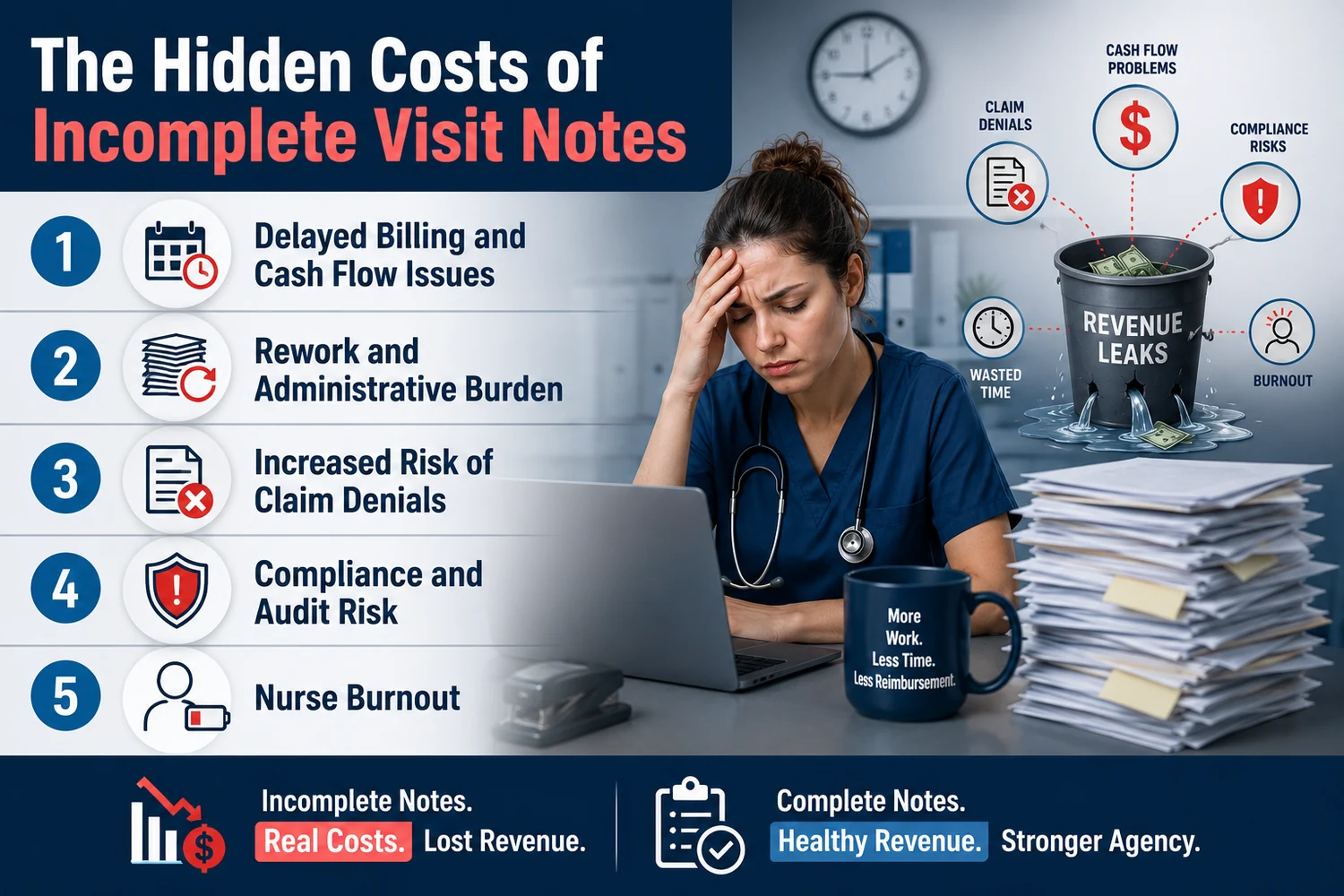
Incomplete notes don't just create extra work, they create delayed billing, rework, denials, compliance risk, and burnout.
How Incomplete Visit Notes Cost Home Health Agencies Money
An incomplete visit note rarely creates just one problem. What starts as a missing clinical detail can move through the agency's workflow and become a QA correction, billing delay, claim issue, or additional audit risk. For agencies operating on tight margins, these small documentation gaps can add up across hundreds or thousands of visits each month.
Understanding this financial impact helps agency leaders see documentation quality as more than a nursing or compliance issue. It is also an operational and revenue-cycle issue.
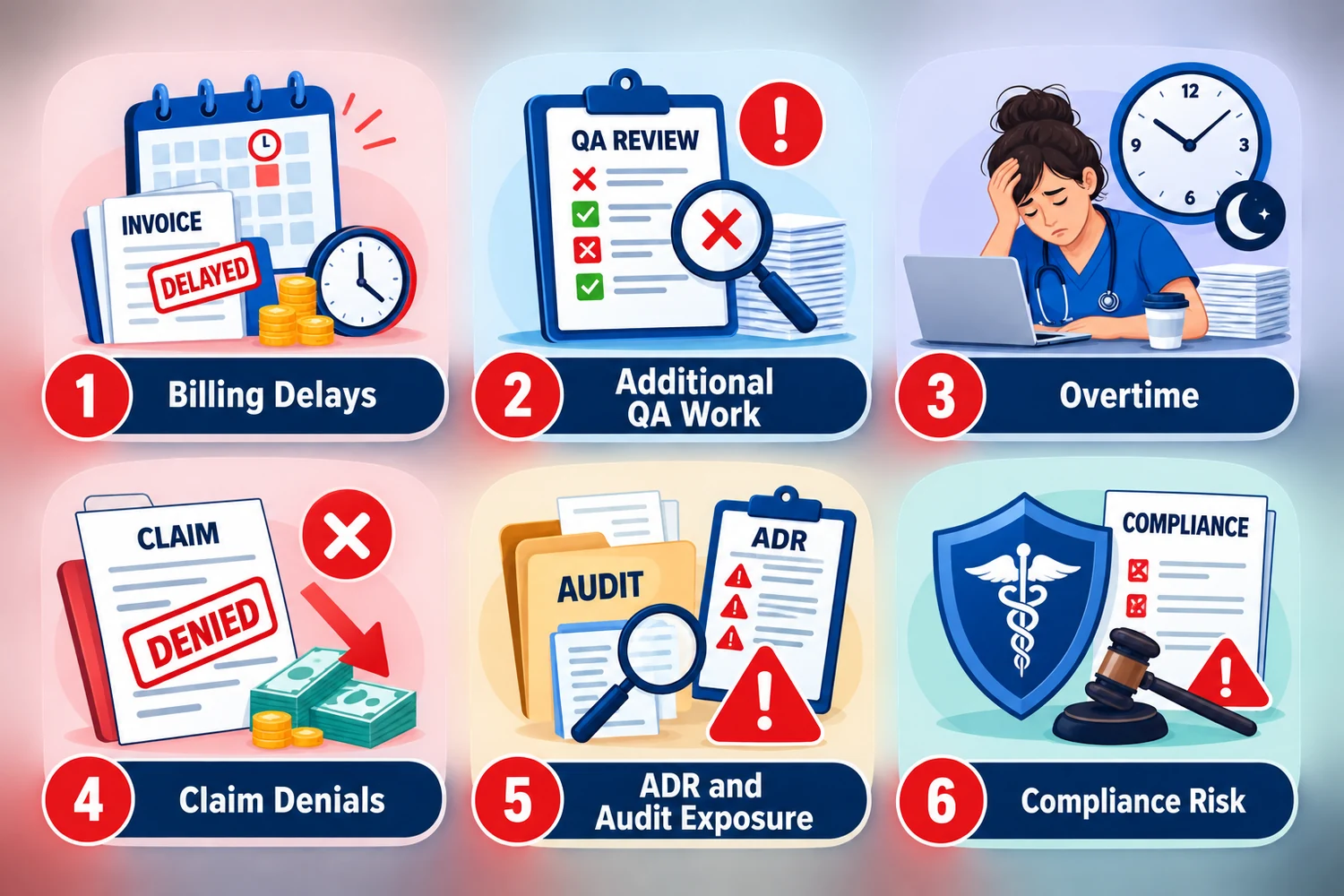
One missing detail can surface later as any of six downstream costs.
1. Billing Delays
If a chart isn't complete, the agency may need to hold the claim until documentation is finalized or reviewed.
2. Additional QA Work
QA staff may have to return charts to clinicians for clarification or correction.
3. Overtime
When nurses finish notes after hours, the agency pays for documentation time that could have been avoided through a better workflow. (We break this down further in The Hidden Cost of Late Nursing Documentation.)
4. Claim Denials
If the medical record doesn't adequately support eligibility, medical necessity, skilled services, or other applicable requirements, the claim may become vulnerable to denial.
5. ADR and Audit Exposure
Incomplete documentation can make it harder to demonstrate why services were appropriate when Medicare requests supporting records.
6. Compliance Risk
Inconsistent, inaccurate, or unsupported documentation can create broader compliance concerns.
The real cost isn't just the missing sentence. It's everything that the missing sentence causes downstream.
What Should a Home Health Visit Note Actually Show?
A home health visit note should allow another clinician, QA reviewer, coder, or payer to understand what happened during the encounter without having been present.
The exact documentation requirements can vary based on the discipline, service, payer, and clinical situation. However, the fundamental principle is consistent: the record should accurately and clearly support the care that was provided.
A strong visit note should establish:
- What was assessed
- What was found
- What skilled service was provided
- Why the service required a skilled clinician
- What interventions were performed
- How the patient responded
- What education was provided
- What changed from the previous visit
- What happens next
The 7 Most Common Gaps in Home Health Visit Notes
Most incomplete visit notes don't fail because the entire note is missing. More often, the note contains basic information but leaves out one or more details needed to demonstrate the clinical significance of the visit.
These gaps can be easy to overlook because the documentation may appear complete at first glance. Agencies should therefore look beyond whether a note was "signed" and ask whether it actually tells the complete clinical story.
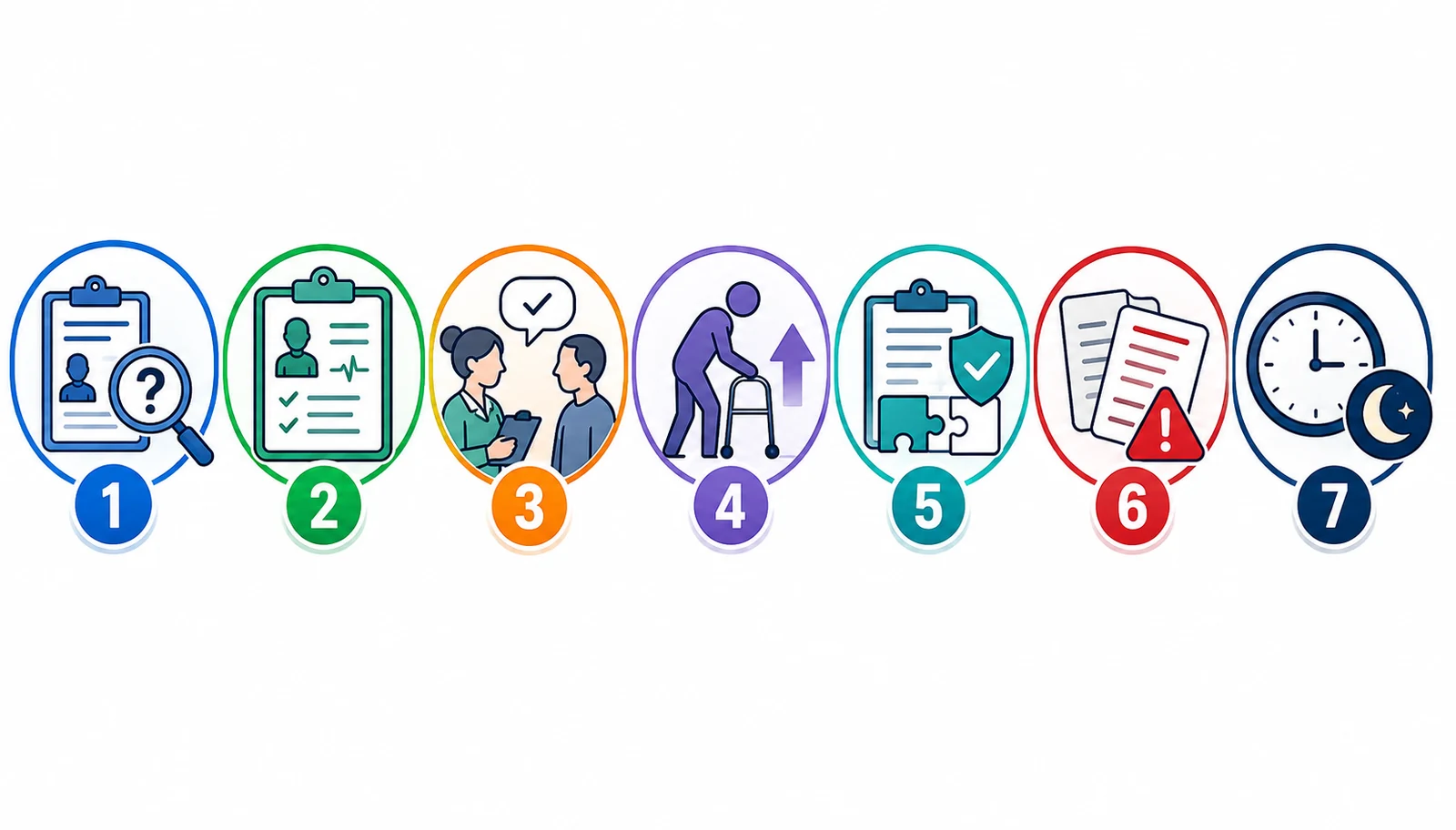
The seven gaps that most often make a signed note incomplete.
1. The Note Doesn't Explain Skilled Need
Documenting an intervention isn't always enough to demonstrate why skilled home health care was necessary. A note may state that medication education, wound care, assessment, or disease-management teaching occurred without explaining the clinical judgment or patient-specific circumstances that required a licensed professional.
Strong documentation connects the patient's condition to the skilled service and makes the rationale for the visit clear. What should the note establish?
- What clinical issue required attention?
- What assessment was performed?
- What clinical judgment was required?
- What skilled intervention was provided?
- Why was a licensed clinician necessary?
- What was the patient's response?
The question QA teams should ask is: "Why did this patient need a skilled clinician today?" The answer should be evident in the documentation.
2. The Patient's Current Condition Isn't Clearly Documented
A visit note should describe the patient's condition as it exists during the current encounter rather than relying on generic statements or historical information. This is especially important in home health, where patients can experience meaningful changes between visits.
Clear documentation of current findings gives the care team, QA staff, and reviewers a reliable picture of what the clinician observed and addressed that day. Depending on the visit, relevant findings may include:
- Symptoms
- Vital signs
- Wound status
- Pain
- Respiratory status
- Functional changes
- Medication issues
- Cognitive changes
- Patient or caregiver concerns
- Response to treatment
- Changes since the previous visit
The note should distinguish today's clinical status from historical information.
3. The Intervention Is Documented, But the Response Isn't
Clinical documentation shouldn't stop at describing what the clinician did. The patient's response helps demonstrate whether the intervention was effective, whether additional teaching or treatment was necessary, and what should happen next.
For example: "Patient educated on diabetic diet." That tells the reviewer what happened. But what happened afterward? Did the patient understand the education? Did the patient have questions? Was additional teaching required? Was a caregiver involved? Could the patient demonstrate the instructed technique?
➡️ A stronger documentation chain is: Assessment → Intervention → Patient Response → Plan. That sequence makes the clinical story easier to follow.
4. Functional Changes Are Missing
Functional status is an important part of understanding a patient's ability to remain safely at home. Changes in mobility, transfers, self-care, strength, endurance, or assistance needs can affect the patient's care plan and overall clinical picture.
Documenting these changes also helps maintain consistency between routine visit documentation and applicable OASIS information. Clinicians should document relevant changes such as:
- Increased assistance requirements
- New mobility limitations
- Changes in transfers
- Fall-risk changes
- New or changed assistive-device use
- Changes in ADL performance
- Improvement or decline in functional ability
The goal is to describe what the patient can actually do and what assistance is required, when relevant to the visit.
5. The Note Doesn't Match the OASIS or Plan of Care
A home health record should tell one consistent clinical story across its different components. The visit note, OASIS, Plan of Care, diagnoses, and other clinical documentation should generally support and explain one another. Problems can arise when:
- OASIS indicates substantial assistance, but the visit note describes independent mobility.
- The Plan of Care focuses on one condition, while visit notes consistently focus on another.
- A diagnosis appears on the claim but isn't supported by the clinical record.
- Functional status changes dramatically without explanation.
- Medication information conflicts across the chart.
When documentation doesn't align, QA teams may have to investigate and request clarification. The question is simple: does the visit note support the rest of the chart?
6. Copy-Forward Documentation Creates Inaccuracies
Templates can make documentation more efficient. Copying yesterday's clinical story into today's note without verifying it is different. Copy-forward documentation can leave behind:
- Old symptoms
- Incorrect medication information
- Outdated wound measurements
- Incorrect functional status
- Previous patient responses
- Old education
- Previous clinical findings
The result can be a note that looks complete but isn't accurate. A complete note isn't necessarily a good note if the information is wrong. Templates should provide structure and not replace clinical judgment.
7. The Note Is Finished Too Late
Late documentation creates more than an administrative inconvenience. When nurses routinely complete notes hours after a visit, they are more likely to:
- Rely on memory
- Leave out details
- Reuse previous language
- Rush documentation
- Finish notes after scheduled work hours
The closer the documentation is captured to the actual encounter, the easier it is to preserve accurate clinical details. This is why documentation timing is both a clinical quality issue and a workforce issue.
Why "Longer Notes" Aren't the Solution
When agencies discover documentation gaps, the instinct is often to ask clinicians to write more. But documentation quality isn't determined by word count. A 1,500-word note filled with boilerplate language can still fail to explain the patient's clinical situation.
A concise note can be clinically strong when it accurately captures current condition, assessment, skilled intervention, clinical rationale, patient response, and plan. The objective should be:
🎯 Specificity > Length. Accuracy > Volume. Clinical relevance > Boilerplate.
The better question isn't "How can we make nurses document more?" It is "How can we help nurses capture the right information with less effort?"
How Incomplete Notes Affect the Revenue Cycle
Documentation sits upstream of the home health revenue cycle. Before a claim can be paid, the agency needs a medical record that supports the services provided and the diagnoses reported. When documentation is incomplete, the problem can move downstream:
➡️ Clinical team → QA → Coding → Billing → Payer review
A small documentation gap at the beginning can therefore create problems several steps later. (This is also central to PDGM documentation strategy, where one inconsistent story across the chart can change the claim.)
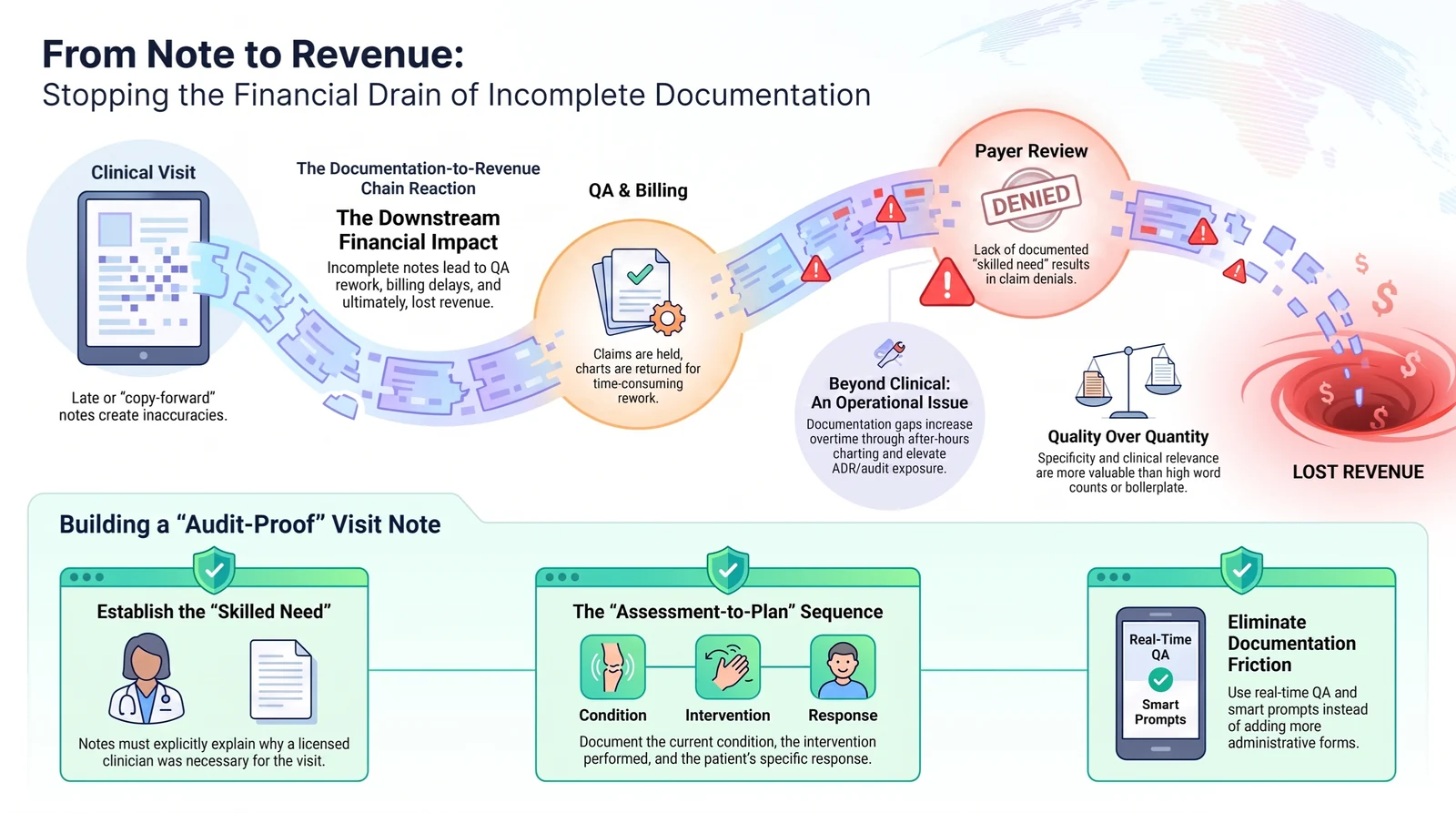
Documentation is upstream of revenue: a note-level gap becomes a revenue-cycle problem, and audit-proof notes stop the drain.
The Documentation-to-Revenue Cycle
🔗 Clinical Visit → Documentation → QA → Coding → Billing → Payment → Audit / ADR (if applicable)
This is why documentation quality should be treated as an operational metric, not simply a clinical documentation metric. Documentation is upstream of revenue.
Incomplete Notes and Medicare Claim Denials
Medicare payment depends on the medical record adequately supporting the services and applicable eligibility requirements. An incomplete note does not automatically mean a claim will be denied. However, documentation gaps can make it harder for an agency to demonstrate medical necessity, skilled need, homebound status, or other applicable Medicare requirements. Common documentation vulnerabilities include:
- Insufficient evidence of homebound status
- Insufficient skilled-need documentation
- Incomplete or inconsistent visit notes
- Unsupported diagnoses
- OASIS/narrative inconsistencies
- Plan of Care inconsistencies
- Missing required documentation
- Timing problems
- Inadequate supporting clinical evidence
This is why agencies shouldn't wait until an ADR arrives to evaluate documentation quality. The best ADR strategy is prevention upstream, and many of these gaps map directly to the top reasons Medicare ADRs get denied.
How Agencies Can Prevent Incomplete Visit Notes
Preventing incomplete notes requires more than telling clinicians to "be more thorough." Agencies need a workflow that makes it easy for nurses and other clinicians to capture the information required for a clinically meaningful note. A strong prevention strategy combines:
- Standardized documentation frameworks
- Targeted prompts
- Clinician training
- Real-time QA
- Clear accountability
- Workflow improvement
- Appropriate technology
The goal is to make the right documentation easier to produce the first time.
Build a Standard Documentation Framework
A consistent framework gives clinicians a repeatable way to document the important elements of each encounter without forcing them to start from a blank page. The framework should help clinicians move logically:
➡️ Patient condition → Assessment → Skilled intervention → Clinical rationale → Response → Follow-up
A consistent structure can improve documentation quality across clinicians while still allowing the note to reflect the individual patient's circumstances.
Use Real-Time Documentation QA
The earlier a documentation problem is identified, the easier it usually is to correct. Traditional QA often finds problems after the clinician has already submitted the note. Real-time QA changes the workflow by identifying potential gaps while the encounter is still fresh. For example, a documentation QA system may flag:
- Missing skilled-need rationale
- Potential OASIS/narrative inconsistencies
- Missing patient response
- Diagnosis/documentation mismatches
- Contradictory information
- Potentially incomplete documentation
The clinician can then review the information before finalizing the record. This can reduce unnecessary back-and-forth between nurses and QA teams.
Give Nurses Documentation Prompts Instead of More Forms
Nurses don't necessarily need more fields, forms, or administrative requirements. They need prompts that help them remember the clinically important information at the right moment. Instead of asking "Write a complete narrative," a workflow can prompt:
- What changed?
- What did you assess?
- What skilled intervention did you provide?
- Why was skilled care necessary?
- How did the patient respond?
- What needs to happen next?
These prompts can guide documentation without requiring nurses to write lengthy narratives.
Use AI to Reduce Documentation Friction
AI documentation can help reduce the manual effort required to turn clinical information into a structured visit note. Depending on the technology, AI may support voice input, structured prompts, clinical note generation, OASIS support, documentation gap detection, coding assistance, QA checks, and EMR integration.
The safest and most useful workflow isn't one where AI independently decides what belongs in the patient's record. Instead:
➡️ Nurse provides clinical information → AI structures documentation → AI flags potential gaps → Nurse reviews → Final documentation enters the EMR
Human clinical review remains essential, a point we cover in depth in AI vs. Manual Charting in Home Health.
Create a Pre-Bill Documentation Check
A pre-bill documentation check gives the agency one final opportunity to identify problems before they affect the claim. The purpose isn't necessarily to manually inspect every word of every note. Instead, agencies can use a targeted checklist or risk-based QA process to confirm that essential documentation is present, internally consistent, and appropriate for the services being billed.
Pre-Bill Questions
- Is the visit note complete?
- Does it explain skilled need?
- Are current findings documented?
- Is the intervention clear?
- Is patient response documented?
- Does the note support the Plan of Care?
- Does the documentation support the diagnosis?
- Are there inconsistencies with OASIS?
- Are the required signatures complete?
- Is anything missing that could delay billing?
Track Documentation Metrics
What gets measured can be improved. If an agency doesn't track how often notes are returned, how long clinicians spend finishing documentation, or how frequently incomplete documentation delays billing, leadership may underestimate the size of the problem. Useful metrics include:
| Metric | What it measures |
|---|---|
| Documentation Completion Rate | How many notes are completed on time |
| QA Return Rate | How many notes are returned to clinicians for correction |
| Average Correction Time | How long it takes to resolve documentation issues |
| Billing Hold Rate | How many claims are delayed because documentation is incomplete |
| Denial Rate | How many claims experience documentation-related denial issues |
| After-Hours Charting | How much documentation is completed outside scheduled working hours |
These metrics can help leadership determine whether the problem is primarily training, workflow, staffing, technology, or a combination of factors.
The Business Case for Better Visit Notes
Better documentation isn't simply a compliance improvement. It can affect several areas of agency performance simultaneously:
➡️ Better documentation → Fewer QA corrections → Less clinician rework → Faster billing → Fewer avoidable claim problems → Better audit readiness → Less after-hours charting
The biggest opportunity isn't necessarily making nurses document faster. It's eliminating the work that shouldn't have to happen twice.
A Simple Home Health Visit Note Checklist
A practical checklist gives clinicians and QA teams a quick way to verify whether a note tells a complete clinical story before it is finalized. The checklist should be simple enough to use consistently and should focus on the information that matters most, not create another administrative burden.
Before Signing a Visit Note, Ask:
- Did I document the patient's current condition?
- Did I document the assessment performed?
- Did I explain the skilled service provided?
- Did I explain why skilled care was necessary?
- Did I document the intervention?
- Did I document the patient's response?
- Did I document relevant education?
- Did I capture meaningful changes from the previous visit?
- Does the note support the Plan of Care?
- Does the documentation support the patient's diagnoses?
- Is the note accurate and free from outdated copy-forward information?
- Is anything missing that could delay QA or billing?
Final Takeaway
Home health agencies don't lose money simply because a nurse forgot to write one sentence. They lose money when incomplete documentation creates a chain reaction:
➡️ Incomplete note → Rework → Delayed billing → Claim risk → More administrative work → Lost revenue
The solution isn't asking nurses to write longer notes. It's building a workflow where nurses can capture the right clinical information quickly, review it, and get it into the EMR accurately the first time. Because the best documentation workflow isn't the one that creates the longest notes, it's the one that helps nurses finish accurate notes without taking the work home.
Home Health Documentation Playbook
The complete guide to OASIS-E, Medicare compliance, PDGM, and AI-assisted documentation. Learn how top agencies reduce documentation time without sacrificing compliance.
Bottom Line
Incomplete home health visit notes rarely cost an agency one sentence, they trigger a chain reaction of QA rework, billing delays, denials, and audit exposure. The fix isn't longer notes; it's a workflow, standard frameworks, real-time QA, targeted prompts, and clinician-reviewed AI, that helps nurses capture accurate, specific, consistent documentation the first time, so the note supports the OASIS, Plan of Care, diagnoses, and services billed.

Arvind Sarin is the founder of Copper Digital. For the past year he has spent three days a week inside a 500+ census Texas home health agency, building AI documentation that finishes OASIS and visit notes the same day, with a nurse reviewing and approving every note. He writes about home health documentation, OASIS, Medicare compliance, and applying AI responsibly in clinical workflows.
Frequently asked
Frequently asked questions
An incomplete visit note may be returned for correction, delay QA or billing, create compliance concerns, or contribute to claim problems if the medical record doesn't adequately support the services provided.
Join the conversation
Leave a comment
Related reading
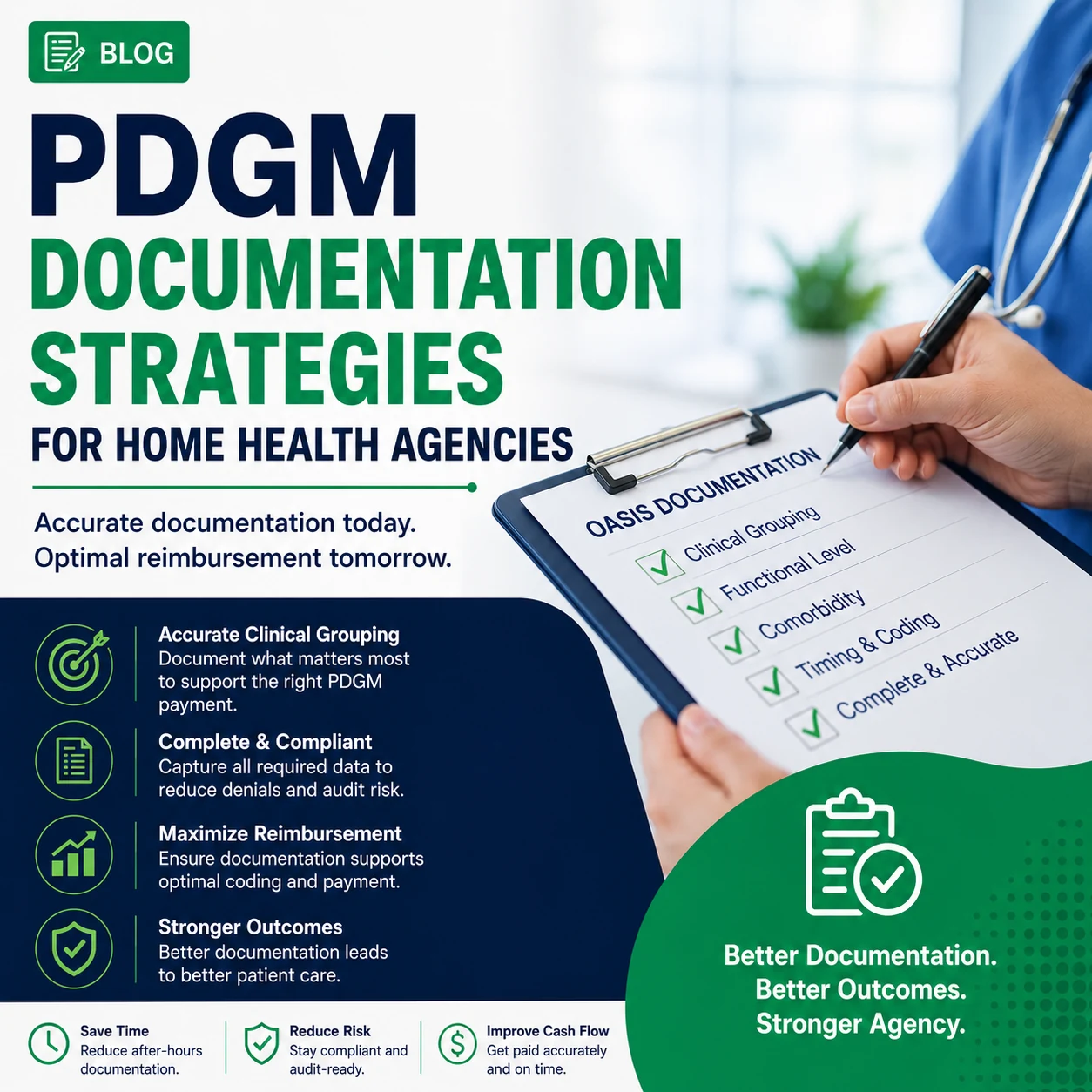
PDGM Documentation Strategies for Home Health Agencies
Under PDGM, documentation establishes the clinical picture that supports classification, medical necessity, coding, and payment. This guide breaks down 15 PDGM documentation strategies, a documentation-to-payment framework, weak-vs-strong examples, and a closed-loop workflow to keep charts consistent and audit-ready.
Why Medicare Home Health Claims Get Denied
Medicare home health claim denials are revenue leaks, not just billing issues. This guide breaks down the ten most common reasons claims get denied, from OASIS gaps and late NOAs to coding and medical-necessity problems, and how to prevent them to get paid faster.

Common OASIS Documentation Mistakes That Lead to Payment Delays
Common OASIS documentation mistakes, such as incomplete assessments, incorrect diagnosis coding, inaccurate Section GG scoring, medication and homebound-status errors, weak skilled-need documentation, and missing physician signatures, are among the biggest causes of home health payment delays. Because OASIS data drives PDGM reimbursement, most of these errors are preventable with point-of-care charting, strong QA, and AI-powered documentation validation.