
How AI and Voice Technology Improve Caregiver Documentation in Home Health
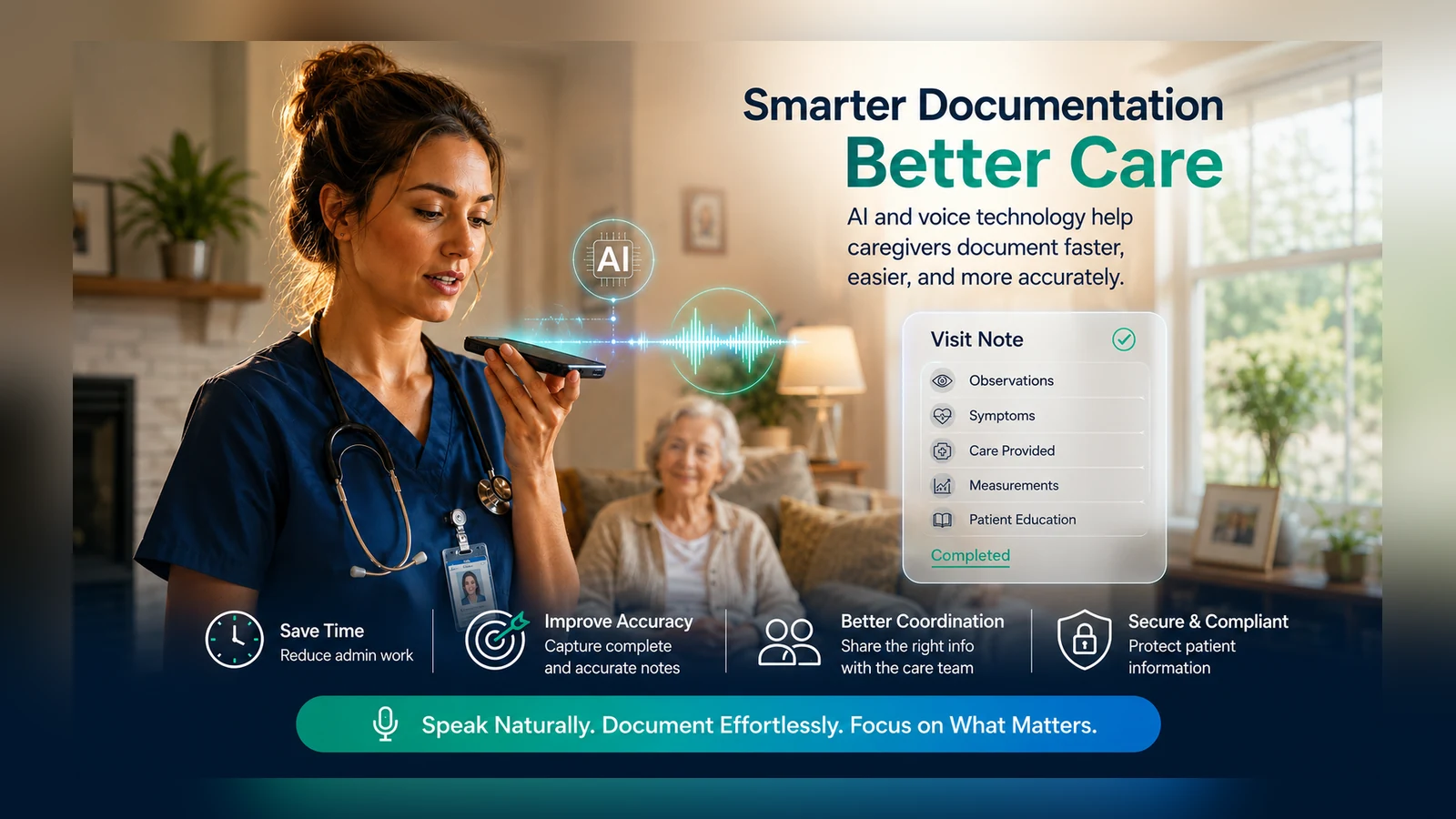
Documentation can eat a caregiver's day. AI and voice technology let caregivers speak their observations while a visit is fresh, then help organize the information into structured documentation — reducing typing, after-hours charting, and errors, while the caregiver reviews and stays accountable for the final record.
Key Takeaways
- AI voice documentation lets caregivers speak observations after a visit; speech-to-text captures the words and AI helps organize them into structured documentation.
- The workflow is speak → AI organizes → caregiver reviews → finalize, so the caregiver stays accountable for the clinical record.
- Hands-free dictation removes typing friction and lets caregivers capture information while the visit is still fresh.
- AI can reduce repetitive data entry and after-hours charting, and help surface changes in condition for better care coordination.
- AI does not replace review: generated documentation must be checked by a caregiver or clinician before it is finalized.
- AI voice documentation and ambient scribes are related but not identical — evaluate what a tool actually does, and confirm it is private and HIPAA compliant.
- The goal is augmentation, not replacement: give caregivers back time to focus on patients.
💡 Quick Answer: AI voice documentation lets home health caregivers speak their observations after a visit instead of typing every detail. Speech-to-text captures what they say, and AI helps organize it into structured documentation. The workflow is speak → AI organizes → caregiver reviews → finalize — so it reduces administrative friction and captures information while it's fresh, while keeping the caregiver accountable for the final clinical record.
Documentation is an essential part of home health care, but it can also become one of the most time-consuming parts of a caregiver's day. A visit may be finished, but the work is not necessarily over: caregivers may still need to record observations, enter patient information, and make sure the right details are available to the rest of the care team. That administrative burden can take time away from what caregivers do best — caring for patients.
This is where AI and voice technology can help. Instead of requiring caregivers to type every detail manually, voice-enabled tools allow them to speak their observations. Speech-to-text converts those spoken observations into written information, while AI helps organize and structure it into usable documentation — a workflow that can be more natural, efficient, and easier to complete. But the value goes beyond replacing typing: it can reduce administrative time, support more complete documentation, improve access to important information, and strengthen care coordination, all while keeping the caregiver involved in reviewing the final record.
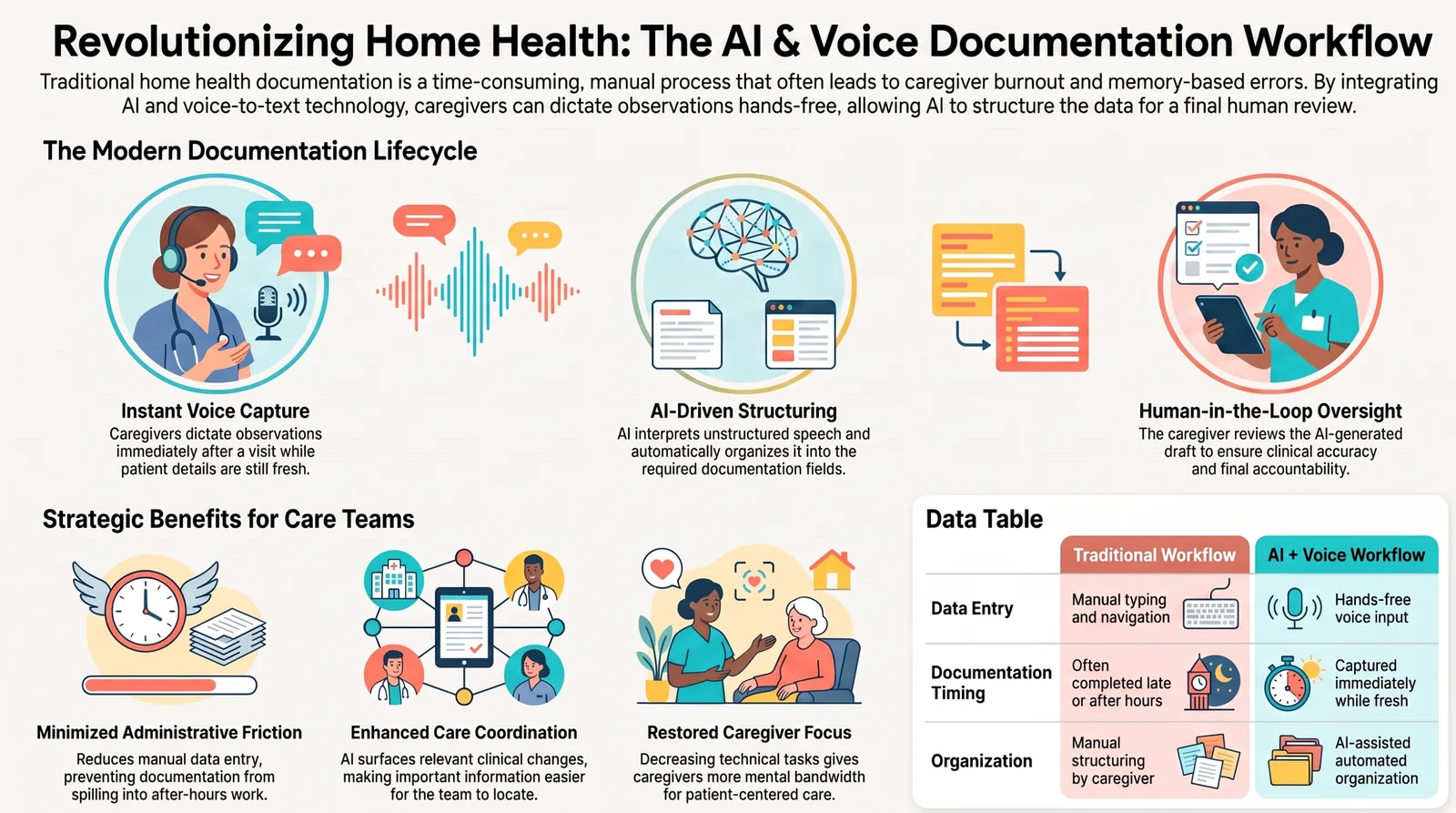
The modern AI + voice documentation lifecycle: capture by voice, let AI structure the information, and keep a human in the loop for final review.
What Is AI Voice Documentation in Home Health?
AI voice documentation combines voice recognition, speech-to-text technology, and artificial intelligence to help caregivers document patient visits. Instead of sitting down to manually type every observation, a caregiver can speak the information aloud. After a visit, a caregiver might verbally describe:
- What they observed
- Patient symptoms or concerns
- Changes in the patient's condition
- Care provided during the visit
- Relevant measurements or vital information
- Patient education or instructions
- Other observations that need to be documented
Voice technology converts the spoken information into text, and AI helps organize it into a documentation format. The important distinction is that voice technology captures what the caregiver says, while AI helps transform that information into organized documentation. The caregiver remains responsible for reviewing the information and ensuring the final documentation accurately reflects the care provided.
1. Hands-Free Dictation Makes Documentation Easier
One of the most straightforward benefits of voice technology is hands-free documentation. Traditional documentation often requires caregivers to stop what they are doing, open an application, navigate through fields, and type information manually. Voice technology introduces another option: speak instead of type. A caregiver can dictate observations immediately after a visit while the details are still fresh — particularly useful in home health, where caregivers move between different patients and locations throughout the day. Instead of holding everything in memory until later and reconstructing the visit, the caregiver can capture relevant information closer to the time of care.
Why hands-free documentation matters
Typing can create friction. The caregiver may know exactly what needs to be documented but still have to spend time translating those observations into a series of fields and written notes. Voice technology removes some of that friction: a caregiver can communicate information in a more natural way, similar to how they might explain the visit to a supervisor or another member of the care team. This doesn't eliminate the need for documentation — it changes how the information gets into the workflow.
2. AI Can Reduce Administrative Time
Documentation is necessary, but excessive administrative work can contribute to caregiver fatigue and frustration. Every additional minute spent typing, navigating software, correcting fields, or entering repetitive information is time that could be spent elsewhere. AI-powered voice documentation can help reduce some of that workload: instead of manually entering every piece of information, caregivers use voice input to capture observations, and AI assists with organizing them into documentation — reducing the amount of manual data entry required.
Less charting after the visit
One of the biggest potential advantages is reducing the documentation that gets pushed to the end of the day. When documentation takes too long, caregivers may find themselves completing notes after their visits are finished — or even after normal working hours. Reducing that burden supports a better workflow: Visit → Voice documentation → AI-assisted organization → Review → Finalize, rather than Visit → move on to the next patient → try to remember details → return to documentation later → manually type everything. The goal isn't simply to make documentation faster; it's to remove unnecessary friction from the process.
3. AI Voice Technology Can Support More Accurate Documentation
Documentation accuracy matters because the patient record needs to reflect what actually happened during care. Manual documentation introduces opportunities for errors — a caregiver may forget a detail, mistype information, enter it into the wrong field, or unintentionally leave something out when trying to complete documentation quickly. These are exactly the gaps that show up in a review of the top documentation errors in home health and in incomplete visit notes. Voice technology provides another way to capture information: modern speech recognition can recognize spoken language and clinical terminology, turning verbal observations into written text, and AI can help organize that information into a more structured format.
But AI does not replace review
This is an important distinction. AI-generated documentation should not be treated as automatically correct simply because it was produced by a sophisticated model. A caregiver or clinician still needs to review the documentation, confirm that it accurately reflects the visit, and make corrections when necessary. The ideal model is not AI writes → documentation automatically submitted. It is caregiver speaks → AI organizes → caregiver reviews → documentation is finalized. That human review is especially important in healthcare, because clinical documentation represents real patient care.
4. AI Can Improve Care Coordination
Home health care involves more than one person. Depending on the patient's needs, information may need to be communicated across caregivers, nurses, supervisors, physicians, and other members of the care team. The challenge is that important information can be buried inside unstructured notes. AI can help make that information easier to identify — for example, by processing spoken information and helping surface relevant details such as:
- Changes in patient condition
- Symptoms
- Vital information
- Important observations
- Potential concerns
- Changes that may require follow-up
Better information flow
The potential benefit is not simply faster documentation — it is better information flow. When documentation is completed more efficiently and important information is easier to identify, members of the care team gain better visibility into what is happening with the patient. That supports communication and care coordination.
5. Voice Documentation Helps Capture Information While It Is Fresh
Memory is an important part of documentation. The longer a caregiver waits to document a visit, the more difficult it can become to reconstruct exactly what happened — especially for caregivers who see multiple patients during a day. Voice technology makes it easier to capture information immediately after a visit: a caregiver can speak through the key observations while the encounter is still fresh. That creates a more direct connection between what happened during the visit, what the caregiver remembers, and what gets documented. The shorter that gap, the less the documentation depends on reconstructing the visit hours later.
6. AI Can Help Turn Unstructured Voice Into Structured Documentation
Caregivers don't necessarily think in the same structure that documentation software requires. A caregiver might naturally say:
She seemed more tired than usual today, wasn't eating as much, and mentioned that she felt weaker when walking to the bathroom.
A documentation system may require that information to be organized across specific sections. AI can help bridge that gap. Instead of forcing the caregiver to think "which field does this belong in?", the caregiver can focus on communicating "what happened with my patient?" — and AI helps organize the information into the appropriate documentation structure. This is one of the most important differences between basic speech-to-text and AI-assisted documentation:
Speech-to-text
Caregiver speaks → text appears.
AI documentation
Caregiver speaks → information is interpreted and organized → structured documentation is created → caregiver reviews. The second workflow has the potential to remove significantly more administrative friction.
7. AI Can Give Caregivers More Time to Focus on Patients
The ultimate goal of documentation technology should not be to create more technology for caregivers to manage — it should be to give them more time for the work that requires a human being. Home health caregivers need to observe patients, communicate with families, recognize changes, provide care, educate patients, and build relationships. Those activities cannot simply be reduced to a checkbox. When technology reduces repetitive administrative work, caregivers may have more time and mental bandwidth for those responsibilities. That matters, because documentation and patient care should not feel like competing priorities — and when they do, it's one of the biggest reasons nurses hesitate to adopt AI. Technology should support the caregiver, not pull the caregiver further away from the patient.
AI Voice Documentation vs. Traditional Documentation
| Documentation Process | Traditional Workflow | AI + Voice Workflow |
|---|---|---|
| Information capture | Manual typing | Voice input |
| Documentation timing | Often completed later | Can be captured immediately |
| Data entry | Primarily manual | AI-assisted |
| Organization | Caregiver manually structures information | AI can help organize information |
| Review | Caregiver reviews manually entered note | Caregiver reviews AI-assisted documentation |
| Administrative burden | Higher | Potentially lower |
| Caregiver focus | More time spent on documentation | More time available for patient care |
The exact capabilities vary by platform, but the underlying goal is consistent: make documentation less burdensome without removing human oversight.
What AI Voice Documentation Should Not Do
AI can be powerful, but healthcare documentation requires boundaries. An AI documentation tool should not replace clinical judgment. It should not encourage caregivers to accept automatically generated information without reviewing it. And it should not create documentation that says something happened when it did not. A responsible AI documentation workflow should include:
Human review
The caregiver or clinician should review the generated documentation.
Clinical accountability
The healthcare professional remains responsible for the accuracy of the final documentation.
Privacy and security
Patient information must be handled using appropriate privacy, security, and organizational controls — which is why it's worth confirming whether an AI documentation tool is HIPAA compliant before it touches patient data.
Transparency
Care teams should understand how the AI system is being used and what it can and cannot do.
Appropriate scope
AI should assist documentation rather than independently make clinical decisions beyond its intended role. The objective is augmentation, not replacement.
Is AI Voice Documentation the Same as an Ambient Scribe?
Not necessarily. The terms are sometimes used interchangeably, but they can describe different workflows. An ambient scribe typically listens to a clinical conversation and automatically generates documentation from the interaction. An AI voice documentation tool may instead allow the caregiver to intentionally dictate a visit summary or specific observations during or after the visit. For home health, this distinction matters: a caregiver may prefer a short, intentional voice debrief after leaving the patient's home rather than having a system continuously listen to the entire visit. We break this down in detail in AI vs. ambient scribe for home health nurses and in how ambient AI is changing clinical documentation. The right approach depends on the workflow, privacy requirements, organization, and the needs of the caregiver.
The Future of Caregiver Documentation in Home Health
Home health documentation is unlikely to disappear — it is essential to care coordination, compliance, communication, and the patient record. The opportunity is to make the process better. Voice technology can make information capture more natural, AI can help organize unstructured information, automated workflows can reduce repetitive data entry, and human review can ensure the final documentation remains accurate and clinically appropriate. Together, these technologies can move home health documentation away from a workflow dominated by typing and administrative tasks toward one that lets caregivers speak, review, and move on. That is the real promise of AI in home health documentation: not replacing caregivers, not replacing clinical judgment — giving caregivers back time to care.
What Should I Document? 100 OASIS Situations Home Health Nurses Face Every Day
100 real OASIS scenarios, worked end to end — clinical situation, common mistake, better approach, and key takeaway. Built around OASIS-E2 (effective April 1, 2026) to turn what you assess into accurate, defensible documentation.
Bottom Line
AI and voice technology can make caregiver documentation faster, more natural, and less burdensome — but the goal should never be to remove the caregiver from the process. The strongest workflow is one where technology handles repetitive administrative work while the caregiver stays in control of the clinical record: speak, capture, organize, review, care. That is where AI voice documentation can make a meaningful difference in home health.

Arvind Sarin is the founder of Copper Digital. For the past year he has spent three days a week inside a 500+ census Texas home health agency, building AI documentation that finishes OASIS and visit notes the same day, with a nurse reviewing and approving every note. He writes about home health documentation, OASIS, Medicare compliance, and applying AI responsibly in clinical workflows.
Frequently asked
Frequently asked questions
AI can help organize information provided through voice or text, reduce repetitive data entry, and assist caregivers in creating structured documentation. The caregiver should still review the generated documentation for accuracy.
Join the conversation
Leave a comment
Related reading
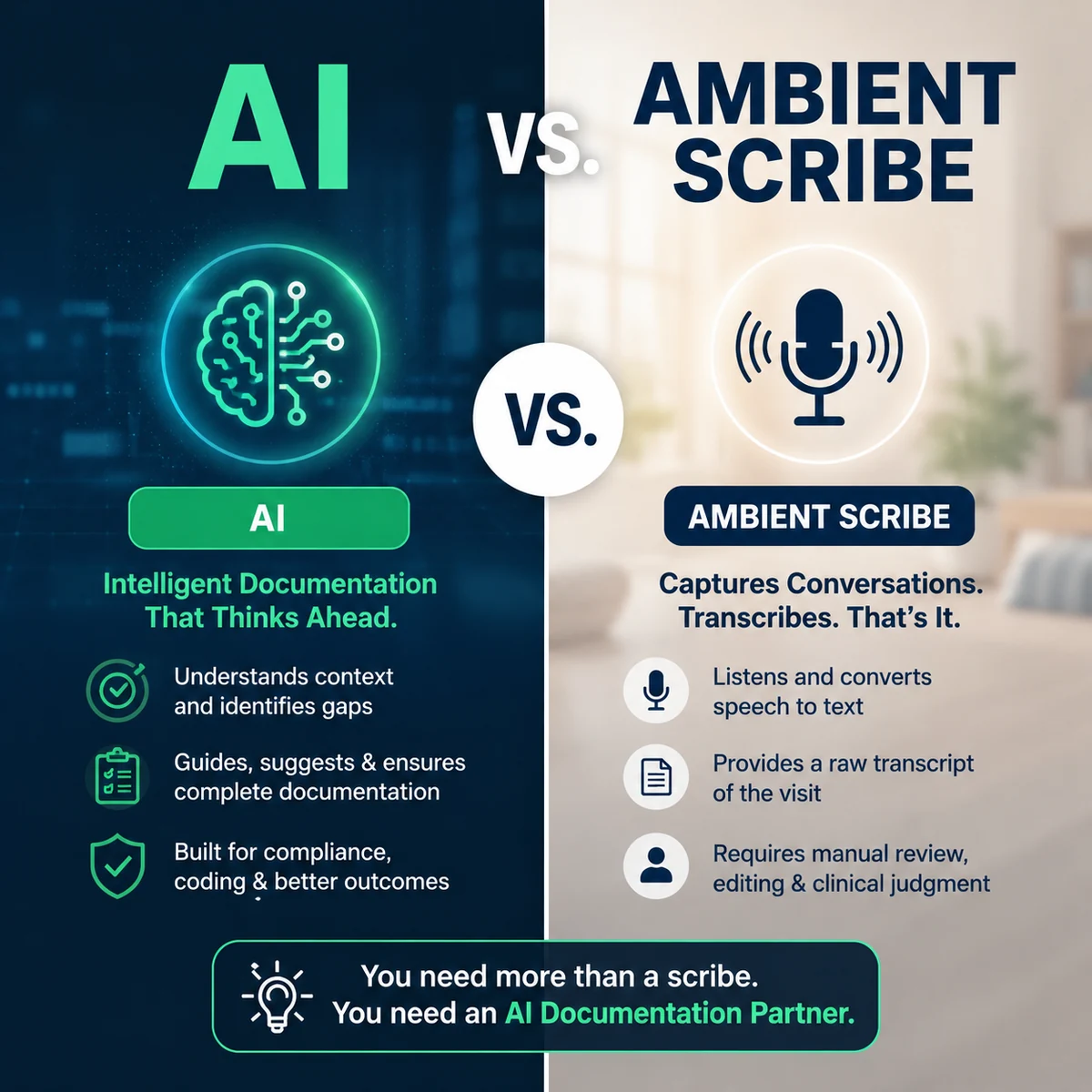
AI vs. Ambient Scribe for Home Health Nurses: What's the Difference?
An ambient scribe listens and drafts a note from the conversation; AI documentation supports a broader capture-to-approval workflow. This guide breaks down the difference, why it matters more in home health (where much of the clinical story is observed, not spoken), a side-by-side comparison, OASIS considerations, and the questions to ask AI vendors.
OASIS Documentation Compliance Tips for Home Health Agencies
OASIS compliance isn't just filling in every field, it's making the assessment tell a consistent, clinically supported story that agrees with the rest of the record. This guide covers 12 practical compliance tips, 9 common errors, a pre-submission checklist, what's new in OASIS-E2, and where AI helps (and where it must not).
AI Scribe vs AI Documentation Agent: Which One Does Home Health Really Need?
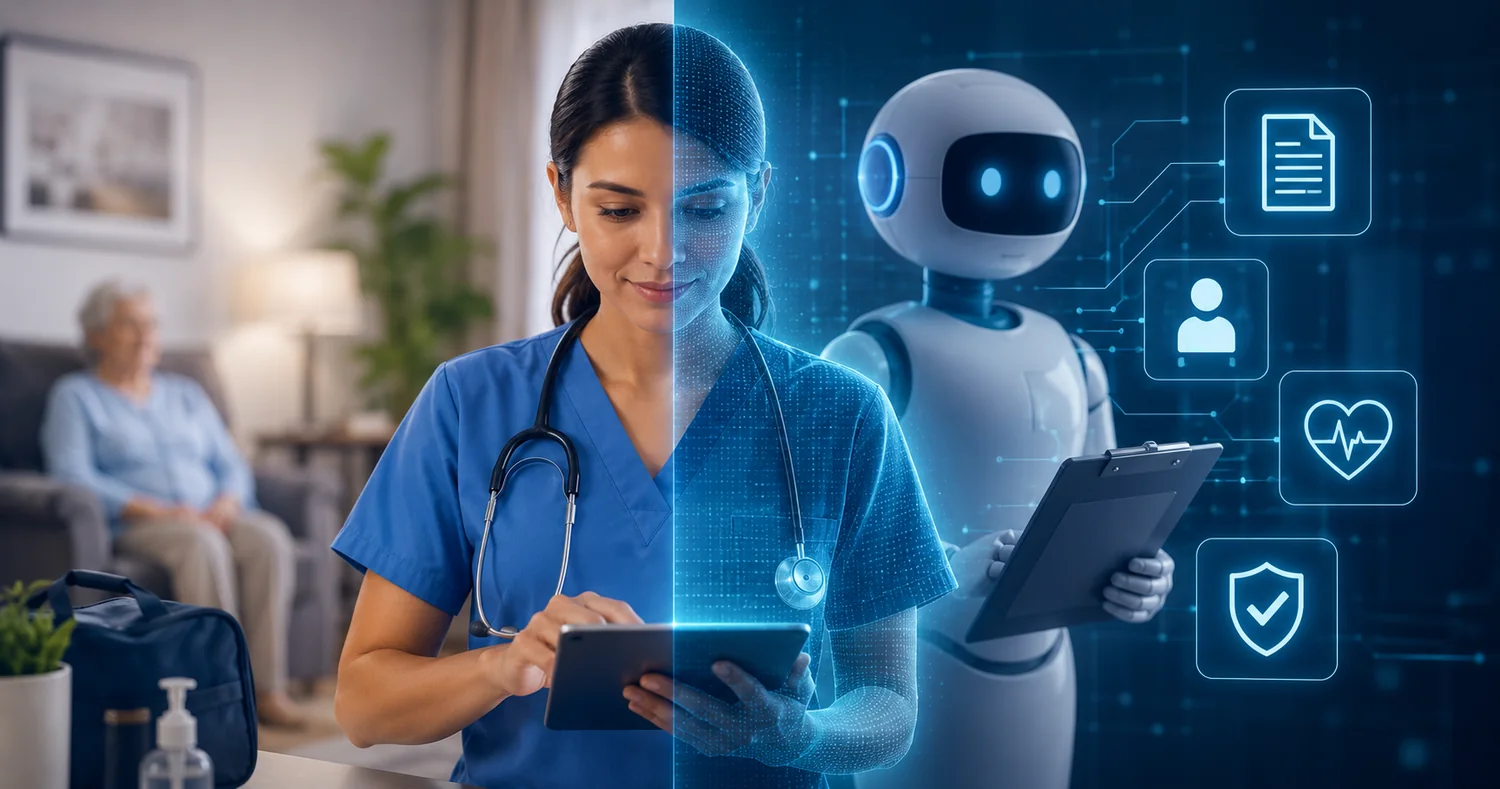
An AI scribe transcribes conversations into notes. An AI Documentation Agent goes further: it understands clinical workflows, processes referral PDFs, drafts OASIS-E assessments, assists with medication reconciliation, surfaces missing documentation, and helps nurses complete compliant charts. For home health's OASIS complexity and referral processing, an AI Documentation Agent does more than a transcription-only scribe.