
Top 10 Reasons Medicare ADRs Get Denied and How to Prevent Them
A Medicare ADR can turn a routine claim into a major administrative project, and the problem usually isn't the care, it's the documentation. This guide breaks down the 10 most common Medicare ADR denial patterns for home health and hospice, with a practical prevention strategy for each.
Key Takeaways
- A Medicare ADR (Additional Documentation Request) asks for medical records and supporting documentation needed to review a claim.
- Strong clinical documentation is critical because reviewers need enough evidence to determine whether Medicare requirements were met.
- Common problems include OASIS-narrative inconsistencies, weak homebound documentation, insufficient skilled-need documentation, coding mismatches, and face-to-face issues.
- Hospice agencies also need to watch recertification narratives and evidence of continued terminal eligibility.
- The best ADR strategy starts before the claim is submitted, with point-of-care documentation, QA, coding review, and compliance checks.
- Agencies can improve their denial rate by analyzing recent ADR outcomes and focusing on their highest-frequency problems first.
💡 Quick Answer: Medicare ADRs (Additional Documentation Requests) get denied mostly when the documentation doesn't clearly prove the care met Medicare requirements: OASIS-narrative inconsistencies, weak homebound and skilled-need documentation, coding that doesn't match the clinical picture, missing face-to-face records, Plan of Care errors, Section GG scoring problems, weak recertification narratives, timing errors, and procedural mistakes in the ADR response itself. The best defense is upstream, point-of-care QA and pre-bill checks, before the claim is ever submitted.
A Medicare ADR can turn a routine claim into a major administrative project. ADR stands for Additional Documentation Request, Medicare uses ADRs to request medical records and supporting information needed to determine whether a claim should be paid.
And the biggest problem isn't always that the care wasn't provided. Sometimes the problem is that the documentation doesn't clearly prove the care met Medicare requirements. A patient's OASIS may say one thing while the narrative says another. A Plan of Care may not align with the services documented. The good news: many of these problems are preventable.
This guide breaks down the 10 common Medicare ADR denial patterns agencies should monitor, with a practical prevention strategy for each.
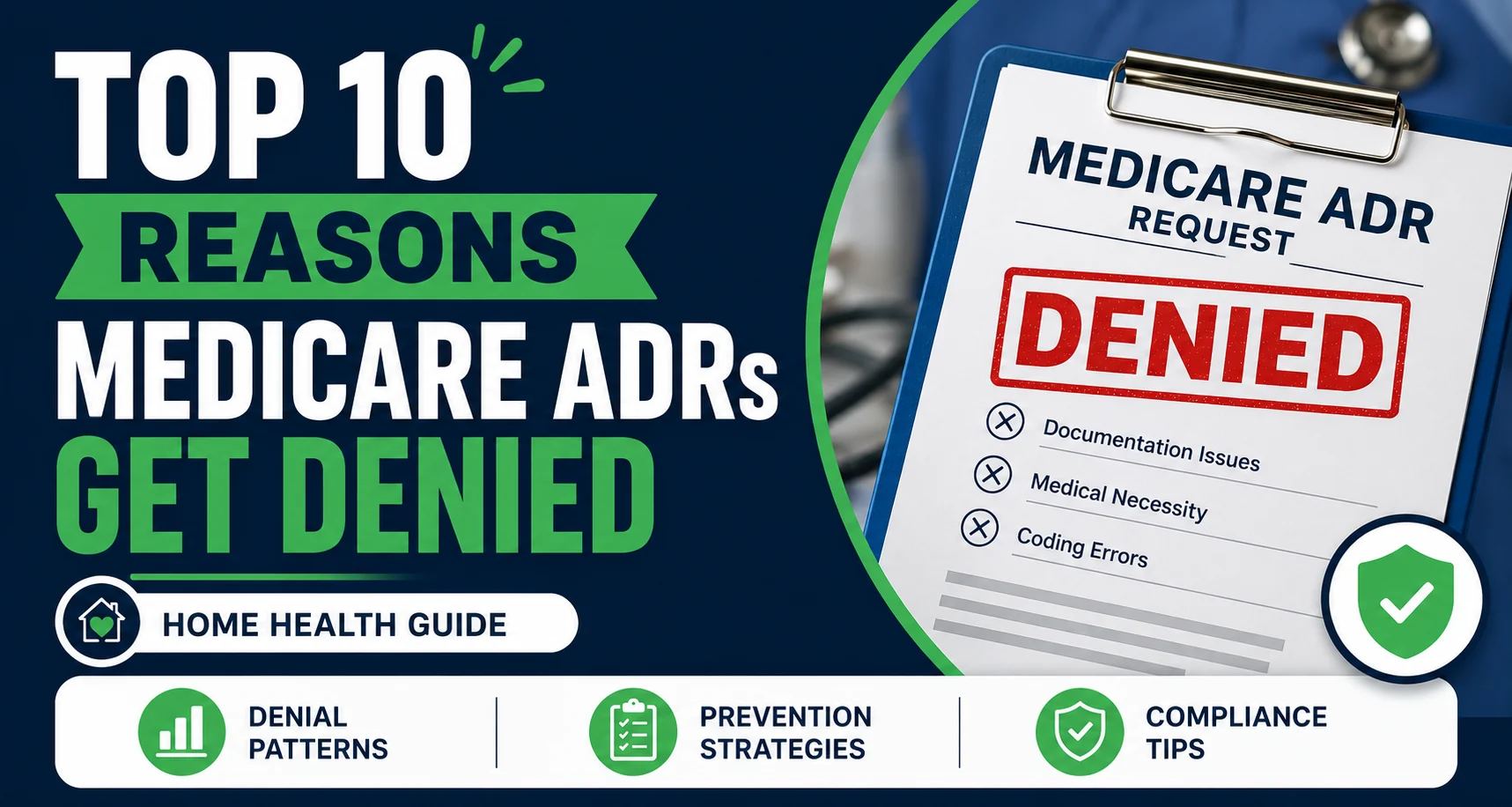
The most common Medicare ADR denial patterns for home health, and how to prevent them.
What Is a Medicare ADR?
A Medicare Additional Documentation Request (ADR) is a request from Medicare or its review contractor for additional records needed to evaluate a claim. The purpose is to obtain documentation that helps the reviewer determine whether the services were covered, medically necessary, properly ordered and certified, properly documented, correctly coded, and consistent with the patient's clinical condition.
For a home health claim, an ADR may involve OASIS assessments, nursing and therapy visit notes, the Plan of Care, physician orders, face-to-face documentation, medication records, progress notes, and hospital records. An ADR does not automatically mean a claim will be denied, the outcome depends heavily on whether the documentation submitted adequately supports the claim.
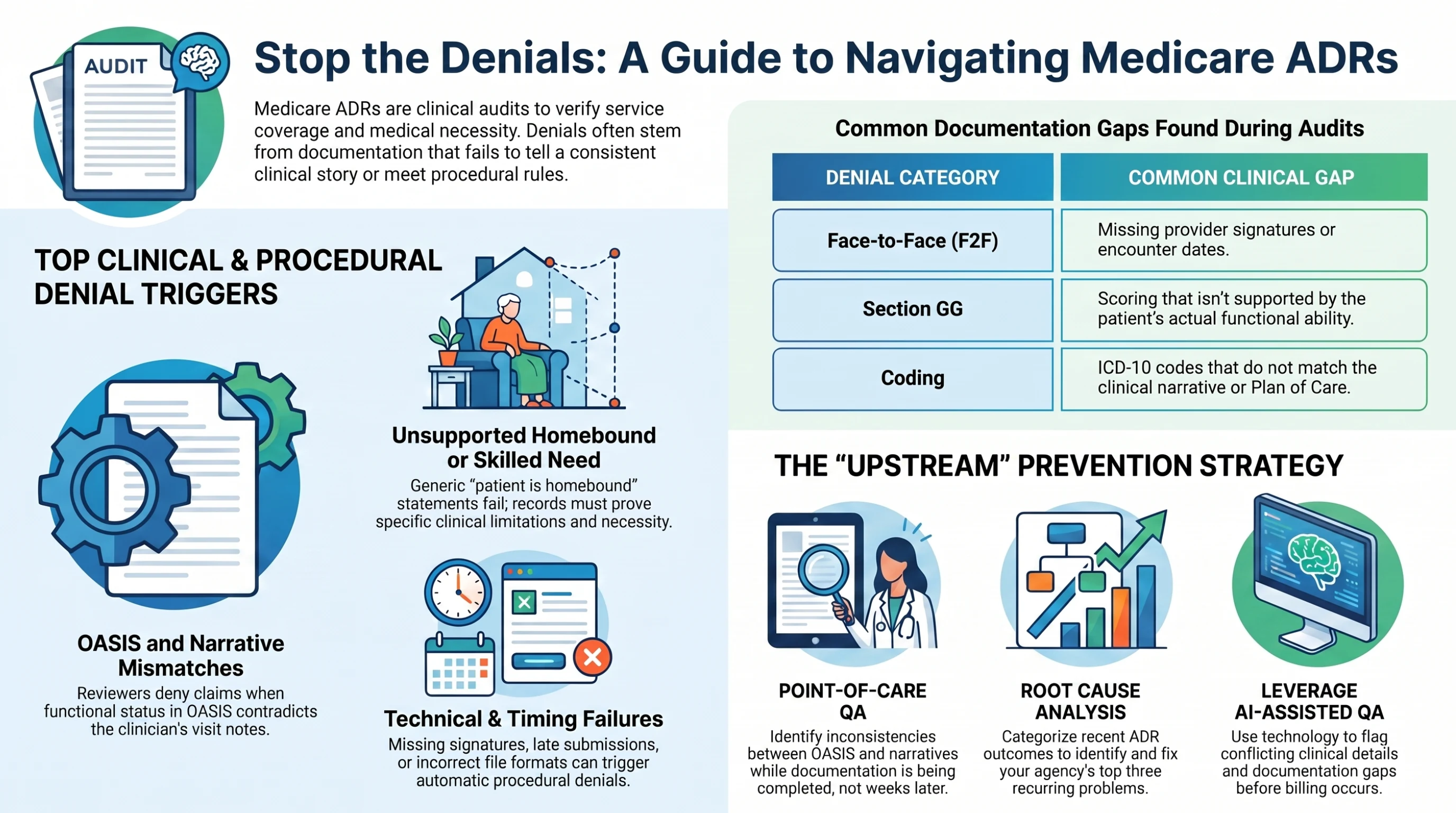
How Medicare ADR denials happen, the common documentation gaps auditors find, and the upstream prevention strategy that stops them before billing.
Top 10 Reasons Medicare ADRs Get Denied
1. OASIS and Clinical Narrative Don't Match
One of the most important problems is a disconnect between what the clinician writes and what the OASIS says. A reviewer may compare the OASIS assessment with narrative visit documentation and find functional status, cognition, or wounds described differently, for example, a narrative saying the patient ambulates independently with a cane while OASIS indicates substantial assistance with mobility. These inconsistencies create questions about the accuracy and reliability of the assessment.
How to prevent it: establish a QA process that cross-checks OASIS responses, visit narratives, Section GG, cognitive assessments, wound documentation, diagnoses, and functional status, and identify inconsistencies while documentation is still being completed, not weeks later during an audit.
2. Homebound Status Is Not Clearly Supported
A generic "patient is homebound" statement may not adequately communicate why the patient meets the requirement. The record should provide patient-specific clinical information, mobility limitations, weakness, pain, shortness of breath, need for assistance, dependence on assistive devices, difficulty transferring, and the effort required to leave home. Train clinicians to document the clinical facts, not rely on generic templates.
3. Skilled Need Is Not Clearly Documented
A medical diagnosis alone does not demonstrate that a service was skilled and medically necessary. Weak documentation says "patient assessed and education provided." A stronger note explains what was assessed, what clinical issue was identified, what intervention was performed, why skilled judgment was necessary, and how the patient responded. The objective isn't longer notes, it's a clearer skilled rationale.
4. ICD-10 Coding and the OASIS Clinical Picture Don't Align
Under PDGM, the patient's clinical information contributes to payment grouping, so accurate diagnosis selection matters. Problems arise when the primary diagnosis identifies one condition while the OASIS, Plan of Care, and visit documentation describe another. Create a structured coding review that compares clinical documentation → OASIS → Plan of Care → ICD-10 → claim. AI-assisted coding can flag mismatches, but complex cases still need human review.
5. Face-to-Face Documentation Is Missing or Insufficient
Face-to-face documentation is critical to home health eligibility. Problems arise when the encounter is missing, incomplete, improperly timed, or inconsistent with the record. Verify the encounter timeframe, date, provider, clinical content, certifications, and signatures. Use an intake checklist that verifies face-to-face requirements before services progress too far into the episode.
6. Plan of Care Errors
The Plan of Care should provide a clear framework for services. Problems arise when it's missing, incomplete, unsigned, or inconsistent with the clinical documentation, for example, establishing one frequency of service while visit documentation reflects another. Use a Plan of Care QA checklist covering orders, frequency, duration, goals, services, diagnoses, signatures, dates, and consistency with OASIS and visit notes. Signature tracking helps identify outstanding physician documentation before it becomes an audit problem.
7. Section GG Functional Scoring Errors
Section GG influences the patient's functional impairment level under PDGM. The problem isn't simply a "wrong" score, it's a score that isn't supported by the clinical record or consistent with the patient's actual ability, including misuse of "activity not attempted" or wide scoring variation between clinicians. Focus on Section GG-specific training, clear scoring guidance, inter-rater reliability checks, and cross-checking against narrative documentation.
8. Weak or Missing Recertification Documentation
For hospice agencies especially, recertification documentation deserves attention. A generic statement that the patient continues to qualify may not communicate the clinical evidence for continued eligibility. Build a structured recertification workflow that prompts clinicians to document what has changed, what has declined, how the current condition compares with the previous period, and what evidence supports continued eligibility, particularly for long-stay cases.
9. Timing Errors
Home health and hospice workflows contain multiple time-sensitive requirements, OASIS completion and submission, face-to-face encounters, Plan of Care signatures, certifications, and recertifications. A complete document submitted at the wrong time may still create a compliance problem. Use a centralized compliance calendar or dashboard with automated reminders for upcoming deadlines and outstanding physician documentation.
10. Procedural Errors in ADR Submission
An agency can have a clinically strong chart and still create problems by submitting the ADR response incorrectly, wrong submission method, late submission, incorrect file format, missing claim identifiers or requested documents, or poorly organized records. Create a standardized ADR submission checklist and prepare the response early enough to leave a buffer for technical or documentation problems.
How to Prevent Medicare ADR Denials
The strongest ADR strategy is upstream prevention: build quality checks into the workflow before the claim is submitted.
- Review documentation at the point of care — the earlier an inconsistency is found, the easier it is to correct.
- Connect OASIS and narrative QA — don't review OASIS as an isolated form; compare it with the clinical narrative, Section GG, diagnoses, Plan of Care, and visit findings.
- Build pre-bill QA into the workflow — before billing, ask: does the chart tell a consistent clinical story across every major documentation source?
- Track missing documentation — a dashboard for missing signatures, orders, face-to-face documentation, incomplete notes, pending QA, and outstanding recertifications.
- Analyze ADRs by root cause — don't just record paid vs denied; categorize the reason so you can fix the pattern.
How to Use the Top 10 ADR Denial List
Don't try to fix all 10 problems at once, start with your own data. Pull your most recent 20-30 ADR outcomes and categorize each: why was the claim questioned, was it paid or denied, which category, how much reimbursement was at risk, and could it have been prevented upstream? Then prioritize your top three: the most frequent denial reason, the highest-dollar problem, and the problem that can be fixed systemically.
For example, if your agency repeatedly sees OASIS-narrative inconsistencies, another round of manual chart review may not be the best long-term answer, you may need better clinician training, better documentation prompts, point-of-care QA, OASIS cross-validation, and feedback loops between QA and clinicians.
Can AI Help Reduce Medicare ADR Risk?
AI can support ADR prevention by identifying potential documentation problems before a claim reaches review, OASIS-narrative inconsistencies, missing information, conflicting clinical details, coding-documentation mismatches, documentation gaps, and unusual functional scoring patterns. The important point is that AI should support clinical and QA teams rather than replace their judgment.
A practical workflow looks like: Visit → Documentation → AI QA → Human Review → Billing, instead of Visit → Billing → ADR → Manual Chart Scramble. When evaluating AI, weigh security, privacy, human oversight, and auditability alongside automation capabilities.
What Home Health Agencies Should Do This Week
If your agency has experienced recent ADRs, don't start by changing everything. Start here: (1) pull your last 20-30 ADR outcomes, (2) categorize each using the 10 denial patterns above, (3) identify your top three recurring problems, (4) assign one specific fix to each, and (5) track the results over the next 90 days.
| Problem | Systemic Fix |
|---|---|
| OASIS / narrative inconsistency | Point-of-care OASIS QA |
| Weak homebound documentation | Clinician training + documentation prompts |
| Weak skilled-need documentation | Structured note prompts + QA |
| Section GG errors | Section GG training + inter-rater review |
| Missing signatures | Automated signature tracking |
| Coding mismatch | Clinical-coding QA |
| ADR submission errors | Standardized ADR checklist |
Measure ADR volume, denial rate, top denial categories, dollars at risk, documentation rework, and time spent responding. The goal isn't simply to respond better to ADRs, it's to build a documentation workflow that prevents avoidable ADR problems before the claim is ever reviewed.
Final Takeaway
Medicare ADRs shouldn't be treated as random events. They often expose weaknesses in the connection between clinical documentation, OASIS, coding, certification, the Plan of Care, billing, and compliance. The most effective strategy is to identify recurring patterns, fix the underlying workflow, and continuously monitor results: better documentation → better QA → fewer avoidable problems → stronger ADR responses. For related failure points, see why Medicare home health claims get denied and common OASIS documentation mistakes.
🚀 Catch ADR triggers before billing. Copper Digital's AI Documentation Agent drafts OASIS and visit notes from voice, photo, and tap, runs hundreds of consistency checks (OASIS vs narrative, Section GG, coding, signatures), and flags gaps, with a nurse reviewing and approving every record before it reaches your EMR. Explore AI tools for home health nurses, review your compliance workflows, or book a demo.
📘 Free download: The Home Health Documentation Playbook, a 232-page guide to OASIS-E, Medicare compliance, PDGM, and AI-assisted documentation, with 150+ point-of-care checklists to strengthen audit readiness.
Home Health Documentation Playbook
The complete guide to OASIS-E, Medicare compliance, PDGM, and AI-assisted documentation. Learn how top agencies reduce documentation time without sacrificing compliance.
Bottom Line
Medicare ADRs get denied mostly for documentation, not care: OASIS-narrative inconsistencies, weak homebound and skilled-need documentation, coding-clinical mismatches, missing face-to-face records, Plan of Care and Section GG errors, weak recertification, timing, and procedural mistakes in the response. The fix is upstream, point-of-care QA and pre-bill checks that make the chart tell one consistent clinical story before the claim is ever submitted.

Arvind Sarin is the founder of Copper Digital. For the past year he has spent three days a week inside a 500+ census Texas home health agency, building AI documentation that finishes OASIS and visit notes the same day, with a nurse reviewing and approving every note. He writes about home health documentation, OASIS, Medicare compliance, and applying AI responsibly in clinical workflows.
Frequently asked
Frequently asked questions
ADR stands for Additional Documentation Request. It is a request for medical records and supporting documentation used during Medicare claim review.
Join the conversation
Leave a comment
Related reading
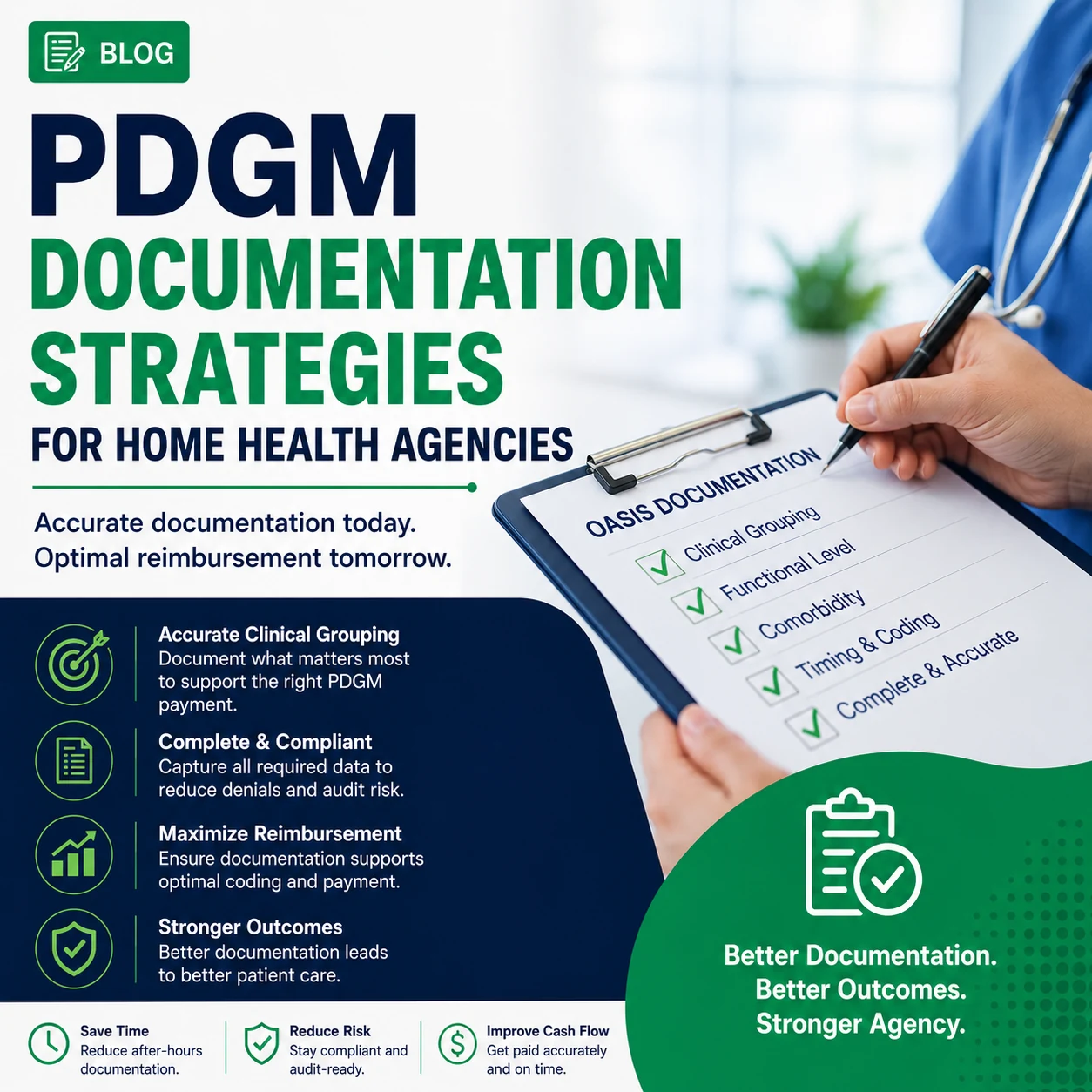
PDGM Documentation Strategies for Home Health Agencies
Under PDGM, documentation establishes the clinical picture that supports classification, medical necessity, coding, and payment. This guide breaks down 15 PDGM documentation strategies, a documentation-to-payment framework, weak-vs-strong examples, and a closed-loop workflow to keep charts consistent and audit-ready.
Why Medicare Home Health Claims Get Denied
Medicare home health claim denials are revenue leaks, not just billing issues. This guide breaks down the ten most common reasons claims get denied, from OASIS gaps and late NOAs to coding and medical-necessity problems, and how to prevent them to get paid faster.
ICD-10 Coding Best Practices for Home Health Agencies
Accurate ICD-10 coding shapes PDGM reimbursement, claim denials, and Medicare compliance in home health. This guide walks through the eight best practices every agency should follow, from selecting the correct primary diagnosis and capturing comorbidities to coding specificity, OASIS alignment, annual updates, audits, and using AI as a coding support tool.