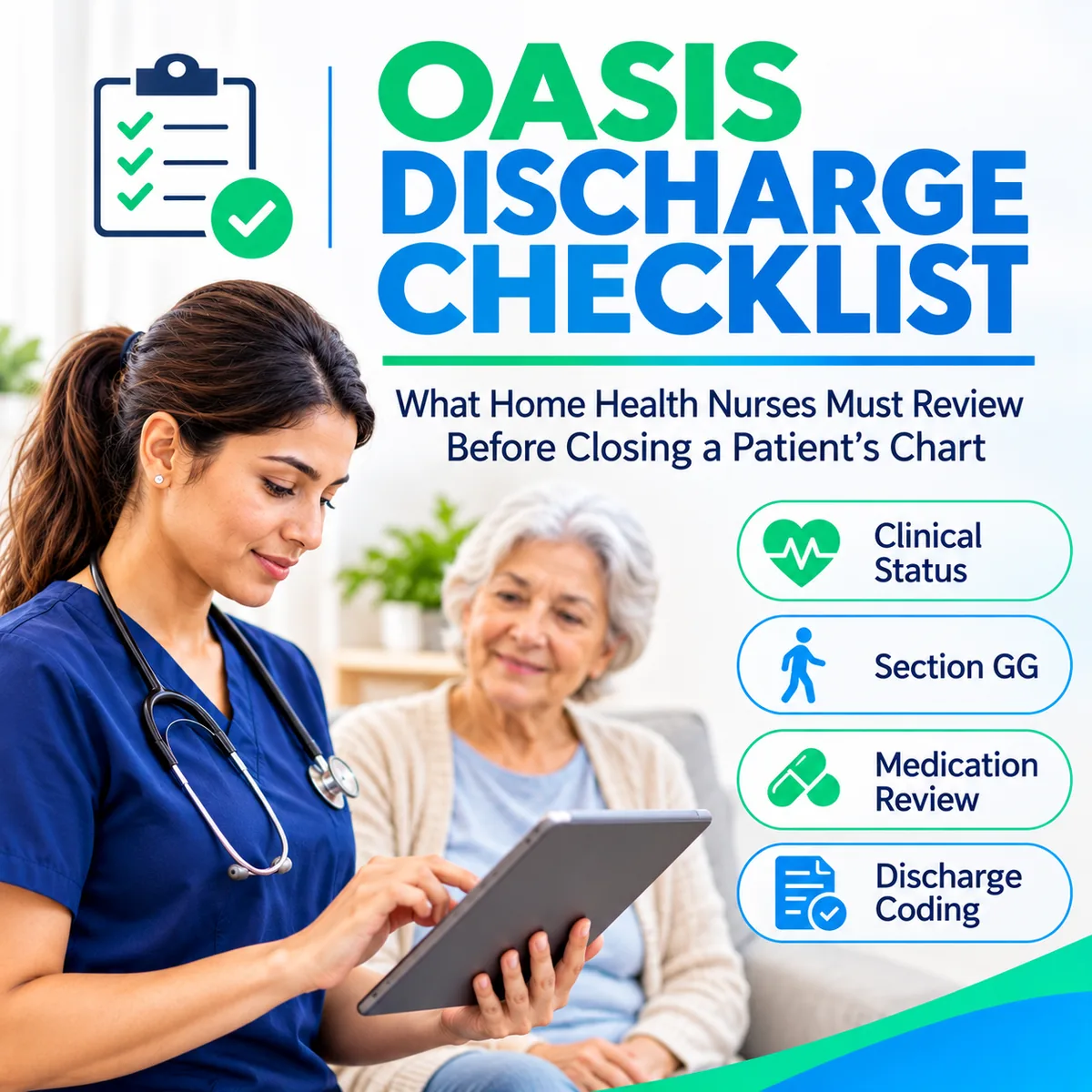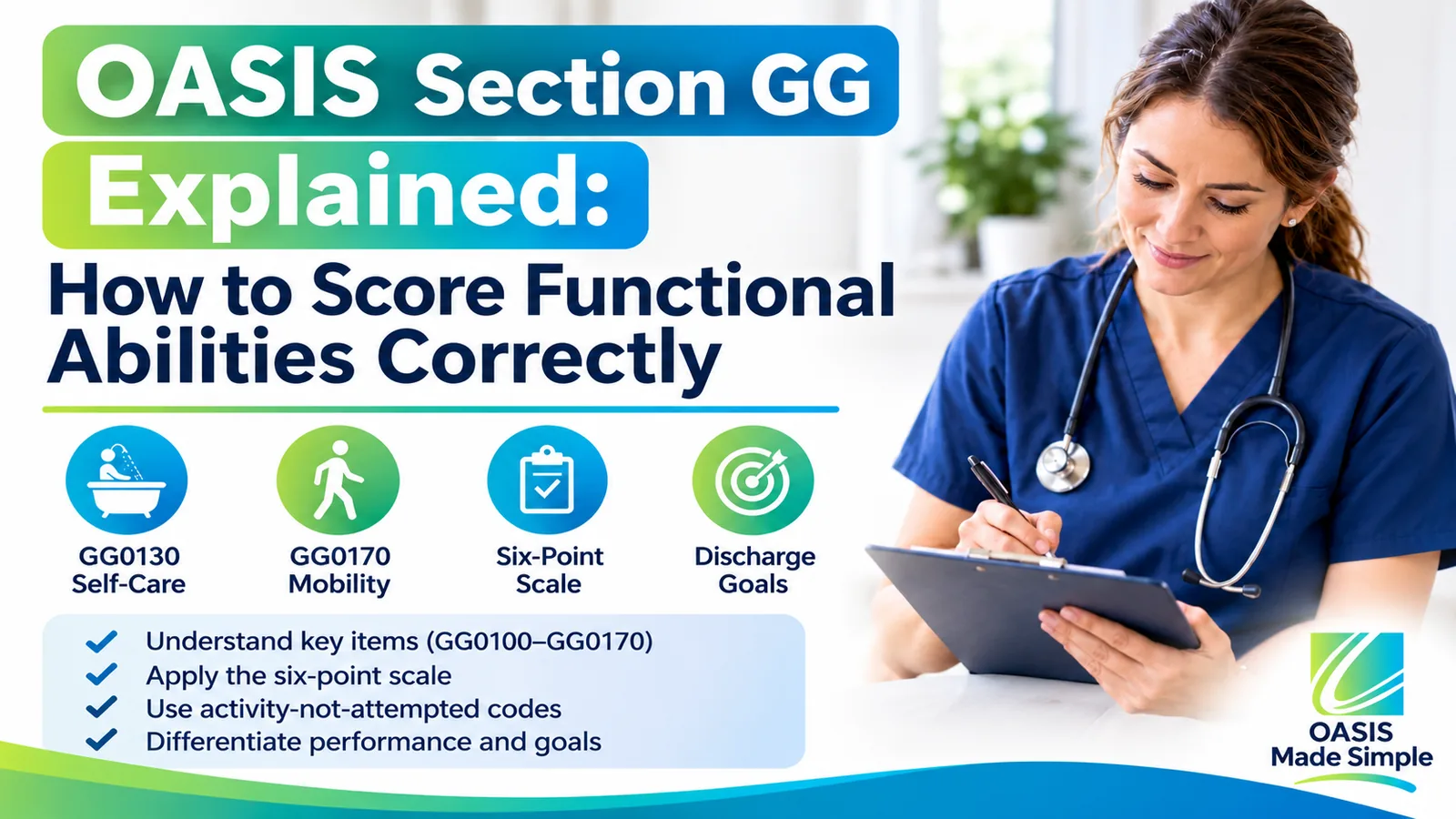
What Is OASIS Section GG and Why Is It Important?
Section GG is the Functional Abilities section of the Outcome and Assessment Information Set (OASIS). It measures a patient's ability to perform specific self-care and mobility activities and identifies how much assistance the patient needs.
Section GG is used across post-acute care settings, including home health agencies, skilled nursing facilities, and inpatient rehabilitation. Each setting has its own applicable assessment requirements and instructions.
For home health agencies, Section GG helps clinicians document a patient's functional status at applicable OASIS assessment time points. It also contributes to CMS quality reporting, including the Discharge Function Score.
The assessment focuses on what the patient actually does, rather than what the patient might be capable of doing under ideal conditions.
The key areas include:
- GG0100: Prior Functioning – What the patient could do before the current illness, exacerbation, or injury.
- GG0110: Prior Device Use – The assistive devices the patient used before the current illness, exacerbation, or injury.
- GG0130: Self-Care – How the patient performs activities such as eating, toileting hygiene, bathing, and dressing.
- GG0170: Mobility – How the patient performs activities such as bed mobility, transfers, walking, and wheelchair mobility.
The current guidance for home health agencies is the CMS OASIS-E2 Guidance Manual, effective April 1, 2026. Clinicians should use the current manual and instrument when completing assessments.
What Do GG0100 and GG0110 Tell Clinicians About Prior Functioning?
Before scoring a patient's current functional performance, clinicians need to understand the patient's functional background.
GG0100 and GG0110 provide context about the patient's abilities and equipment use before the current illness, exacerbation, or injury.
What Does GG0100 Measure?
GG0100 captures the patient's prior functioning in everyday activities.
It covers four areas:
- Self-Care: The patient's ability to complete activities such as bathing, dressing, and eating.
- Indoor Mobility: The patient's ability to move around inside the home or living environment.
- Stairs: The patient's ability to negotiate steps or stairs.
- Functional Cognition: The patient's ability to manage everyday cognitive tasks, such as planning and organizing daily activities.
This information helps clinicians understand how the patient's current functional status compares with their prior level of functioning.
What Does GG0110 Measure?
GG0110 identifies the devices the patient used before the current illness, exacerbation, or injury.
These may include:
- Manual wheelchair.
- Motorized wheelchair or scooter.
- Mechanical lift.
- Walker.
- Orthotics or prosthetics.
Prior device use is important because it provides context for the patient's mobility and functional independence before the current episode.
It should not be confused with the patient's current device use or the assistance required during the present assessment.
Which Activities Are Included in GG0130 and GG0170?
Section GG includes two major groups of functional activities: self-care and mobility.
Which Activities Are Included in GG0130 Self-Care?
GG0130 contains seven self-care activities.
| Item | Activity |
|---|---|
| GG0130A | Eating |
| GG0130B | Oral hygiene |
| GG0130C | Toileting hygiene |
| GG0130E | Shower/bathe self |
| GG0130F | Upper body dressing |
| GG0130G | Lower body dressing |
| GG0130H | Putting on/taking off footwear |
The item lettering skips D. These are the seven self-care activities included in the OASIS-E2 Section GG assessment.
Which Activities Are Included in GG0170 Mobility?
GG0170 evaluates bed mobility, transfers, walking, steps, and wheelchair mobility.
| Item | Activity |
|---|---|
| GG0170A | Roll left and right |
| GG0170B | Sit to lying |
| GG0170C | Lying to sitting on side of bed |
| GG0170D | Sit to stand |
| GG0170E | Chair/bed-to-chair transfer |
| GG0170F | Toilet transfer |
| GG0170G | Car transfer |
| GG0170I | Walk 10 feet |
| GG0170J | Walk 50 feet with two turns |
| GG0170K | Walk 150 feet |
| GG0170L | Walking 10 feet on uneven surfaces |
| GG0170M | 1 step (curb) |
| GG0170N | 4 steps |
| GG0170O | 12 steps |
| GG0170P | Picking up object |
| GG0170Q | Does the patient use a wheelchair or scooter? |
| GG0170R | Wheel 50 feet with two turns |
| GG0170S | Wheel 150 feet |
GG0170Q identifies whether the patient uses a wheelchair or scooter. GG0170R and GG0170S capture wheelchair mobility performance when applicable.
The item lettering also skips H. Clinicians should follow the exact item wording, skip patterns, and assessment instructions in the current OASIS-E2 instrument.
When Should Section GG Be Completed in OASIS?
Section GG is collected at applicable OASIS assessment time points, including:
- Start of Care (SOC).
- Resumption of Care (ROC).
- Follow-up assessments.
- Discharge from the agency.
Not every item is collected at every time point. Clinicians must follow the time-point requirements listed for each item in the current OASIS-E2 instrument.
How Should Section GG Be Scored at SOC and ROC?
At SOC and ROC, clinicians assess the patient's functional performance at or soon after the start of the agency's care.
The assessment should reflect the patient's baseline ability before the benefit of services provided by the agency.
For example, if a patient needs physical assistance to stand before receiving therapy services, the baseline performance score should reflect that assistance.
A later improvement resulting from agency services should not be used to make the baseline score appear more independent.
How Should Section GG Be Scored at Follow-Up and Discharge?
At follow-up and discharge, clinicians should record the patient's usual performance during the applicable assessment period.
For GG0130 and GG0170, usual performance means the patient's ability to complete the activity more than 50% of the time during the applicable look-back period.
For example, if a patient requires supervision for an activity on most occasions but needs partial physical assistance occasionally, the clinician should consider the usual performance pattern rather than selecting the best or worst isolated performance.
The goal is to represent the patient's typical ability during the assessment period.
How Do Discharge Goals Differ From Functional Performance Scores?
Performance scores and discharge goals serve different purposes.
A performance score describes what the patient is currently able to do. A discharge goal describes the expected level of functional performance by the time the patient is discharged.
At SOC and ROC, applicable Section GG items include performance assessment and discharge goal information. The goal should reflect the expected functional outcome based on the patient's condition, needs, and plan of care.
At follow-up and discharge, clinicians complete the applicable performance items according to their time-point instructions.
Should a Discharge Goal Be the Same as the Patient's Current Performance Score?
Not necessarily.
For example, a patient may require substantial assistance to transfer at SOC, but the care team may expect the patient to need only supervision by discharge.
The current performance score should reflect the patient's actual baseline ability. The discharge goal should reflect the expected outcome.
Goals should be realistic and clinically supported, not selected simply to make the patient appear more independent.
What Is the Six-Point Scoring Scale Used in Section GG?
GG0130 and GG0170 use the same six-point performance scale.
The score is based on the amount and type of assistance a helper provides while the patient completes the activity.
| Code | Scoring Level | What Does It Mean? |
|---|---|---|
| 06 | Independent | Patient completes the activity without assistance from a helper. |
| 05 | Setup or clean-up assistance | Helper sets up or cleans up before or after the activity. |
| 04 | Supervision or touching assistance | Helper provides verbal cues, supervision, touching, steadying, or contact guard assistance. |
| 03 | Partial/moderate assistance | Helper provides less than half of the effort. |
| 02 | Substantial/maximal assistance | Helper provides more than half of the effort. |
| 01 | Dependent | Helper provides all the effort, or two or more helpers are required. |
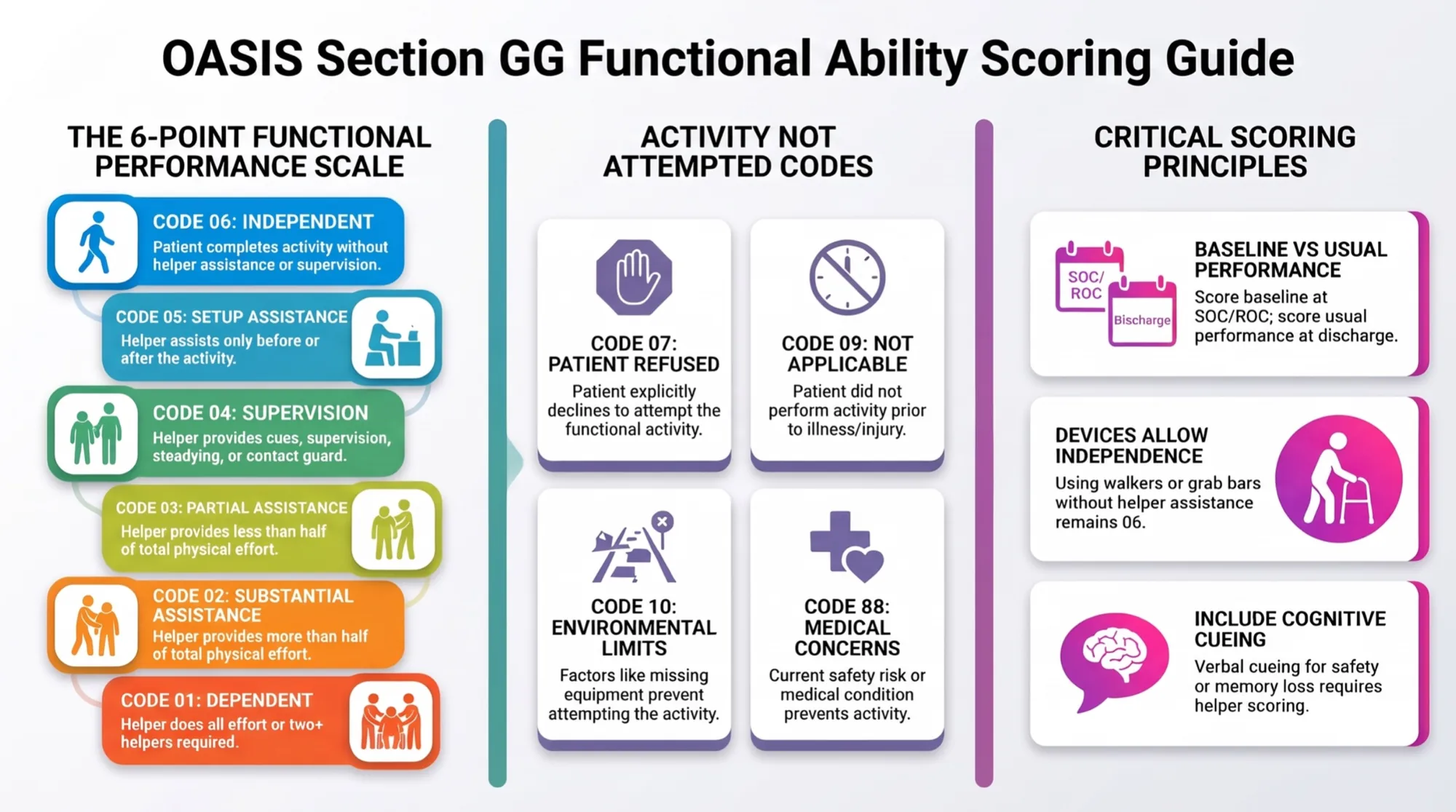
The six-point Section GG scale scores the help a patient needs. Activity-not-attempted codes explain why an activity was not completed.
When Should a Clinician Use Code 06 for Independent Performance?
Use code 06 when the patient completes the activity without assistance from another person.
The patient may use an assistive device and still receive a score of 06.
For example, a patient who independently walks with a walker does not automatically require a lower score because a device is being used.
When Should a Clinician Use Code 05 for Setup or Clean-Up Assistance?
Use code 05 when a helper provides assistance only before or after the activity.
For example, a caregiver places the patient's hygiene supplies within reach, and the patient completes the activity independently.
If the helper needs to provide verbal cues, supervision, or physical assistance during the activity, code 05 is not appropriate.
When Should a Clinician Use Code 04 for Supervision or Touching Assistance?
Use code 04 when the patient needs supervision, verbal or nonverbal cues, touching, steadying, or contact guard assistance.
For example, a patient may be physically capable of standing and transferring but needs a helper to provide steadying assistance to complete the activity safely.
Verbal prompting during an activity can also qualify when the patient needs those cues to complete the task.
When Should a Clinician Use Code 03 for Partial or Moderate Assistance?
Use code 03 when the helper provides less than half of the effort required to complete the activity.
For example, a patient performs most of a transfer independently, but the nurse supports the patient's trunk or leg to help complete the movement.
The patient contributes more than half of the effort.
When Should a Clinician Use Code 02 for Substantial or Maximal Assistance?
Use code 02 when the helper provides more than half of the effort.
For example, a patient can participate in a transfer but requires the caregiver to provide most of the physical support.
The patient contributes less than half of the effort.
When Should a Clinician Use Code 01 for Dependent Performance?
Use code 01 when the helper completes all the effort and the patient contributes none.
It also applies when two or more helpers are required to complete the activity, even if one helper provides only standby assistance.
For example, if two caregivers are needed to safely transfer a patient, the activity is coded as dependent.
What Are the Activity-Not-Attempted Codes in Section GG?
Sometimes an activity cannot be completed during the assessment period.
CMS provides four activity-not-attempted codes to identify why the activity was not completed.
| Code | Meaning | Example |
|---|---|---|
| 07 | Patient refused | Patient declines to attempt the activity. |
| 09 | Not applicable | Patient did not perform the activity before the current illness, exacerbation, or injury. |
| 10 | Environmental limitations | Activity could not be attempted because of environmental factors. |
| 88 | Medical condition or safety concerns | Activity could not be attempted because of the patient's medical condition or safety concerns. |
When Should Code 07 Be Used?
Use code 07 when the patient refuses to attempt the activity.
The refusal should be documented appropriately according to agency policy.
When Should Code 09 Be Used?
Use code 09 when the patient did not perform the activity before the current illness, exacerbation, or injury.
This is not simply a code for an activity that was not observed during the visit.
When Should Code 10 Be Used?
Use code 10 when environmental limitations prevent the activity from being attempted.
For example, required equipment may not be available, or environmental conditions may prevent an outdoor activity.
When Should Code 88 Be Used?
Use code 88 when the activity is not attempted because of the patient's medical condition or safety concerns.
For example, the clinician may determine that attempting a particular mobility activity would create an unacceptable safety risk.
Should Clinicians Use Activity-Not-Attempted Codes Whenever an Activity Is Not Observed?
No.
CMS guidance permits clinicians to use other appropriate sources of information when direct observation is unavailable.
These may include:
- Patient or caregiver reports.
- Assessment of similar activities.
- Collaboration with other agency staff who have had direct contact with the patient.
- Other appropriate methods of gathering information.
An activity-not-attempted code should be used when the activity was not completed and the performance score cannot be determined through other available information.
How Should Clinicians Determine the Patient's Usual Performance?
A patient's functional ability may vary depending on fatigue, pain, time of day, medication effects, or other clinical factors.
For GG0130 and GG0170 at follow-up and discharge, CMS expects clinicians to identify the patient's usual performance during the applicable look-back period.
The more-than-50% rule helps clinicians select the performance level that best represents the patient's typical ability.
For example:
A patient needs supervision during an activity on four occasions and partial physical assistance on two occasions.
If the available assessment information supports that pattern, supervision may represent the patient's usual performance because it occurs more than 50% of the time.
The clinician should consider the full activity and all relevant information during the assessment period.
The score should not automatically reflect the patient's best performance or the most recent observation.
Can Assistive Devices Be Considered When Scoring Section GG?
Yes. Patients may complete Section GG activities with or without assistive devices.
A patient who uses a walker, wheelchair, grab bar, or other adaptive equipment may still be independent if no helper assistance is required.
The clinician should score the amount of assistance the patient needs to complete the activity safely.
For example:
- A patient walks independently with a walker: code 06.
- A caregiver retrieves a required device before the activity, but the patient completes the activity without help: code 05 may apply.
- A patient requires physical support while walking with a walker: score according to the amount of assistance provided.
Using an assistive device does not automatically mean the patient needs supervision or physical assistance.
How Do Cognitive and Physical Limitations Affect Section GG Scoring?
Section GG considers the assistance a patient needs to complete an activity, whether the limitation is physical, cognitive, or related to safety.
A patient may have enough physical strength to complete an activity but still require verbal cues or supervision because of memory loss, confusion, impaired judgment, or difficulty following instructions.
For example, a patient may be able to dress independently from a physical standpoint but require repeated verbal cues to complete the activity safely and correctly.
In this situation, the clinician should consider the assistance actually required.
Cognitive limitations do not automatically result in a lower score. The clinician should determine whether they affect the patient's ability to perform the specific activity.
What Item-Specific Rules Should Clinicians Remember When Scoring GG0130?
Each self-care activity has its own definition. Understanding what is included and excluded helps prevent inaccurate scoring.
What Should Clinicians Consider When Scoring Eating?
The eating item evaluates the patient's ability to use suitable utensils to bring food and liquid to the mouth and swallow them once the meal is placed before the patient.
The clinician should consider the assistance needed for the eating activity itself.
Tube-feeding management should not automatically be treated as eating assistance.
What Should Clinicians Consider When Scoring Oral Hygiene?
Oral hygiene includes the patient's ability to use appropriate items to clean their teeth or dentures.
The clinician should consider the assistance required to complete the activity, including setup, cueing, or physical help.
What Should Clinicians Consider When Scoring Toileting Hygiene?
Toileting hygiene includes managing clothing and performing perineal hygiene before and after using the toilet or other toileting equipment, as applicable.
The clinician should assess the assistance required for the complete activity rather than only the patient's ability to transfer to the toilet.
Managing ostomy equipment is not included in the toileting hygiene item.
What Should Clinicians Consider When Scoring Shower/Bathe Self?
Shower/bathe self includes washing, rinsing, and drying the face, upper and lower body, perineal area, and feet.
The item excludes washing the back and hair. It also excludes transferring into or out of the tub or shower.
Bathing assistance and transfer assistance should not be confused when scoring these separate activities.
What Should Clinicians Consider When Scoring Dressing and Footwear?
Upper body dressing, lower body dressing, and putting on or taking off footwear are separate activities.
The clinician should assess the patient's ability to complete each activity and the assistance required.
For example, a patient may independently dress the upper body but require physical assistance with lower body dressing because of limited balance or range of motion.
The scores should reflect the patient's performance for each specific item.
What Item-Specific Rules Should Clinicians Remember When Scoring GG0170?
Mobility activities also have specific definitions and should not be treated as interchangeable.
How Should Clinicians Score Bed Mobility?
Bed mobility includes rolling left and right, moving from sitting to lying, and moving from lying to sitting on the side of the bed.
The clinician should assess the assistance required for each movement separately.
A patient may be independent with rolling but require physical assistance to move from lying to sitting.
How Should Clinicians Score Transfers?
Transfers include sit to stand, chair/bed-to-chair, toilet, and car transfers.
Each activity should be scored based on the assistance required to complete that particular transfer safely.
A patient who needs help with a toilet transfer may not need the same level of assistance for a chair-to-bed transfer.
How Should Clinicians Score Walking Activities?
Walking items assess the patient's ability to walk specified distances and manage different walking conditions.
These include:
- Walking 10 feet.
- Walking 50 feet with two turns.
- Walking 150 feet.
- Walking 10 feet on uneven surfaces.
The clinician should consider the patient's safety, endurance, balance, and required assistance.
A patient who can walk 10 feet may not necessarily be able to walk 50 or 150 feet safely.
How Should Clinicians Score Steps and Stairs?
Section GG includes one step or curb, four steps, and twelve steps.
The clinician should assess the patient's ability to negotiate the specified number of steps safely and with the assistance required.
The ability to climb one step does not automatically indicate the ability to manage a full flight of stairs.
How Should Clinicians Score Wheelchair Mobility?
When applicable, wheelchair mobility is assessed through the specified distance activities.
GG0170Q identifies whether the patient uses a wheelchair or scooter. GG0170R and GG0170S assess wheelchair mobility over 50 feet with two turns and 150 feet, respectively.
Clinicians should follow the applicable item instructions and avoid assigning a wheelchair performance score simply because a patient owns or has access to a wheelchair.
Can Patient or Caregiver Reports Be Used When Direct Observation Is Not Available?
Yes. Direct observation is an important source of information, but it is not the only acceptable source.
CMS guidance allows clinicians to consider other appropriate information when determining functional performance.
This may include:
- Patient reports.
- Caregiver reports.
- Information from other clinicians who have worked with the patient.
- Assessment of similar activities.
- Other available clinical information.
For example, if the clinician cannot directly observe a patient walking 150 feet, information from a qualified team member who has observed the activity may help determine the patient's performance.
However, reports should be evaluated carefully. The clinician must use professional judgment to determine whether the information is reliable and sufficient to support the selected score.
How Should Clinicians Score Activities When the Patient's Performance Is Unsafe?
Safety is a central consideration when scoring Section GG.
If the patient needs assistance because the activity would otherwise be unsafe or performed with poor quality, the clinician should score according to the type and amount of assistance required.
For example, a patient may be physically capable of standing but require steadying assistance to prevent a fall.
In that situation, the clinician should consider the assistance needed for safe completion rather than assigning an independent score based only on physical capability.
The assessment should reflect what the patient can safely do, not what the patient might be able to do under ideal conditions.
What Does a Dash Mean in Section GG?
A dash indicates that no information is available for the item.
It is not the same as an activity-not-attempted code.
The four activity-not-attempted codes explain why an activity was not completed. A dash indicates that the required information is unavailable.
CMS expects the use of a dash to be rare. Clinicians should make reasonable efforts to obtain the information needed to complete applicable items.
The current OASIS-E2 manual should be consulted for the specific circumstances and reporting instructions that apply.
What Are the Most Common Section GG Scoring Mistakes?
Incorrect Section GG coding can happen when clinicians rely on assumptions instead of the item definitions and scoring instructions.
Why Is Scoring Based Only on the Patient's Diagnosis Incorrect?
A diagnosis does not automatically determine a functional score.
Two patients with the same diagnosis may have very different abilities and assistance needs.
The score must reflect the patient's actual functional performance.
Why Should Assistive Device Use Not Automatically Lower the Score?
A patient may independently complete an activity using an assistive device.
The need for a device is not the same as the need for assistance from a helper.
Why Is the Patient's Best Performance Not Always the Correct Score?
At follow-up and discharge, the clinician must identify usual performance during the applicable look-back period.
Selecting an isolated best performance may overstate the patient's usual functional ability.
Why Should Activity-Not-Attempted Codes Not Be Overused?
An activity that was not directly observed may still be scored using patient or caregiver reports, assessment of similar activities, or collaboration with other staff.
Clinicians should determine whether a performance score can be supported before selecting an activity-not-attempted code.
Why Should the Clinician Assess the Entire Activity?
Some activities involve multiple steps.
If only part of an activity is observed, the clinician should determine whether the available information is sufficient to score the complete activity.
If it is not, the appropriate activity-not-attempted code may be necessary.
Why Should OASIS Responses Match the Supporting Clinical Documentation?
Section GG scores should be consistent with the clinical information recorded in the comprehensive assessment.
For example, if the narrative describes a patient requiring substantial physical assistance with transfers, an independent transfer score should be reviewed for accuracy.
The clinician should verify the actual findings and correct discrepancies based on the assessment. Information should never be changed simply to make entries agree.
How Can Home Health Agencies Improve Section GG Scoring Accuracy?
Agencies can improve scoring consistency through education, structured assessment practices, and quality assurance.
Can Section GG Training Help Reduce Scoring Errors?
Yes. Regular training helps clinicians understand the difference between the six performance levels and when to use activity-not-attempted codes.
Training should include practical examples of self-care and mobility activities, not just a review of definitions.
Can a Section GG Quick-Reference Guide Help Clinicians?
A concise reference guide can help clinicians distinguish between:
- Setup assistance and supervision.
- Supervision and physical assistance.
- Partial/moderate and substantial/maximal assistance.
- Dependent performance and activity-not-attempted codes.
- Baseline performance and usual performance.
- Performance scores and discharge goals.
The guide should reflect the current OASIS-E2 manual and agency policies.
How Can QA Teams Review Section GG Documentation More Effectively?
QA teams can review whether:
- The selected score matches the documented assistance level.
- The clinical narrative supports the structured response.
- The correct assessment time point and look-back period were used.
- Activity-not-attempted codes have appropriate supporting information.
- The assessment reflects safe performance.
- The score is based on actual assessment information rather than assumptions.
- Discharge goals are realistic and supported by the patient's care plan.
QA should identify potential discrepancies and request clarification when needed. Clinical decisions and corrections must remain with the appropriate assessing clinician.
How Can AI Support More Consistent OASIS Section GG Documentation?
AI-assisted documentation tools can help clinicians organize visit information and identify potential inconsistencies before a chart is submitted for review.
For example, an AI tool may help:
- Structure a clinician's spoken description of functional performance.
- Organize supporting clinical narratives.
- Flag possible differences between structured responses and narrative documentation.
- Identify potentially incomplete documentation for clinician review.
AI should not independently determine a patient's functional score from incomplete information or replace the assessing clinician's judgment.
The nurse or other qualified assessing clinician must verify the patient's actual performance, select the appropriate response, and approve the final documentation.
Copper AI is designed to support home health documentation workflows by helping clinicians turn visit narratives into structured drafts for review and approval.
The objective is to reduce repetitive documentation work while keeping clinical decisions in the hands of healthcare professionals.
What Should Home Health Nurses Remember When Scoring Section GG?
Accurate Section GG scoring depends on understanding what each activity measures and how much assistance the patient actually needs.
Before finalizing a score, clinicians should ask:
- What exactly does this OASIS item measure?
- Did I assess the patient's ability to complete the activity safely?
- What type and amount of assistance did the patient require?
- Am I using the correct assessment time point and look-back period?
- Does the selected score reflect baseline or usual performance, as applicable?
- If the activity was not attempted, have I established why and considered other available assessment information?
- Does the supporting clinical documentation agree with the selected response?
- Have I distinguished current performance from discharge goals?
Section GG is not simply a checklist of what a patient can or cannot do. It is a structured way to document functional ability consistently.
When clinicians understand the scoring rules and agencies provide clear training and QA support, they can produce more accurate assessments and reduce avoidable documentation corrections.
Related Reading
- What Is OASIS-E2? A Complete Guide for Home Health Agencies.
- OASIS-E1 vs OASIS-E2: A Complete Side-by-Side Comparison for Home Health Agencies.
- What Is a Comprehensive Assessment in Home Health?.
- OASIS Discharge Assessment: When Is It Required and When Can It Be Skipped?.
- How to Reduce Rework Between Home Health Nurses and QA Teams.
- PDGM vs. PPS: What's Changed for Home Health?.