Why Does Rework Happen Between Home Health Nurses and QA Teams?
A home health nurse completes a patient visit, documents the assessment, and submits the chart for review. The QA team reviews it, identifies missing information or inconsistencies, and sends it back for corrections.
The nurse makes the changes and resubmits the chart. QA reviews it again, finds another issue, and returns it.
This cycle can repeat several times before the documentation is ready for finalization.
For home health agencies, this is more than a documentation inconvenience. Repeated corrections consume clinical and administrative time, delay chart completion, increase pressure on QA teams, and make it harder for clinicians to focus on patient care.
Rework often happens because:
- Clinical documentation is incomplete or unclear.
- OASIS responses do not align with supporting clinical narratives.
- EMR templates do not prompt clinicians for important information.
- Required orders or signatures are missing.
- Documentation expectations differ between QA reviewers.
- Correction requests are vague or arrive too late.
- Nurses and QA teams lack a consistent feedback process.
- Manual documentation workflows create opportunities for omissions and inconsistencies.
The solution is not simply asking nurses to document faster or QA teams to review more quickly.
Agencies need to shift from reactive chart auditing to proactive, point-of-care validation and standardized clinical communication.
What Is Documentation Rework in Home Health?
Documentation rework refers to the additional effort required to correct, clarify, complete, or resubmit clinical documentation after an initial submission.
It can happen when a QA reviewer identifies an issue that prevents the chart from moving forward or requires clarification before it can be finalized.
Examples include:
- Returning an OASIS assessment because a response does not match the supporting clinical information.
- Requesting clarification about a patient's functional status.
- Asking a nurse to complete a missing assessment field.
- Correcting inconsistencies between visit narratives and structured documentation.
- Following up on missing orders or required signatures.
- Requesting additional detail to support a clinical finding.
- Resolving conflicting information across different sections of a chart.
Not every QA correction indicates a clinical mistake. Some corrections result from unclear documentation, incomplete information, workflow gaps, or differences in interpretation.
The objective is to make documentation accurate, complete, and consistent before it moves through the final review process.
What Are the Most Common Reasons Home Health Nurses Receive QA Corrections?
Understanding why charts are returned is the first step toward reducing rework.
Why Does Incomplete Documentation Lead to Rework?
A clinical note may describe the general condition of a patient but leave out details needed to understand the assessment.
For example, a nurse may document that a patient has difficulty walking without explaining the observed limitation, assistance required, or relevant functional details.
QA may need to request clarification because the original note does not provide enough information to support the documentation.
Structured documentation prompts and clear expectations can help nurses capture clinically relevant details during the visit.
Why Do Inconsistencies Between OASIS and Clinical Notes Cause Problems?
OASIS responses and supporting clinical documentation should tell a consistent story about the patient's condition.
For example, a narrative note may describe a patient as requiring substantial assistance with mobility, while a related structured assessment response suggests a different level of independence.
Such inconsistencies may require the clinician to review the assessment and clarify the patient's actual status.
QA teams should identify discrepancies, while clinicians should verify the underlying clinical information and make appropriate corrections.
Why Do Missing Details in Functional Assessments Create Rework?
Functional assessment documentation requires more than general statements about whether a patient can perform an activity.
Depending on the item and assessment requirements, documentation may need to explain the patient's usual performance, the type of assistance required, relevant limitations, and other supporting details.
When these details are unclear, QA reviewers may need to ask the clinician for clarification.
Why Do Missing Orders and Signatures Delay Chart Completion?
Clinical documentation may be complete while required orders, practitioner signatures, or supporting records remain outstanding.
These issues can prevent a chart from moving through the agency's completion and billing workflows.
Agencies should maintain clear tracking for outstanding orders, signatures, and other required documentation instead of relying entirely on manual follow-ups.
Why Does Unclear Communication Between Nurses and QA Teams Increase Rework?
Sometimes the issue is not the clinical documentation itself but the way correction requests are communicated.
A message such as "Please fix OASIS" does not tell a nurse what needs attention.
The clinician may make a change that does not resolve the original concern, leading to another round of review.
QA feedback should identify the specific item, explain the concern, and clarify what information or action is needed.
How Can Home Health Agencies Prevent Documentation Errors at the Point of Care?
The most effective way to reduce rework is to identify potential documentation gaps while the nurse is still completing the visit.
Once a clinician has moved on to several other patients, reconstructing the details of an earlier visit can be difficult.
Point-of-care validation helps nurses identify missing information and inconsistencies before submitting the chart.
Can EMR Hard Stops Prevent Incomplete Documentation?
Electronic medical record systems can use mandatory fields, conditional prompts, and validation rules to identify incomplete documentation.
For example, an EMR may:
- Require completion of applicable assessment fields.
- Prompt for supporting information when a particular response is selected.
- Flag inconsistent wound measurements across documentation sections.
- Identify missing information before submission.
- Alert users to incomplete required fields.
Agencies using platforms such as WellSky, Homecare Homebase, or Axxess can evaluate the validation and configuration options available within their systems.
However, hard stops should be implemented carefully. They should prevent avoidable omissions without forcing clinicians to enter unsupported information or blocking clinically necessary workflows.
Potential inconsistencies should be flagged for human review rather than automatically deciding which entry is correct.
How Can Guided Templates and Smart Phrases Improve Documentation?
Blank free-text fields can lead to inconsistent documentation because clinicians may interpret the same prompt differently.
Guided templates can provide structured questions and prompts that remind nurses to document relevant details.
For example, prompts may help clinicians describe:
- The patient's homebound status.
- The skilled service being provided.
- The clinical findings supporting continued skilled care.
- Functional limitations.
- Medication-related concerns.
- Wound measurements and observations, when applicable.
- Patient and caregiver education.
- Response to interventions.
Smart phrases can also help standardize frequently used documentation structures.
However, templates should support patient-specific documentation rather than encourage generic or copied notes. Nurses must ensure that every entry reflects the actual visit.
Can AI-Assisted Documentation Tools Identify Gaps Before QA Review?
AI-assisted tools can help organize clinical information and flag potential gaps before a chart enters the QA queue.
Depending on the tool and its capabilities, these checks may include:
- Potentially missing documentation fields.
- Inconsistencies between narrative and structured responses.
- Vague or incomplete clinical descriptions.
- Missing information in relevant assessment sections.
- Potential discrepancies in patient information.
These flags should be treated as prompts for review, not automatic clinical decisions.
The nurse remains responsible for verifying the information and approving the final documentation.
How Can Agencies Standardize Clinical Documentation Expectations?
Nurses often receive charts back because different QA reviewers apply different expectations.
One reviewer may request additional narrative detail, while another may accept the same documentation. Inconsistent feedback creates confusion and unnecessary work.
Agencies should establish a shared definition of what complete and acceptable documentation looks like.
Can a Top 10 QA Kickback Checklist Help Nurses?
Yes. Agencies can analyze their correction records from the previous 90 days and identify the most frequent reasons charts are returned.
These issues can be summarized in a one-page checklist or digital reference guide.
A typical checklist may include:
- Medication reconciliation discrepancies.
- Unclear homebound status documentation.
- Insufficient support for skilled need.
- Inconsistent OASIS responses and narratives.
- Missing or incomplete wound measurements.
- Incomplete functional assessment details.
- Missing orders or signatures.
- Unclear patient or caregiver education.
- Incomplete assessment fields.
- Missing supporting clinical information.
The actual checklist should reflect the agency's own QA findings rather than assume every agency has the same documentation problems.
How Can QA Teams Improve Inter-Rater Reliability?
Inter-rater reliability refers to the consistency with which different reviewers evaluate the same documentation.
If multiple QA reviewers interpret the same chart differently, nurses may receive conflicting correction requests.
Agencies can improve consistency through monthly calibration sessions.
For example:
- Select a sample of completed charts.
- Ask multiple QA reviewers to assess the same documentation independently.
- Compare their findings.
- Discuss differences in interpretation.
- Agree on consistent review criteria.
- Update internal guidance where needed.
The purpose is to ensure reviewers apply the same clinical, regulatory, and organizational standards rather than returning charts based on personal writing preferences.
How Should Agencies Distinguish Critical Errors from Minor Corrections?
Not every documentation issue should result in a chart being returned.
Agencies can categorize findings according to their significance.
Critical issues: Potential patient safety concerns, clinically significant inconsistencies, or issues affecting regulatory or payer compliance.
Required corrections: Missing or incomplete information that must be resolved before the chart can be finalized.
Editorial improvements: Grammar, formatting, or stylistic suggestions that do not affect clinical meaning or compliance.
A minor formatting preference should not create another correction cycle when the documentation is otherwise clear and compliant.
However, an apparent editorial issue must be addressed if it changes the meaning or clarity of the clinical record.
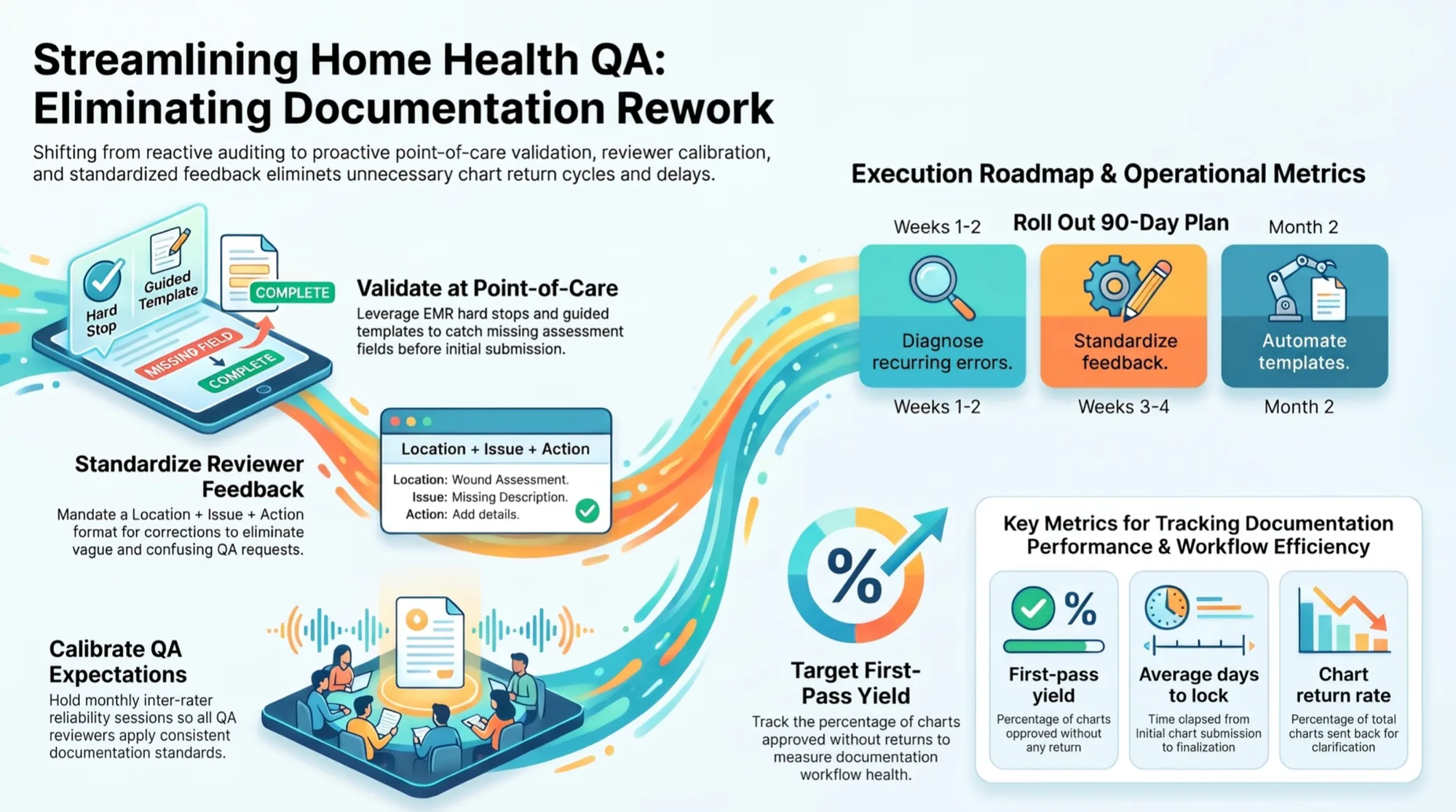
Moving from reactive chart auditing to point-of-care validation, reviewer calibration, and standardized feedback cuts unnecessary chart return cycles.
How Can QA Teams Improve the Feedback Loop With Nurses?
When a chart needs revision, how QA communicates with the nurse determines how quickly and accurately the issue gets resolved.
How Quickly Should QA Teams Review Submitted Charts?
Agencies should establish a defined review turnaround target.
A practical operational goal is to review submitted charts within one business day where staffing and chart volume permit. A 24–48-hour correction window may also be established for appropriate non-urgent issues.
These are agency workflow targets, not universal CMS deadlines.
Reviewing charts promptly helps keep visit details fresh in the clinician's memory and gives the agency more time to resolve outstanding issues.
Time-sensitive clinical or compliance concerns should be prioritized according to their urgency rather than waiting for a routine review cycle.
How Should QA Teams Write Specific and Actionable Correction Requests?
Vague messages such as "Clarify skilled need" or "Fix OASIS" create unnecessary back-and-forth.
A better approach is to use a consistent Location + Issue + Action format.
- Location: Identify the exact section, field, or assessment item.
- Issue: Explain what appears to be missing, unclear, or inconsistent.
- Action: State what the clinician needs to review, verify, or clarify.
For example:
Unclear feedback:
"Please correct wound documentation."
More actionable feedback:
"In the integumentary section, wound width is recorded as 2 cm, while the narrative describes it as 3 cm. Please verify the original assessment findings and correct or clarify the documentation as appropriate."
This approach gives nurses a clear starting point without telling them to change clinical information simply to satisfy a review.
Should QA Teams Batch Non-Urgent Corrections?
Yes, where practical.
Repeated messages throughout the day can interrupt nurses while they are driving, visiting patients, or completing other clinical responsibilities.
Agencies can group non-urgent correction requests into a consolidated message or scheduled review period.
This approach helps nurses plan their documentation work while allowing urgent patient safety or time-sensitive issues to be escalated immediately.
How Can Agencies Prioritize QA Review Queues?
Not every chart carries the same level of urgency.
A risk-based review process can help QA teams prioritize:
- Potential patient safety concerns.
- Time-sensitive assessments and documentation.
- Upcoming submission or billing deadlines.
- Missing orders or required signatures.
- Significant clinical inconsistencies.
- Routine documentation completion.
Clear prioritization helps QA teams use available review capacity more effectively.
How Can Nurses and QA Teams Build a More Collaborative Relationship?
Nurses and QA reviewers often work under different pressures.
Nurses balance patient visits, travel, documentation, and care coordination. QA teams manage chart reviews, correction queues, and documentation deadlines.
Both teams are working toward the same outcome: accurate, complete, and timely clinical documentation.
Can Dedicated QA Reviewers Improve Nurse Communication?
Assigning QA reviewers to specific nurse teams or clinical groups can help build familiarity and improve communication.
Dedicated reviewers may better understand recurring documentation challenges, team workflows, and training needs.
This should not compromise independent review or consistent application of standards. Review criteria must remain the same across the agency.
Can Short Chart Huddles Reduce Repeated Documentation Errors?
Yes. Agencies can introduce 15-minute biweekly chart huddles as a practical training approach.
A huddle may include:
- One anonymized example of well-documented clinical work.
- One common correction trend.
- A brief explanation of the applicable documentation expectation.
- Questions from nurses and QA reviewers.
- One practical takeaway for the next set of visits.
These sessions turn recurring QA corrections into shared learning opportunities.
How Should Agencies Use Nurse-Level Rework Metrics?
Agencies can track correction patterns by clinician to identify where additional support may be useful.
However, a higher return rate should not automatically be treated as an individual performance problem.
Managers should first investigate whether the pattern is related to:
- Insufficient training.
- Unclear documentation templates.
- EMR limitations.
- Inconsistent QA expectations.
- High workloads or scheduling pressure.
- Recurring workflow problems.
When an individual nurse needs additional support, a constructive one-on-one coaching session is generally more useful than repeatedly returning charts without explanation.
How Can Agencies Protect Clinical Documentation Integrity During Corrections?
Reducing rework should never come at the expense of accurate clinical records.
A chart should not be changed simply to pass QA review.
Nurses and other authorized clinicians must make corrections based on the actual assessment, available clinical evidence, and applicable documentation policies.
Agencies should ensure that:
- Corrections reflect the patient's actual condition and the clinician's findings.
- Nurses do not change responses merely to make them agree with another field.
- Amendments follow the agency's EMR correction and audit-trail procedures.
- Entries are not backdated.
- Staff do not reconstruct undocumented findings as though they were recorded during the original visit.
- Unverifiable information is handled according to agency policy.
- The reason for a correction is clear when required by the documentation process.
QA teams should identify concerns and request appropriate clarification. They should not direct clinicians to enter findings that they did not observe or verify.
The goal is accurate documentation, not simply getting a chart through the review process.
How Can AI Help Reduce Rework Between Home Health Nurses and QA Teams?
AI can support documentation quality by helping clinicians organize information, identify potential gaps, and reduce repetitive administrative work.
It can also help QA teams identify patterns that may otherwise remain buried in large volumes of correction requests.
Can AI Help Nurses Complete Documentation More Consistently?
AI-assisted documentation tools can help structure clinician-provided information and reduce repetitive typing.
For example, a nurse can describe a visit conversationally. An AI tool can turn that narrative into a structured draft that the clinician reviews and corrects.
This can help organize the visit information while allowing the nurse to retain control over the final documentation.
Can AI Identify Potential Documentation Gaps Before QA Review?
AI tools may be able to flag:
- Potentially incomplete fields.
- Conflicting information across documentation sections.
- Vague clinical descriptions.
- Missing supporting details.
- Potential inconsistencies between structured responses and narratives.
These alerts should be validated by a human reviewer.
Agencies should also monitor how often alerts are accurate. Too many false positives can create another layer of work instead of reducing rework.
Can AI Help QA Teams Identify Recurring Correction Patterns?
AI-assisted analysis can help categorize correction requests and identify repeated documentation issues.
For example, an agency may discover that many returned charts involve the same OASIS item, missing wound details, or unclear skilled-need documentation.
These insights can guide targeted training, template improvements, and workflow changes.
Can AI Approve or Finalize Clinical Documentation Without a Nurse?
No. AI should not replace the clinician's responsibility for verifying clinical information.
Nurses must review, correct, and approve their documentation before it is finalized. AI-generated suggestions should never be treated as verified clinical findings without appropriate human review.
How Does Copper AI Help Home Health Nurses Spend Less Time on Documentation?
Home health nurses often complete documentation after the patient visit, sometimes while managing several other responsibilities.
Copper AI is designed to help home health agencies reduce repetitive documentation work through AI-powered workflows.
Its voice agent, Joy, allows clinicians to describe a visit conversationally. Joy turns the spoken narrative into structured documentation for the nurse to review, correct, and approve.
This can help clinicians spend less time typing and organizing information while keeping the final documentation under their control.
Copper AI can also support broader administrative and documentation workflows designed to reduce repetitive tasks and improve information handling.
The objective is not to remove QA or eliminate clinical review. It is to help nurses create clearer documentation and give QA teams more consistent records to review.
Care in the home, not charting at home.
Which Metrics Should Home Health Agencies Track to Measure QA Rework?
Agencies cannot improve what they do not measure.
Tracking a few meaningful metrics can help identify whether documentation quality is improving and where the workflow continues to create unnecessary work.
| Metric | What Does It Measure? |
|---|---|
| First-pass yield | Percentage of submitted charts approved without being returned for correction |
| Chart return rate | Percentage of submitted charts returned for clarification or correction |
| Average correction cycles | Average number of review-and-correction rounds per chart |
| Time in QA queue | Time a chart spends awaiting QA review |
| Correction turnaround time | Time taken to resolve a QA correction request |
| Repeat correction rate | Frequency of recurring correction categories |
| Average days to lock | Average time from a defined starting point to chart lock or finalization |
| Documentation completion time | Time required to complete and finalize documentation |
| Pre-submission flag accuracy | Percentage of automated flags confirmed as genuine issues |
Two metrics deserve particular attention:
First-Pass Yield: The percentage of submitted charts approved without being returned for correction.
Average Days to Lock: The average time between a clearly defined starting event, such as chart submission, and the chart being locked or finalized.
Agencies should define their measurement periods and starting and ending events consistently.
They should also track why charts are returned. A minor clarification should not necessarily be treated the same as a significant clinical documentation issue.
How Can Home Health Agencies Reduce QA Rework in 90 Days?
Agencies do not need to redesign their entire documentation process at once.
A phased implementation plan can help identify recurring problems, standardize review practices, and introduce appropriate automation.
| Timeline | Focus Area | Key Action |
|---|---|---|
| Weeks 1–2 | Diagnose | Review recent QA reports and identify the top five reasons charts are returned |
| Weeks 3–4 | Standardize | Align reviewers on correction criteria and introduce Location + Issue + Action feedback |
| Month 2 | Automate and train | Improve EMR validation, introduce a Top 10 checklist, and train field nurses |
| Ongoing | Measure | Track first-pass yield, correction cycles, correction turnaround, and average days to lock |
What Should Agencies Do During the First Two Weeks?
Start by collecting recent QA correction data.
Identify the most frequent issues, determine which ones are avoidable, and separate clinical documentation problems from workflow or system-related problems.
What Should Agencies Standardize During Weeks Three and Four?
Agree on shared review criteria, correction categories, and communication expectations.
Introduce a standardized correction-request format and hold a reviewer calibration session.
What Should Agencies Introduce During the Second Month?
Update EMR templates and validation rules to address the most frequent avoidable errors.
Share a one-page documentation checklist with nurses and provide targeted training on recurring issues.
What Should Agencies Measure on an Ongoing Basis?
Compare performance against the original baseline.
Track whether fewer charts are being returned, whether correction cycles are decreasing, and whether documentation is being finalized more efficiently.
The purpose is continuous improvement, not simply meeting a numerical target.
What Should Home Health Agencies Remember About Reducing QA Rework?
Reducing rework between nurses and QA teams requires more than better chart review. It requires a process that prevents avoidable errors, sets consistent expectations, and makes communication easier.
The most effective approach combines four practices:
- Prevent errors at the point of care through guided templates, EMR validation, and appropriate AI assistance.
- Standardize documentation expectations through shared checklists, clear review criteria, and QA calibration.
- Improve the feedback loop through timely reviews, specific correction requests, and collaborative communication.
- Measure and improve continuously using first-pass yield, correction cycles, and chart completion time.
When nurses understand what is expected and QA teams provide consistent, actionable feedback, documentation becomes a shared responsibility rather than a repeated cycle of corrections.
The goal is not to eliminate QA. It is to make QA more effective, reduce unnecessary administrative work, and give clinicians more time to focus on patients.
Related Reading
- OASIS Discharge Checklist for Home Health Nurses.
- Home Health Recertification Checklist.
- Voice AI for Home Health Nurses: How Spoken Notes Become Structured Documentation.
- What Is OASIS-E2? A Complete Guide for Home Health Agencies.
- AI Governance in Healthcare: A Practical Guide for Healthcare Leaders.