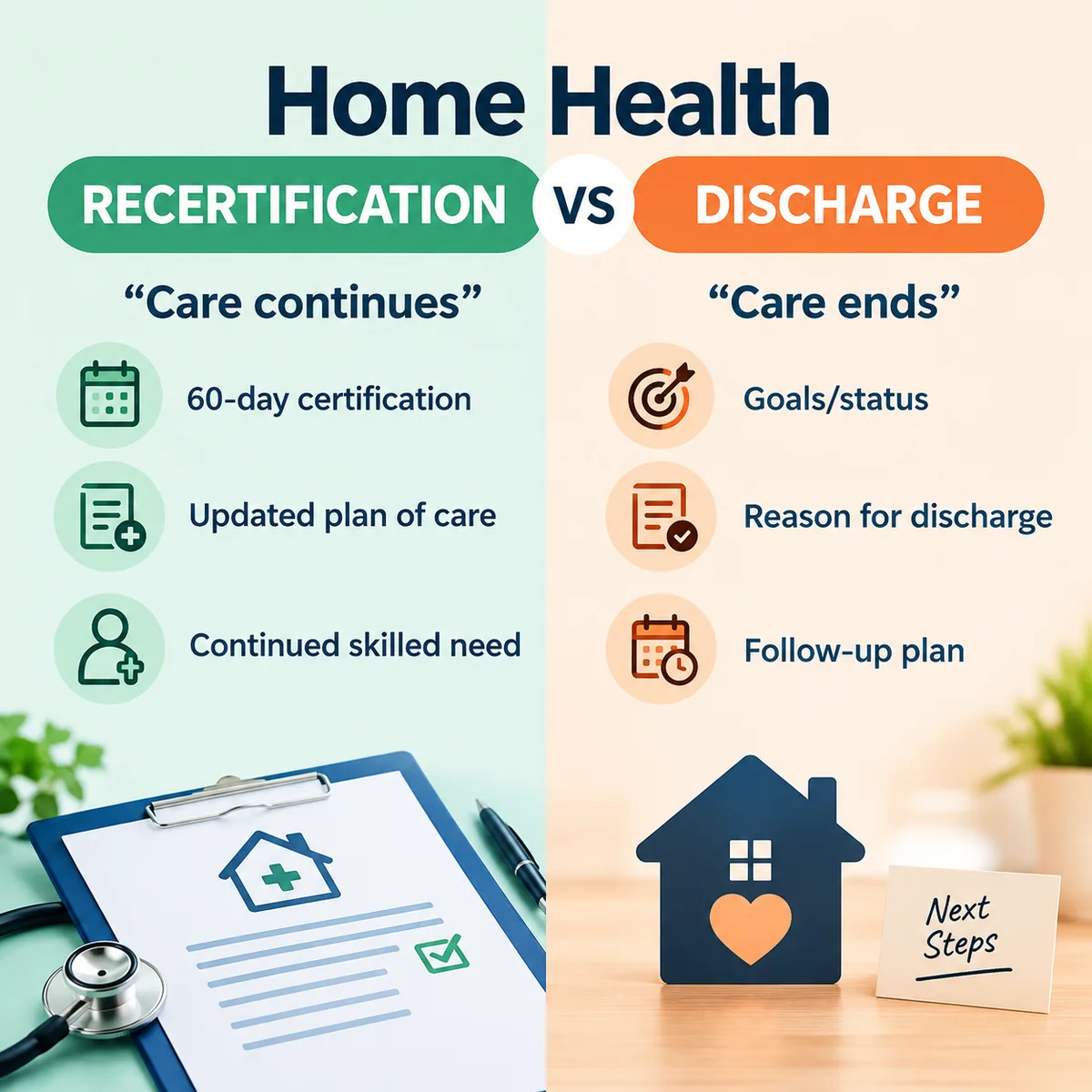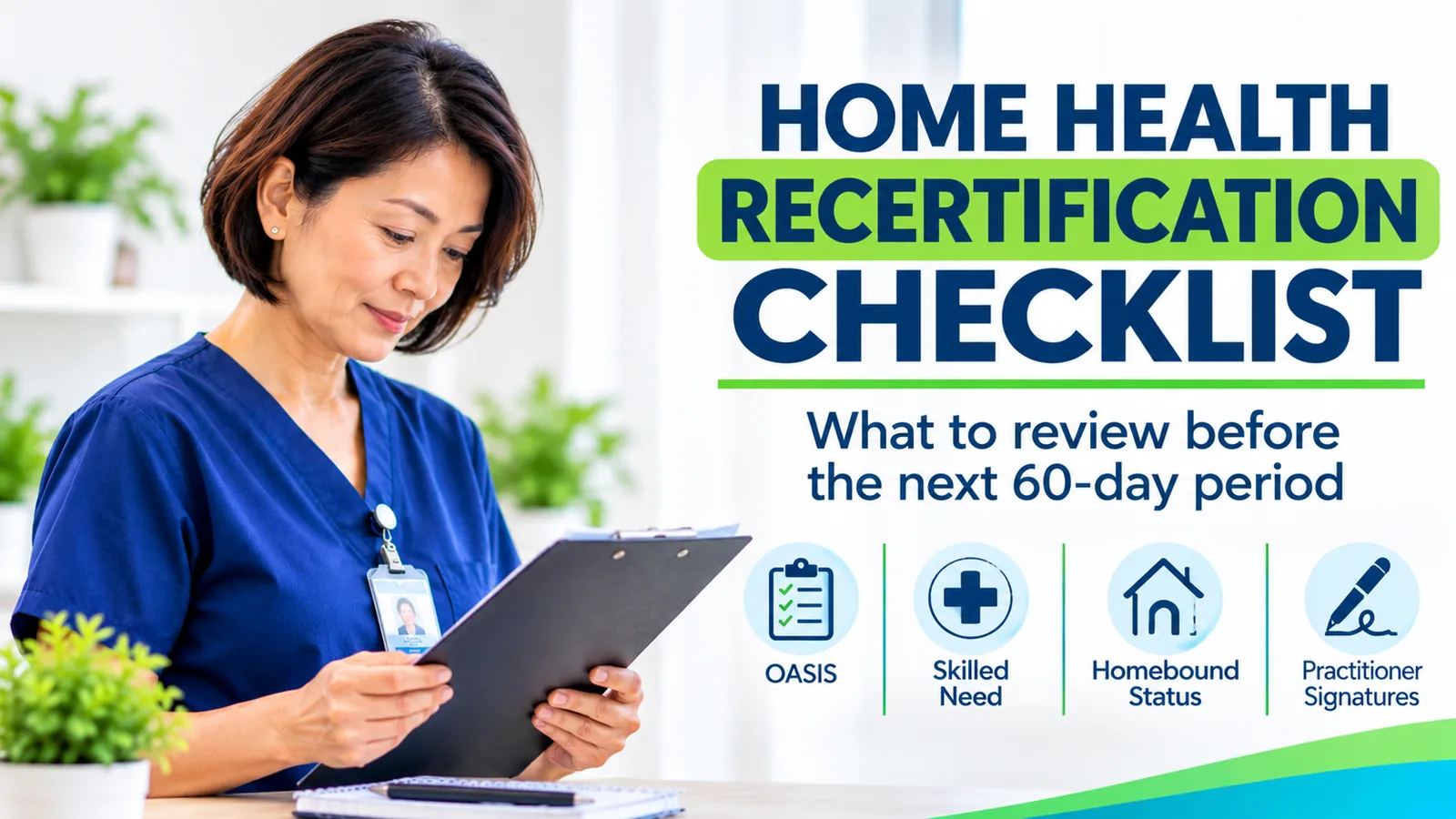
Home health recertification is the process of determining whether a patient continues to meet the requirements for home health services beyond the current certification period.
For Medicare patients, recertification is generally required at least every 60 days when there is a continuing need for home health care. It involves more than renewing an order or completing another assessment. The agency must reassess the patient's condition, establish whether the need for covered services continues, update the plan of care, and obtain the required physician or allowed practitioner recertification.
The process helps ensure that continued services are supported by the patient's current clinical condition and documented needs.
For home health agencies, completing recertification on time also means coordinating the clinician's assessment, OASIS documentation, plan-of-care review, and practitioner signature without allowing paperwork to accumulate at the end of the certification period.
When Should a Home Health Recertification Assessment Be Completed?
Under Medicare's home health Conditions of Participation, the comprehensive assessment must be updated at least during the last five days of every 60-day period, beginning with the original Start of Care date.
For OASIS-E2, the recertification time point is RFA 4, and the assessment must be completed during days 56–60 of the current 60-day certification period.
A few timing details are important:
- The recertification assessment window is days 56–60, not the first five days of the next period.
- Unless the patient has been discharged, the recertification schedule is calculated from the original Start of Care date, not the Resumption of Care date.
- If the patient returns from an inpatient stay during the last five days of the certification period, a Resumption of Care assessment may also serve the recertification function under the circumstances described in CMS guidance.
- If an agency misses the recertification window, CMS instructs the agency not to discharge and readmit the patient simply to reset the timeline. The agency should complete the assessment as soon as the oversight is identified and document the circumstances.
Agencies should plan the assessment before the final days of the period so there is enough time to complete the clinical review and coordinate the required documentation.
When Should Agencies Start Preparing for Home Health Recertification?
Although the OASIS recertification assessment must be completed during days 56–60, agencies do not need to wait until that window to begin preparing.
Starting around Day 50 is a useful operational practice. It gives clinical and administrative teams time to review the patient's record, identify outstanding documentation, coordinate the assessment visit, and contact the physician or allowed practitioner about the plan of care.
A practical preparation timeline may look like this:
| Timeline | Recommended activity |
|---|---|
| Days 50–55 | Review the current plan of care, clinical progress, recent changes, and outstanding documentation. Schedule the assessment. |
| Days 56–60 | Complete the comprehensive recertification assessment and applicable OASIS-E2 documentation (RFA 4). |
| During plan-of-care review | Send the updated plan and supporting documentation to the appropriate physician or allowed practitioner for review and signature. |
| Before claim submission | Verify that required plan-of-care signatures and supporting documentation are in place. |
This is an agency workflow recommendation, not a separate CMS-mandated Day 50 or Day 58 deadline.
Starting early can reduce last-minute follow-ups, but the actual assessment must still be completed within the applicable assessment window.
What Should Agencies Review Before Starting Recertification?
Before scheduling or completing the recertification assessment, the care team should review the patient's existing clinical record.
This helps the assessing clinician understand what has changed, what services have been provided, and what needs to be evaluated during the next assessment.
Has the Patient's Clinical Condition Changed?
Review the patient's condition since the previous comprehensive assessment.
Consider:
- New diagnoses or changes in existing conditions.
- Emergency department visits or hospitalizations.
- Changes in symptoms or functional ability.
- New wounds, worsening wounds, or healing progress.
- Falls or other safety incidents.
- Changes in pain, mobility, cognition, or respiratory status.
- New medications, discontinued medications, or dosage changes.
- Response to treatment and progress toward established goals.
The purpose is to establish an accurate picture of the patient's current condition, not simply repeat the previous assessment.
Does the Patient Still Meet Medicare Home Health Eligibility Requirements?
For Medicare home health services, the record must support the patient's continued eligibility.
The agency should review whether the patient continues to meet the applicable requirements, including:
- A continuing need for covered skilled nursing, physical therapy, or speech-language pathology services, as applicable.
- Homebound status.
- Care under a physician or allowed practitioner.
- Services provided under an established and periodically reviewed plan of care.
Occupational therapy may support continued services when the applicable Medicare requirements are met.
The patient's current clinical status and supporting documentation should explain why continued home health services are necessary.
Is There Evidence Supporting the Need for Continued Skilled Services?
A diagnosis by itself does not explain why skilled home health services must continue.
The documentation should connect the patient's current condition to the skilled services being provided.
For example:
- Does the patient require skilled wound assessment or treatment?
- Is skilled nursing needed to monitor a condition or manage a treatment plan?
- Does the patient require skilled therapy to address functional limitations?
- Are there ongoing risks or clinical changes that require professional assessment?
- Has the patient made progress, and what goals or needs are still being addressed?
If the patient has improved, the record should explain whether skilled services remain necessary and what goals or needs are still being addressed.
If the patient is not making expected progress, the care team should document the clinical reasons and whether the plan needs to change.
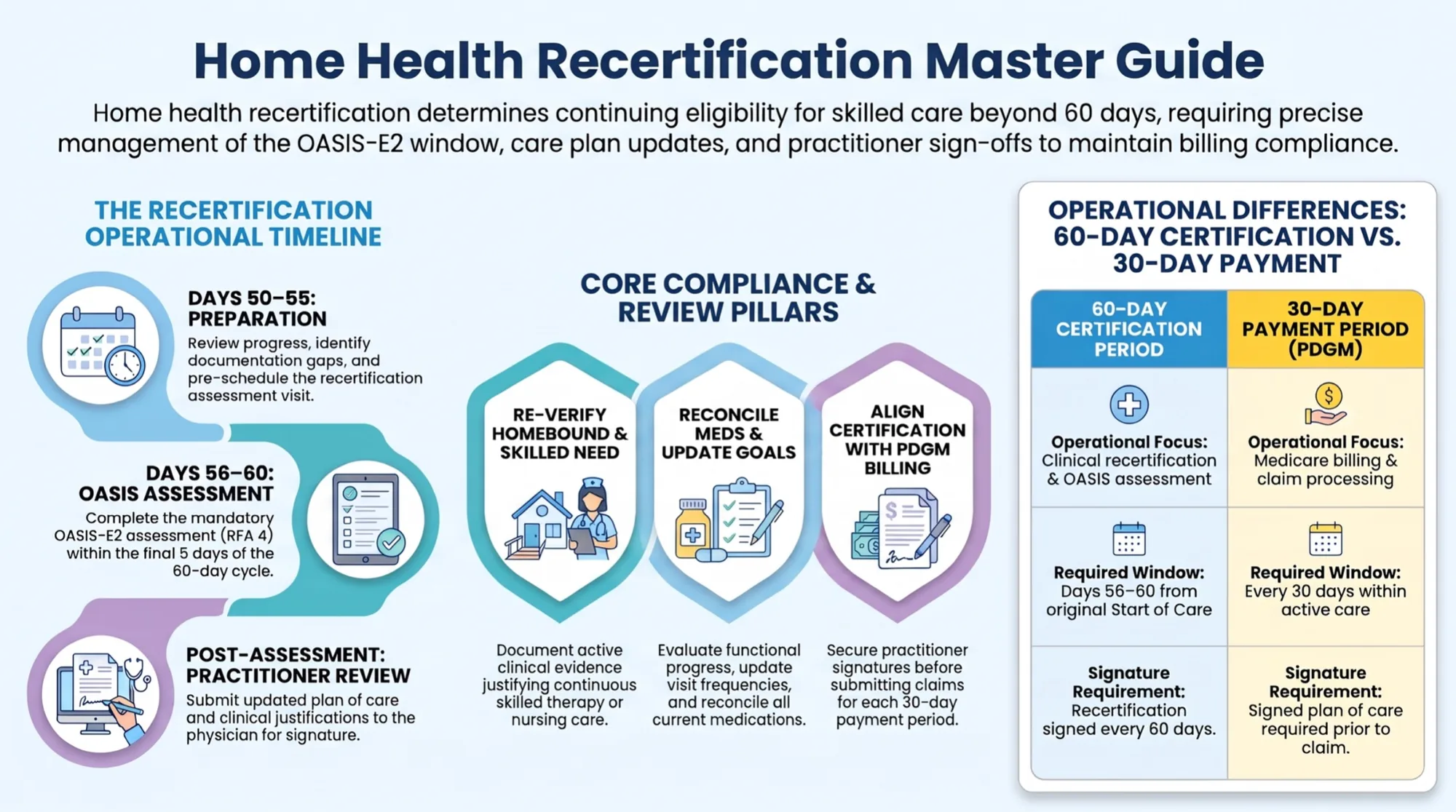
Recertification runs on a 60-day clock; billing runs on 30-day payment periods. Track both.
What Should Be Included in the Home Health Recertification Assessment?
The recertification assessment should provide an accurate, current picture of the patient's health and care needs.
Under 42 CFR §484.55, the comprehensive assessment includes the patient's current health, psychosocial, functional, and cognitive status; strengths and goals; continuing need for home care; medication review; caregiver support; and applicable OASIS items.
The following checklist can help clinicians organize the review.
Has the Patient's Current Health Status Been Reassessed?
Review and document relevant clinical findings, including:
- Vital signs and relevant clinical observations.
- Current symptoms and changes in condition.
- Pain and response to interventions.
- Respiratory and cardiovascular status, as applicable.
- Wound or skin condition, when relevant.
- Nutritional and hydration concerns.
- Cognitive and behavioral status.
- Relevant diagnoses and comorbidities.
Documentation should reflect the patient's actual condition at the time of assessment.
Has Functional Ability Been Reassessed?
Evaluate the patient's current ability to perform daily activities and move safely.
Depending on the patient's needs and applicable OASIS items, this may include:
- Bathing and personal hygiene.
- Dressing.
- Toileting.
- Transfers.
- Ambulation and mobility.
- Eating and other self-care activities.
- Use of assistive devices.
- Ability to follow safety instructions.
For applicable OASIS-E2 assessments, Section GG captures functional abilities using the required assessment conventions. The clinician should code the patient's usual performance based on the applicable guidance rather than relying on assumptions or a single isolated observation.
Have the Patient's Goals and Progress Been Reviewed?
Compare the patient's current condition with the goals established in the existing plan of care.
Document:
- Goals achieved.
- Goals partially achieved.
- Goals that remain unmet.
- New goals based on the patient's current needs.
- Barriers affecting progress.
- Changes required in the care plan.
A useful recertification record explains both what has improved and why additional skilled care may still be necessary.
Has Medication Reconciliation Been Reviewed?
The comprehensive assessment must include a review of the medications the patient is currently using.
Look for:
- New or discontinued medications.
- Changes in medication dosage or frequency.
- Potential adverse effects.
- Significant drug interactions.
- Duplicate medication therapy.
- Ineffective drug therapy.
- Medication noncompliance.
- Patient or caregiver ability to manage medications.
Any identified medication concerns should be addressed and communicated according to the agency's clinical policies and applicable requirements.
Have Caregiver Support and Home Safety Been Reassessed?
The patient's home environment and available support can change during a certification period.
Review:
- Who is providing assistance.
- Whether the caregiver is willing and able to provide care.
- Caregiver availability and schedule.
- Changes in the patient's living arrangements.
- Fall risks and environmental safety concerns.
- Availability and use of durable medical equipment.
- Patient and caregiver understanding of the care plan.
These details help the agency understand whether the current support system remains appropriate.
Which OASIS Items and Documentation Should Be Checked During Recertification?
OASIS-E2 is effective April 1, 2026. For a Medicare recertification assessment, agencies should use the applicable OASIS-E2 follow-up instrument and its item-specific guidance.
The assessment covers the relevant domains of the patient's current condition. Depending on the patient's circumstances and the applicable assessment items, the clinician may need to review:
| OASIS area | What should be evaluated? |
|---|---|
| Section A | Administrative information and assessment time point |
| Section B | Hearing, speech, and vision |
| Section C | Cognitive patterns |
| Section D | Mood |
| Section E | Behavior |
| Section F | Preferences for customary routine activities |
| Section GG | Functional abilities and performance |
| Section H | Bladder and bowel |
| Section I | Active diagnoses |
| Section J | Health conditions |
| Section K | Swallowing and nutritional status |
| Section M | Skin conditions |
| Section N | Medications |
| Section O | Special treatments, procedures, and programs |
| Section Q | Participation in assessment and goal setting |
Not every item is applicable to every patient or every time point. Clinicians should follow the OASIS-E2 item-specific instructions and the recertification instrument rather than treating this table as a requirement to complete every item.
The assessment should be consistent with the clinical record and accurately reflect the patient's current status.
What Must Be Updated in the Home Health Plan of Care?
The plan of care should reflect the patient's current needs and the services required during the next certification period.
Before recertification is finalized, the agency should review whether the existing plan remains appropriate or needs revision.
Check the following:
- Are the patient's diagnoses and relevant clinical needs current?
- Are the ordered services still appropriate?
- Are the frequency and duration of visits supported by the patient's needs?
- Are the interventions and treatment goals still relevant?
- Have new problems or risks been identified?
- Are changes in the patient's condition reflected in the plan?
- Are patient and caregiver education needs addressed?
- Are discharge planning needs being considered?
The plan should describe the services that will be provided and how they relate to the patient's identified needs and goals.
The physician or allowed practitioner must review and sign the plan of care as required.
What Should Agencies Check About Visit Frequency and Skilled Services?
The plan should identify the disciplines providing care and the frequency and duration of the services ordered.
Agencies should verify that:
- The planned visits reflect the patient's current clinical needs.
- Changes in visit frequency have been reviewed and ordered appropriately.
- Skilled interventions are clearly identified.
- Services remain consistent with the patient's goals.
- Any interval without covered skilled nursing, PT, SLP, or OT services is appropriately addressed when required.
Medicare's rules generally require at least one covered skilled nursing, physical therapy, speech-language pathology, or occupational therapy visit during each 60-day period. If no such visit is provided, the plan of care is generally terminated unless the physician or allowed practitioner documents that the interval without these services is appropriate for treating the patient.
This is an important compliance check for agencies managing patients with changing service needs.
Who Must Sign the Home Health Recertification?
For Medicare home health services, the physician or allowed practitioner who reviews the plan of care must sign and date the recertification.
Recertification is required at least every 60 days when continuous home health care is needed, subject to the applicable exceptions.
The agency should verify that:
- The appropriate physician or allowed practitioner has reviewed the plan.
- The recertification statement is completed.
- The statement is signed and dated.
- The supporting medical record documentation is available.
- Any required clinical justification is included.
There is an important additional requirement when the patient's underlying condition or complication requires an RN to ensure that essential non-skilled care is achieving its purpose and requires the RN to participate in developing, managing, and evaluating the care plan.
In that situation, the physician or allowed practitioner must include a brief narrative explaining the clinical justification for the RN's involvement. If the narrative is an addendum, the practitioner must also sign immediately following the narrative.
Agencies should not treat a pending signature as a completed recertification.
What Plan-of-Care Signature Requirements Should Agencies Verify Before Billing?
Completing the recertification assessment and obtaining a practitioner signature are important, but agencies should also check that the plan-of-care requirements are satisfied for billing.
Under Medicare requirements:
- The physician or allowed practitioner must review the plan of care at least every 60 days, or more frequently when required by changes in the patient's circumstances.
- The practitioner must sign and date the plan of care or any changes before the agency submits the claim for each 30-day payment period.
- The plan should identify the responsible disciplines and the frequency and duration of services.
- Required documentation must support the services billed.
Agencies should distinguish the 60-day certification period from the 30-day Medicare payment periods. The 60-day period governs the recertification cycle, while Medicare home health payment under PDGM is organized into 30-day periods.
These requirements are related but are not interchangeable.
An internal deadline for collecting signatures before the end of the certification period can help agencies avoid last-minute follow-ups. However, an internal Day 58 target is an operational practice, not a separate CMS-mandated signature deadline.
What Supporting Documentation Should the Physician or Allowed Practitioner Maintain?
The recertification decision must be supported by documentation in the certifying physician's or allowed practitioner's medical record, or the relevant acute or post-acute facility record when applicable.
Home health agency documentation may also support eligibility when it is corroborated by other entries in the practitioner's or facility's medical record, creating a clinically consistent picture of the patient's eligibility. The applicable regulatory requirements for practitioner review, signature, and dating must also be met.
Agencies should make sure that the documentation sent for review clearly explains:
- The patient's current clinical condition.
- The reason the patient continues to meet homebound criteria.
- The continuing need for covered skilled services.
- The progress made toward established goals.
- The reason additional services are appropriate.
- Any changes to the plan of care.
A signed recertification statement should be supported by the clinical record rather than treated as a substitute for it.
What Happens If the Patient No Longer Qualifies for Continued Home Health Services?
Not every patient should automatically be recertified.
The reassessment may show that the patient has met the established goals, no longer requires covered skilled services, or no longer meets the applicable home health eligibility requirements.
In such cases, the agency should evaluate whether discharge is appropriate and follow the applicable discharge requirements.
If the patient continues to need home health services, the agency should ensure that the clinical assessment, supporting documentation, plan of care, and practitioner recertification support that decision.
Recertification should reflect the patient's actual needs, not simply continue the previous schedule.
What Common Home Health Recertification Errors Should Agencies Avoid?
Even when the assessment is completed on time, documentation gaps can create compliance and payment concerns.
Common issues include:
- Completing the recertification assessment outside the required days 56–60 window without documenting the circumstances.
- Using the previous certification's clinical narrative without updating it.
- Failing to explain the continuing need for skilled services.
- Relying on diagnoses without describing the patient's current clinical needs.
- Not reassessing homebound status.
- Leaving changes in medication or functional status undocumented.
- Using outdated goals or interventions in the plan of care.
- Failing to obtain the required practitioner signature and date.
- Omitting the required clinical justification narrative when the specific RN-involvement requirement applies.
- Failing to check whether required plan-of-care signatures are in place before claim submission.
- Confusing the 60-day certification period with the 30-day payment period.
- Treating a completed OASIS assessment as a substitute for the full recertification process.
A strong quality assurance process should check both the assessment and the supporting documentation.
How Can Home Health Agencies Make Recertification Workflows More Efficient?
Recertification involves several connected tasks. When they are handled separately, agencies can lose time coordinating visits, reviewing records, completing OASIS, updating plans of care, and following up on signatures.
A more organized workflow can help.
Can Agencies Start Preparing Before Day 56?
Yes. Agencies can begin reviewing the record and coordinating the process before the formal assessment window.
Before day 56, clinical and administrative teams can:
- Identify patients approaching the end of their certification period.
- Review the previous assessment and plan of care.
- Check for recent hospitalizations or significant changes.
- Identify outstanding documentation.
- Coordinate the recertification visit.
- Confirm which practitioner needs to review and sign the plan.
The comprehensive recertification assessment itself must still be completed within the applicable window.
Can Agencies Use a Recertification Checklist for Quality Assurance?
A standardized checklist can help clinical managers and QA teams review whether the necessary steps have been completed.
It can also make pending items easier to track, such as assessments awaiting correction, plans awaiting review, and recertifications awaiting signatures.
The checklist should support clinical judgment, not replace the clinician's assessment.
Can AI Help Reduce Recertification Documentation Work?
AI can help organize information and reduce repetitive documentation tasks.
For example, voice-enabled tools can turn a clinician's spoken observations into a structured draft. AI-supported workflows may also help organize relevant information already available in the patient's record, where the integration supports it.
Copper AI is designed to support home health documentation workflows. Its voice agent, Joy, allows clinicians to describe a visit conversationally and turns the narrative into a structured draft for review.
The clinician remains responsible for checking the information, making corrections, and approving the final documentation. AI should not independently determine continued eligibility, make clinical decisions, or replace the required practitioner recertification and signature.
The goal is to make documentation easier to prepare while keeping clinical responsibility with the appropriate professionals.
What Is the Final Home Health Recertification Checklist?
Before the next certification period begins, use this checklist to confirm that the key steps have been addressed.
Clinical and assessment review
- Confirm the original Start of Care date and current 60-day certification period.
- Identify patients approaching recertification around Day 50.
- Review recent clinical notes, hospitalizations, and changes in condition.
- Reassess current health, psychosocial, functional, and cognitive status.
- Verify continued homebound status, where Medicare eligibility applies.
- Confirm the continuing need for covered skilled services.
- Review progress toward patient goals.
- Reconcile and review current medications.
- Reassess caregiver availability and support.
OASIS and plan-of-care review
- Complete the applicable OASIS-E2 recertification assessment (RFA 4) during days 56–60.
- Check OASIS responses for accuracy and consistency.
- Update the plan of care to reflect current needs.
- Verify ordered disciplines, visit frequency, and duration.
- Review any interval without covered skilled services.
Practitioner and billing documentation
- Confirm the appropriate physician or allowed practitioner has reviewed the plan.
- Obtain the required signed and dated recertification.
- Obtain required plan-of-care signatures before claim submission for each 30-day payment period.
- Include the required clinical justification narrative when applicable.
- Confirm supporting documentation is available in the appropriate medical record.
- Check for missing information, inconsistencies, and outstanding corrections.
- Ensure completed documentation is filed and handled according to agency and CMS requirements.
A completed checklist does not replace the applicable regulations or OASIS-E2 guidance, but it can help agencies keep the recertification process organized.
How Can Agencies Ensure a Smooth Transition Into the Next Certification Period?
Home health recertification is an opportunity to evaluate whether the patient still needs care, whether the current plan remains appropriate, and what should change in the next 60 days.
When agencies plan ahead, complete the assessment within the required window, document continued eligibility, update the plan of care, and obtain the necessary practitioner signature, they can reduce last-minute follow-ups and improve documentation consistency.
The process should not become a paperwork exercise. Every part of the recertification record should tell a clear clinical story: what the patient's condition is today, what has changed, what skilled care is still needed, and why continued services are appropriate.