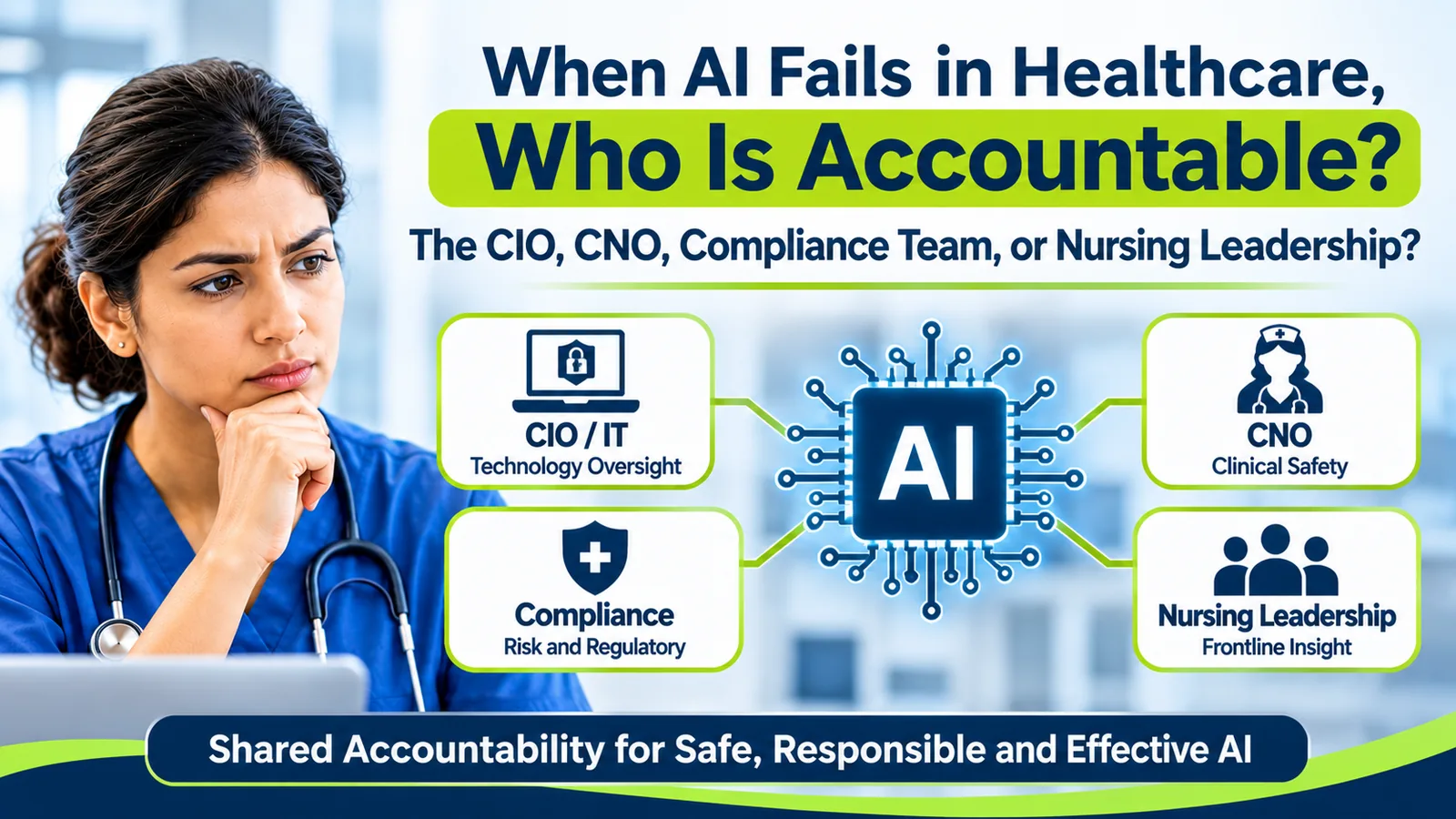
Artificial intelligence is becoming part of everyday healthcare operations. It supports clinical documentation, helps process information, streamlines administrative tasks, and increasingly influences how healthcare teams work.
But as AI becomes more involved in healthcare workflows, one important question deserves more attention:
When an AI system makes a mistake, who is responsible?
Is it the CIO who oversees technology? The CNO who is accountable for nursing practice? The compliance team responsible for regulatory obligations? Or nursing leadership, which understands how these tools affect clinicians on the ground?
The answer is not as simple as assigning responsibility to one department.
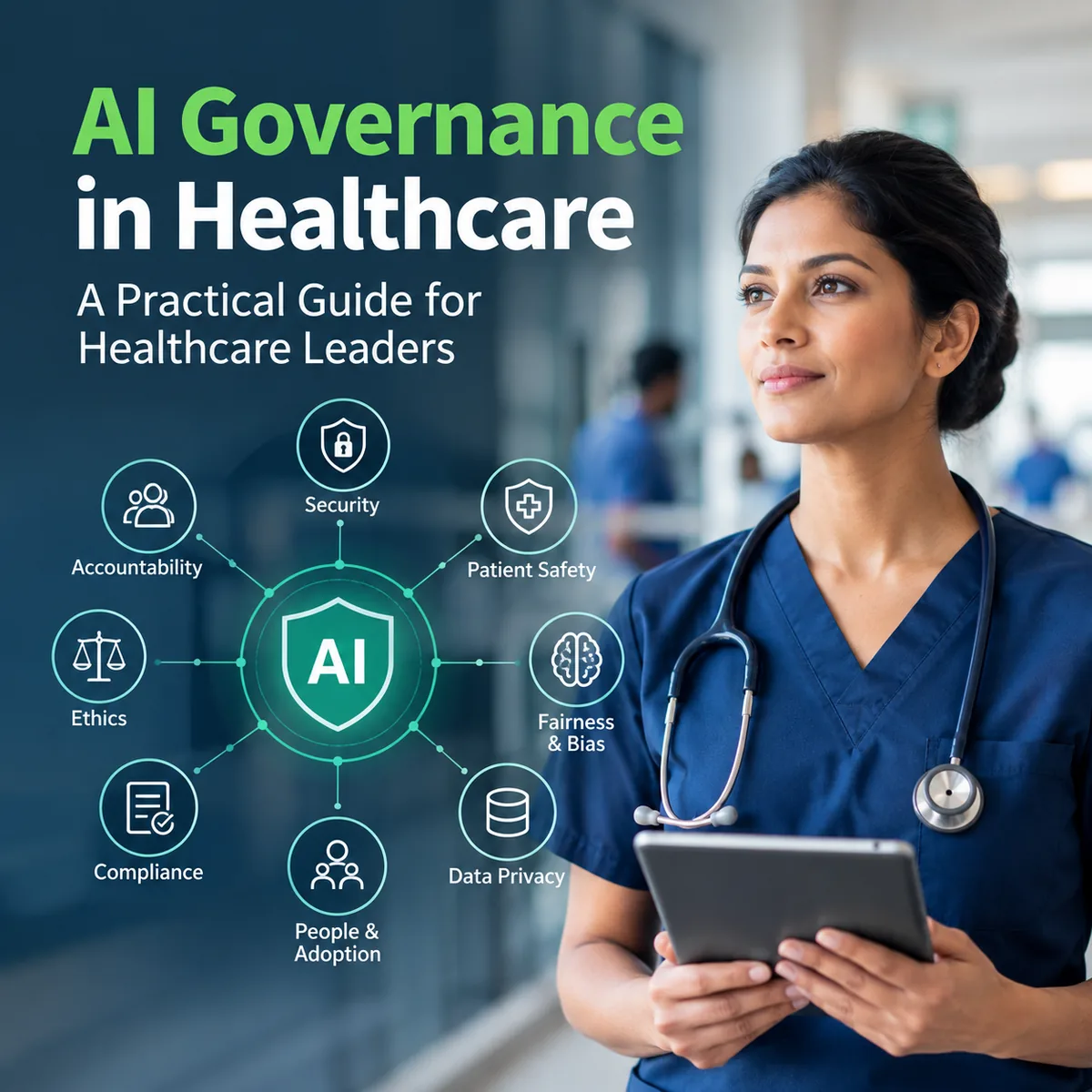
Healthcare AI governance requires shared accountability. Technology teams, clinical leaders, compliance professionals, and nursing leadership each have a role in ensuring AI is implemented, monitored, and used responsibly.
The challenge is making those responsibilities clear before something goes wrong.
What Does AI Accountability Mean in Healthcare?
AI accountability in healthcare means establishing who is responsible for selecting, implementing, monitoring, and overseeing AI systems, as well as responding when they produce errors or create risk.
It goes beyond asking whether the technology works.
Healthcare organizations must also consider:
- Who approves an AI tool before it enters a clinical workflow?
- Who evaluates its potential impact on patient care?
- Who checks whether it meets privacy and security requirements?
- Who monitors its performance after implementation?
- Who investigates errors or unexpected outcomes?
- Who has the authority to pause or restrict its use?
Without clear answers, organizations can end up with a system that everyone uses but nobody fully oversees.
Accountability should be built into the AI governance process, not decided after an incident.
Why Can't IT Own AI Governance Alone?
The CIO and IT teams play a critical role in healthcare AI governance. They understand the organization's technology infrastructure, integrations, cybersecurity requirements, data access, and system reliability.
However, AI does not operate in isolation from the people and processes around it.
An AI tool may be technically secure and function as designed while still creating problems in clinical practice. It might generate incomplete documentation, introduce workflow friction, or produce information that requires additional clinical review.
These are not problems that IT can evaluate independently.
For example, an AI documentation tool may integrate successfully with an electronic health record, but nurses may find that its output does not reflect the way patient visits actually happen.
The technology may be functioning correctly from an IT perspective, yet failing to support the clinical workflow.
That is why AI governance cannot sit with IT alone. Technology oversight must work alongside clinical judgment, compliance requirements, and frontline experience.
What Is the CIO Responsible for in Healthcare AI Governance?
The CIO is responsible for ensuring that AI systems fit within the organization's technology and security environment.
This includes evaluating:
- Technology selection: Assessing whether an AI solution meets organizational technology requirements.
- Data security: Reviewing how information is accessed, stored, transmitted, and protected.
- System integration: Ensuring AI tools work appropriately with existing platforms and workflows.
- Vendor oversight: Evaluating technology providers, their security practices, and their operational responsibilities.
- System monitoring: Identifying technical failures, access issues, and performance concerns.
The CIO helps answer an important question:
Can this AI system operate safely and reliably within our technology environment?
But technical reliability does not automatically establish clinical safety or usability. Those responsibilities require other leaders at the table.
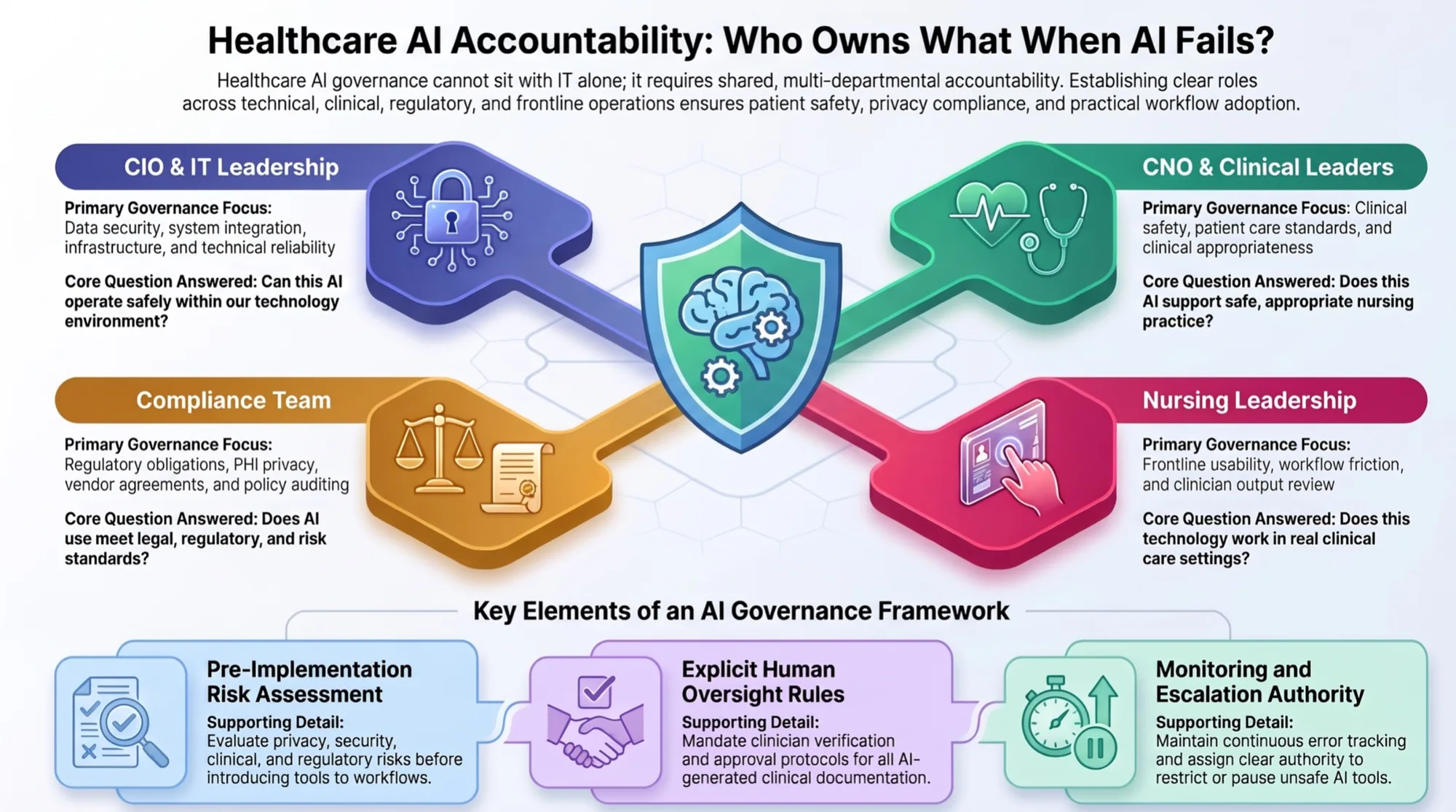
Healthcare AI governance cannot sit with IT alone. Each leader owns a different question, and executive leadership brings them together.
What Is the CNO Responsible for When Healthcare Uses AI?
The Chief Nursing Officer brings the clinical perspective to AI governance.
Because nursing teams work directly with patients and clinical documentation, the CNO can help assess how AI affects nursing practice, clinical standards, and patient care.
Key responsibilities may include:
- Evaluating the clinical appropriateness of AI-supported workflows.
- Ensuring AI use aligns with nursing policies and professional standards.
- Identifying risks that could affect patient safety.
- Establishing expectations for clinical review and oversight.
- Involving nursing teams in AI evaluation and implementation.
- Addressing concerns about how AI changes clinical responsibilities.
The CNO helps answer:
Does this AI system support safe, appropriate nursing practice?
An AI tool should not be considered successful simply because it reduces documentation time or completes a task faster. Its impact on clinical work and patient care matters just as much.
What Role Does the Compliance Team Play in AI Governance?
Healthcare AI introduces questions around privacy, security, documentation, regulatory obligations, and organizational risk.
The compliance team helps ensure that AI use is consistent with applicable laws, regulations, internal policies, and contractual requirements.
Its responsibilities may include:
- Reviewing privacy and regulatory risks.
- Assessing how protected health information is handled.
- Evaluating vendor agreements and Business Associate Agreements where applicable.
- Establishing policies for acceptable AI use.
- Supporting audit readiness and documentation requirements.
- Helping investigate potential compliance incidents.
- Reviewing changes in regulatory obligations that may affect AI use.
The compliance team helps answer:
Are we using AI in a way that meets our legal, regulatory, and organizational obligations?
However, compliance should not become a final checkpoint that happens only after a tool has been selected. Compliance professionals should be involved early enough to identify risks before implementation.
Why Does Nursing Leadership Need a Voice in AI Governance?
Nursing leadership often has the clearest understanding of how technology affects everyday clinical work.
Senior executives may approve an AI initiative, and IT may complete the implementation, but nurses are the people who experience the tool during patient visits, documentation, and follow-up.
Their feedback can reveal issues that may not appear during vendor demonstrations or technical testing.
For example:
- Does the AI-generated documentation accurately reflect what happened during the visit?
- Can nurses easily review and correct the output?
- Does the tool reduce administrative work or create additional steps?
- Are clinicians clear about what the AI can and cannot do?
- Do nurses know when they must use their own clinical judgment?
- Are there situations where the tool should not be used?
Nursing leadership helps answer:
Does this technology work in the real environment where care is delivered?
Frontline feedback should not be treated as an optional part of implementation. It is an important source of information for identifying risks and improving AI systems.
What Happens When AI Produces an Incorrect Clinical Output?
An incorrect AI output does not automatically mean that one person or department is responsible for the entire incident.
Accountability depends on what happened, who controlled the relevant decision, how the system was designed and implemented, and whether established policies and safeguards were followed.
Consider a few examples:
| Situation | Areas of responsibility to examine |
|---|---|
| AI generates inaccurate clinical documentation | Clinical review process, vendor performance, workflow design, and implementation |
| AI exposes protected health information | Security controls, access management, vendor practices, and compliance response |
| Staff use an unapproved AI tool | Organizational policy, workforce training, access controls, and individual conduct |
| AI output is not reviewed before being used | Human oversight requirements, workflow design, and role clarity |
| AI integration creates incorrect data in the EHR | Technical validation, integration controls, and operational monitoring |
The purpose of this approach is not to shift blame between departments.
It is to understand where the failure occurred, identify which safeguards were missing or ineffective, and determine who had responsibility and authority to address the issue.
Organizations should investigate incidents systematically rather than assume that the clinician, IT team, or vendor is automatically at fault.
Who Is Responsible for Reviewing AI-Generated Clinical Documentation?
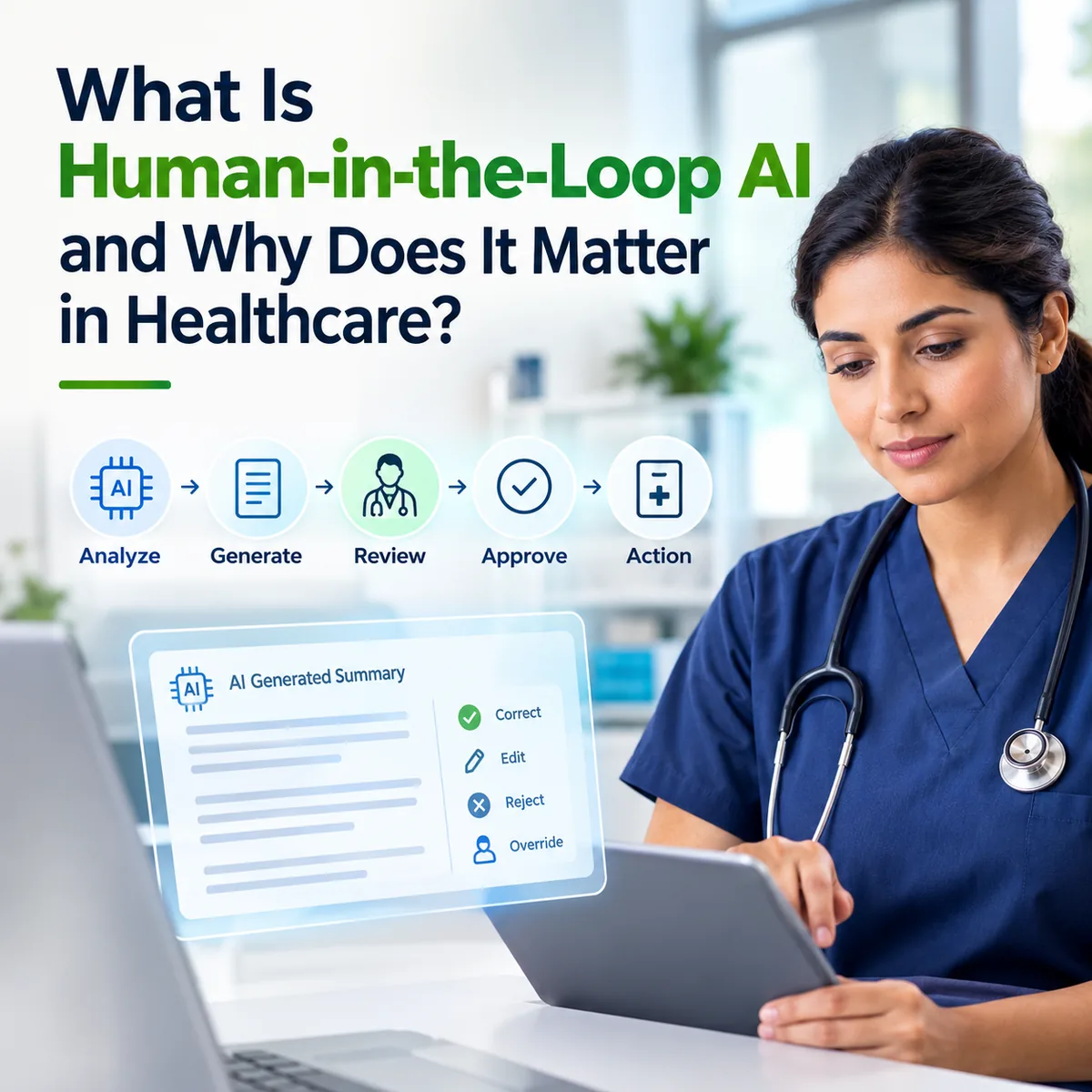
AI-generated clinical documentation requires clearly defined human oversight.
An AI system may organize information, prepare a summary, or generate a draft note. But healthcare organizations must establish who is responsible for reviewing that output and what level of approval is required before it becomes part of the clinical record.
For example, in an AI-assisted home health documentation workflow:
- The clinician describes the patient visit or provides relevant information.
- The AI organizes the information into a structured draft.
- The clinician reviews the documentation.
- The clinician corrects or adds information where necessary.
- The clinician approves the final documentation according to organizational policy.
The organization must define these responsibilities clearly.
AI should not blur the distinction between generating information and making a clinical decision. Clinicians need to understand what the system has prepared, what requires verification, and what remains their responsibility.
How Should Healthcare Organizations Divide AI Governance Responsibilities?
AI governance works best when responsibilities are shared but clearly assigned.
A practical framework can look like this:
| Role | Primary governance responsibility |
|---|---|
| CIO / IT leadership | Technology, security, integration, and system reliability |
| CNO / Clinical leadership | Clinical safety, standards, and appropriate use |
| Compliance team | Regulatory obligations, privacy, policies, and risk |
| Nursing leadership | Workflow suitability, frontline feedback, and adoption |
| Executive leadership | Organizational accountability, resources, and oversight |
| AI vendor | Product performance, technical documentation, security commitments, and agreed support obligations |
These responsibilities should be adapted to each organization's size, structure, and regulatory environment.
A smaller home health agency may not have a separate AI governance department or dedicated CNO. In that case, responsibilities can be assigned to existing leaders. What matters is that each responsibility has a named owner and a clear escalation path.
Shared accountability should never mean that accountability belongs to nobody.
What Should an Effective Healthcare AI Governance Framework Include?
A practical AI governance framework should address the entire lifecycle of an AI tool, from evaluation to ongoing monitoring.
Healthcare leaders should establish:
1. Clear ownership
Identify who approves AI tools, who oversees their use, and who can restrict or pause them when necessary.
2. Risk assessment before implementation
Evaluate privacy, security, clinical, operational, and regulatory risks before introducing a tool into daily workflows.
3. Defined human oversight
Specify when a person must review AI-generated information, who performs that review, and who has final approval authority.
4. Frontline involvement
Include nurses, clinicians, and operational staff in testing and evaluating AI tools before wider deployment.
5. Ongoing monitoring
Review performance, errors, user feedback, changes in workflows, and emerging risks after implementation.
6. Incident reporting and escalation
Establish a clear process for reporting AI-related errors, investigating incidents, documenting findings, and taking corrective action.
7. Workforce training
Make sure employees understand approved tools, acceptable use, data protection requirements, and the limitations of AI-generated outputs.
Governance should evolve as AI systems, organizational needs, and regulatory expectations change.
How Can Healthcare Leaders Prevent AI Governance Gaps?
The first step is to stop treating AI governance as a technology project with a one-time approval process.
It should be an ongoing leadership responsibility.
Healthcare leaders can begin by asking:
- Do we know which AI tools are being used across the organization?
- Is there a defined approval process before a new AI tool is introduced?
- Have clinical, IT, compliance, and nursing leaders agreed on their responsibilities?
- Do employees understand which AI tools are approved?
- Are human review and approval requirements documented?
- Can staff report AI-related concerns without confusion about where to go?
- Are we measuring the impact of AI on clinical workflows and patient care?
- Who has the authority to stop or limit the use of an AI tool if a serious risk emerges?
These questions can help organizations identify gaps before they become incidents.
They also create an opportunity to understand why employees may turn to unapproved AI tools in the first place. Sometimes, unauthorized use is a sign that existing systems are not meeting the needs of the people doing the work.
Good governance should address both the risks of AI and the problems employees are trying to solve with it.
Is AI Governance a Shared Responsibility or an Executive Responsibility?
It is both.
AI governance requires participation from the teams closest to the technology, the clinical workflow, and the regulatory environment. But shared participation does not remove the need for executive accountability.
Senior leadership must ensure that governance has:
- An executive sponsor.
- A cross-functional oversight structure.
- Clearly documented responsibilities.
- Defined approval and escalation authority.
- Adequate resources for monitoring and training.
- Regular reporting on AI performance and risk.
Without executive support, AI governance can become a collection of disconnected policies that are difficult to apply consistently.
Leaders must make sure that accountability is visible, practical, and supported across the organization.
So, Who Is Accountable When AI Fails in Healthcare?
The CIO, CNO, compliance team, and nursing leadership all have important responsibilities. None of them can govern healthcare AI effectively in isolation.
The CIO understands the technology. The CNO understands clinical accountability. Compliance understands regulatory obligations. Nursing leadership understands what happens when technology reaches the frontline.
And executive leadership must bring these perspectives together, assign clear ownership, and ensure that governance works in practice.
As AI becomes more deeply integrated into healthcare, the question should not simply be whether an organization has adopted AI.
It should be whether the organization knows who is responsible for it.
Because responsible AI adoption is not just about having the right technology. It is about having the right people accountable for how that technology is used.