
Free Home Health Billing Cheat Sheet
Home health billing gets complicated fast — PDGM, HIPPS, OASIS, NOA, LUPA, HCPCS and revenue codes, and payer rules all have to line up with the documentation. This guide walks through the essentials and gives you a free, downloadable cheat sheet your billing and clinical teams can actually use.
Key Takeaways
- A home health billing cheat sheet puts PDGM, HIPPS, OASIS, NOA, LUPA, HCPCS, revenue codes, documentation, and common denials in one quick reference.
- Clean billing starts at eligibility, the plan of care, and documentation — not when a claim reaches the billing department.
- PDGM classifies 30-day periods into 432 payment groups, each with its own case-mix weight and LUPA threshold.
- The NOA establishes the admission and is distinct from the final claim; NOA errors create downstream claim problems.
- A claim is only as strong as the clinical record: OASIS, coding, and the claim must tell the same story.
- Medicare Advantage and Medicaid can differ from Original Medicare — verify payer- and state-specific rules.
- CY 2026 brings updated rates, recalibrated PDGM weights and LUPA thresholds, and a new Grouper release.
💡 Quick Answer: A home health billing cheat sheet is a quick-reference for the concepts behind Medicare home health claims — PDGM, HIPPS, OASIS, the Notice of Admission (NOA), LUPA, HCPCS and revenue codes, documentation requirements, and common denials. Clean billing doesn't start at claim submission; it starts with eligibility, the plan of care, the services provided, and the documentation the clinical team creates.
Home health billing can get complicated fast. Agencies have to coordinate clinical documentation, OASIS assessments, the plan of care, coding, payer requirements, claims, authorizations, and changing Medicare rules. A small inconsistency between what was documented and what is billed can create a denial, delay payment, or trigger additional review. That's why a home health billing cheat sheet is useful — it puts the most important concepts clinical, billing, coding, and operations teams need in one place.
⚠️ Important: Billing and coding requirements change. Use this article as an educational reference and verify current requirements with CMS, your Medicare Administrative Contractor (MAC), state Medicaid program, or individual payer before submitting a claim.
Download the Free Home Health Billing Cheat Sheet
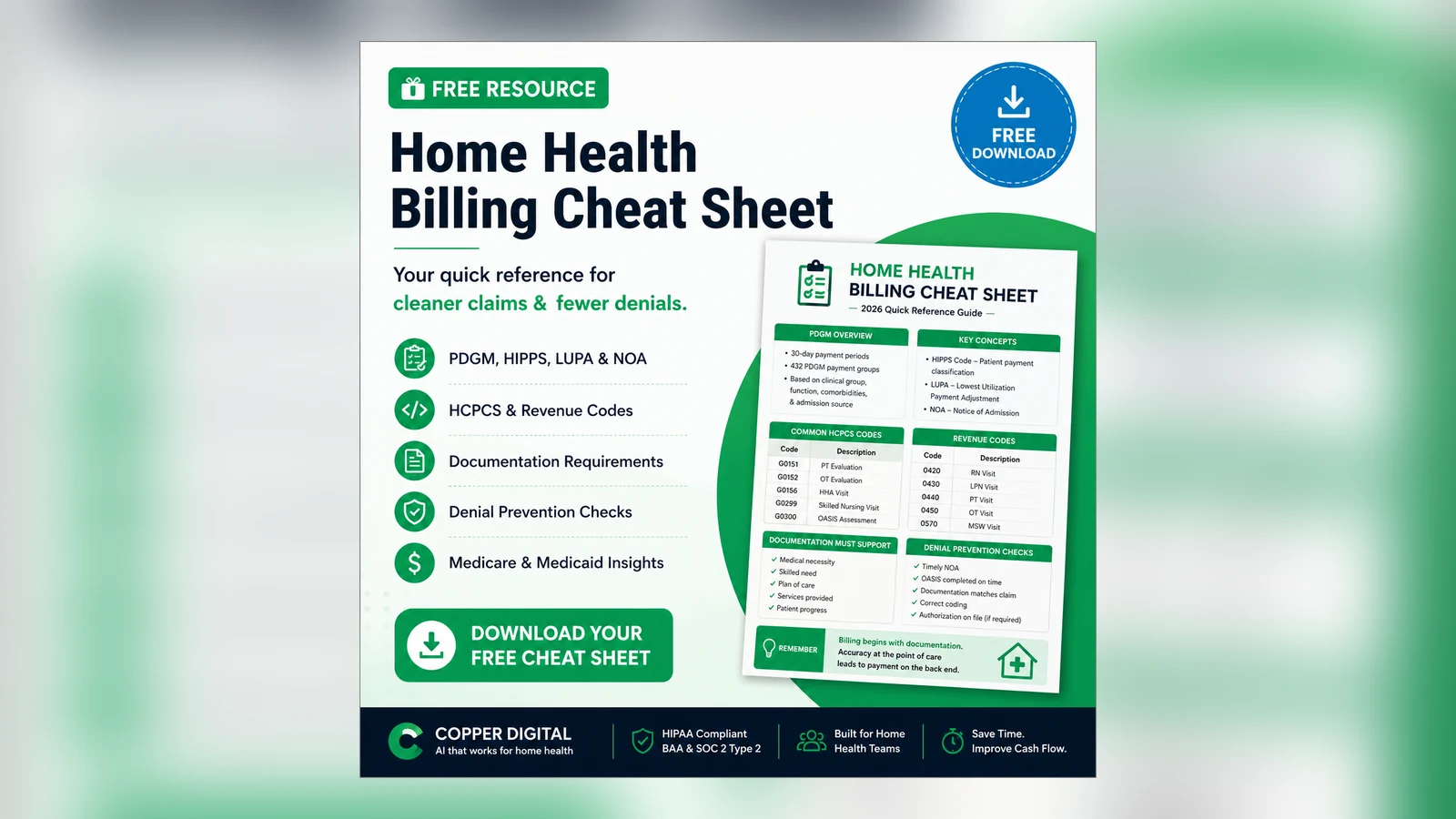
Looking for a quick reference your billing and clinical teams can actually use? Download the free Home Health Billing Cheat Sheet — a concise, one-look reference covering:
- PDGM
- HIPPS codes
- OASIS
- NOA
- LUPA
- HCPCS codes
- Revenue codes
- Documentation requirements
- Common billing errors
- Denial-prevention checks
- Medicare and Medicaid considerations
Download the Free Home Health Billing Cheat Sheet
What Is a Home Health Billing Cheat Sheet?
A home health billing cheat sheet is a quick-reference resource that helps clinical and billing teams understand the major components involved in submitting and supporting home health claims. It should not replace official payer guidance — instead, it gives staff a practical framework for how the pieces fit together.
A typical Medicare home health billing workflow runs: patient eligibility → face-to-face requirements → plan of care → OASIS → NOA → clinical services → documentation → coding → claim submission → payment/denial review. The important point is that billing does not begin when a claim reaches the billing department. It begins with the patient's eligibility, the care plan, the services provided, and the documentation created by the clinical team. CMS's Medicare Claims Processing Manual, Chapter 10, provides detailed requirements for home health agency billing, including HH PPS periods of care and claims submission.
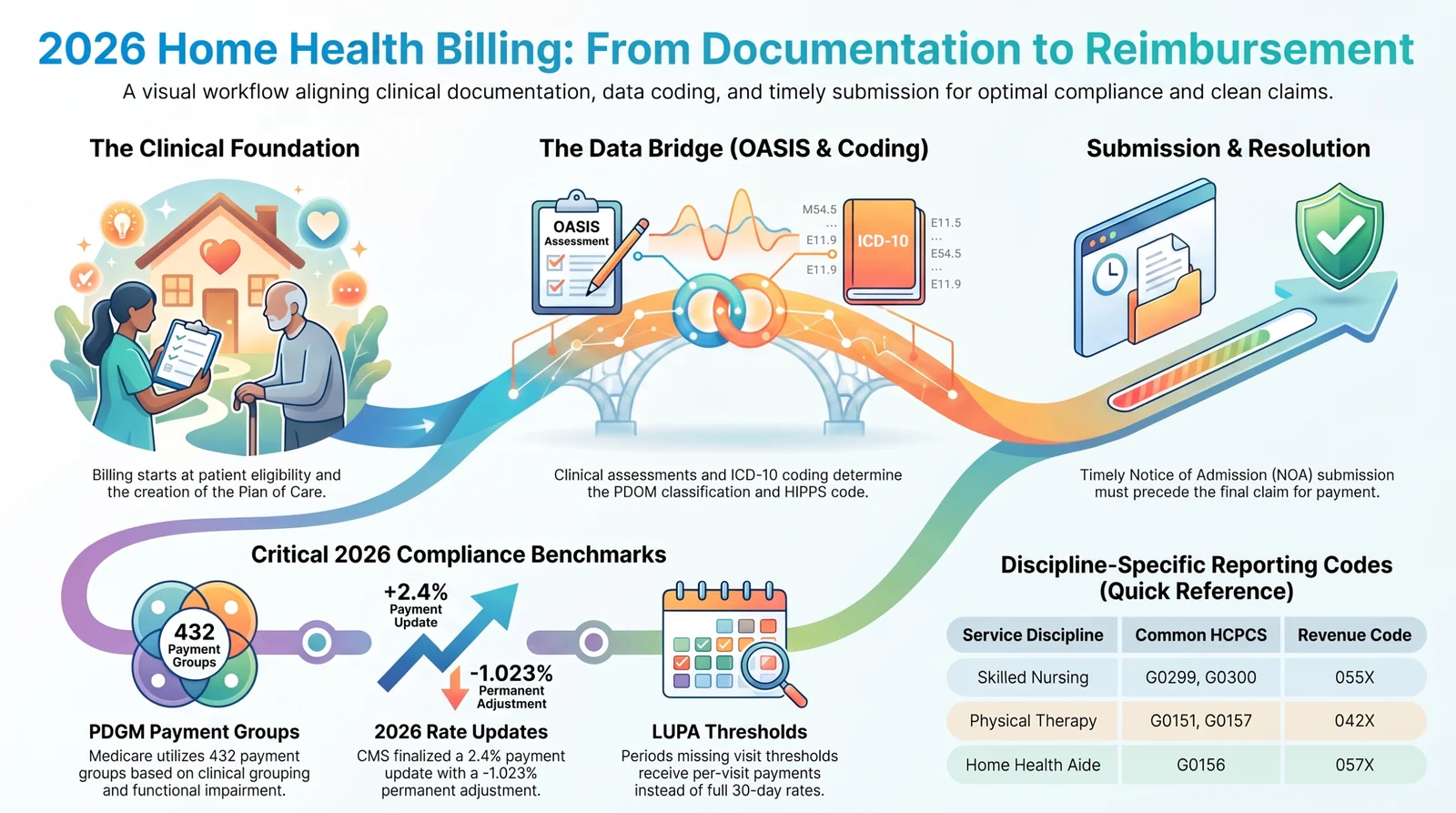
From documentation to reimbursement: clinical assessment and coding drive PDGM/HIPPS classification, and a timely NOA must precede the final claim.
Understanding Medicare Home Health Billing
Medicare home health payment operates under the Home Health Prospective Payment System (HH PPS). Under PDGM, Medicare generally pays agencies using a 30-day period of care rather than the former 60-day episode, with payment adjusted based on clinical characteristics and other patient information. That means agencies need to understand more than individual visit codes — they need the relationship between:
- Patient condition
- OASIS
- Clinical grouping
- Functional impairment
- Comorbidities
- HIPPS
- LUPA
- Documentation
- Services provided
- Claims
How PDGM Affects Home Health Billing
The Patient-Driven Groupings Model (PDGM) is central to Medicare home health reimbursement. It uses patient and clinical characteristics to classify 30-day periods into payment categories — CMS currently describes 432 PDGM payment groups, each with an associated case-mix weight and LUPA threshold. PDGM considers admission source, timing of the 30-day period, clinical group, functional impairment, and a comorbidity adjustment. The result is a payment classification that reflects the patient's expected resource needs.
Why this matters for billing
Clinical documentation needs to accurately reflect the patient's condition and the care actually being provided. A disconnect between the clinical record, OASIS, coding, and the claim creates downstream billing problems. Think of it as: clinical reality → documentation → OASIS/coding → PDGM classification → claim → payment. The same disconnects show up in a review of the top documentation errors in home health and in incomplete visit notes.
What Is a HIPPS Code in Home Health?
A HIPPS (Health Insurance Prospective Payment System) code represents a patient's payment classification under the applicable prospective payment system. In home health, HIPPS information is connected to the patient's assessment and PDGM classification, and it should be supported by the underlying clinical and assessment information.
HIPPS billing checklist
Before finalizing a claim, verify:
- Does the OASIS support the patient's documented condition?
- Does the clinical documentation support the services provided?
- Is the HIPPS information correct?
- Are the relevant claim fields complete?
- Are there inconsistencies between the clinical record and billing information?
What Is a Notice of Admission (NOA)?
The Notice of Admission (NOA) is another critical component of Medicare home health billing, and it is not the same thing as the final claim. The NOA establishes the home health admission for Medicare billing purposes, while the subsequent claim reflects the services and payment information for the applicable period. CMS's Medicare Claims Processing Manual contains dedicated guidance for NOA submission and the interaction between NOAs and subsequent claims.
Why NOA accuracy matters
Errors involving the NOA can create payment and claims-processing problems. Billing teams should have a defined process for confirming admission information, checking Medicare eligibility, ensuring required information is accurate, monitoring submission timelines, resolving rejected or incorrect NOAs, and coordinating NOA information with subsequent claims.
What Is LUPA in Home Health?
LUPA stands for Low-Utilization Payment Adjustment. Under PDGM, 30-day periods that do not meet the applicable visit threshold may receive a per-visit payment rather than the full 30-day payment. There is no single universal LUPA threshold — CMS assigns thresholds based on the applicable PDGM payment group, and they are updated periodically. For CY 2026, CMS recalibrated the PDGM case-mix weights and LUPA thresholds.
Why LUPA matters
LUPA shouldn't be treated simply as a billing problem — it can signal that an agency needs to examine patient needs, visit patterns, clinical documentation, care plans, scheduling, and whether the expected services are actually being delivered. The goal is never to provide unnecessary visits just to avoid a LUPA; it's to ensure the care delivered is clinically appropriate and accurately documented.
Home Health HCPCS Codes
HCPCS codes report specific healthcare services. Home health agencies encounter different HCPCS codes depending on the discipline and service provided:
| Service | Common HCPCS examples |
|---|---|
| Skilled nursing | G0299, G0300 |
| Physical therapy | G0151, G0157, G0159 |
| Occupational therapy | G0152, G0158, G0160 |
| Speech-language pathology | G0153, G0161 |
| Home health aide | G0156 |
| Medical social services | G0155 |
This is not an exhaustive coding list — verify current code descriptions, coverage rules, and payer requirements before billing. The principle is simple: the code billed should accurately represent the service that was actually provided and documented.
Home Health Revenue Codes
Revenue codes are another component of institutional claim reporting. Common home health revenue-code categories include:
| Revenue Code | Service |
|---|---|
| 042X | Physical Therapy |
| 043X | Occupational Therapy |
| 044X | Speech-Language Pathology |
| 055X | Skilled Nursing |
| 056X | Medical Social Services |
| 057X | Home Health Aide |
Revenue codes and HCPCS codes should be reviewed together rather than as separate pieces of the claim. CMS billing guidance provides the applicable requirements for home health claim reporting and coding.
Condition, Occurrence, and Value Codes
Home health claims can also involve condition, occurrence, and value codes, which communicate additional information such as circumstances, dates, or other required claim details. Because the appropriate code depends on the specific billing situation, avoid relying on a static list without checking the latest CMS and MAC instructions.
Billing team checklist
Before submission, confirm required condition codes, occurrence codes, and applicable value codes; dates; patient and provider information; revenue codes; HCPCS codes; modifiers where applicable; and all required claim fields.
Documentation Is the Foundation of Home Health Billing
One of the biggest mistakes agencies make is treating documentation and billing as separate processes. They're connected — a claim can only be as strong as the clinical record supporting it. Documentation should clearly communicate why the patient requires skilled care, what the clinician assessed, what intervention was provided and why it was necessary, how the patient responded, what changed, what education was provided, what follow-up is required, and how the care relates to the plan of care.
Consider the chain: assessment → clinical documentation → OASIS → plan of care → coding → PDGM/HIPPS classification → claim → payment. If information becomes inconsistent anywhere in that chain, the agency may have a problem.
Medical Necessity and Home Health Billing
Correct coding alone does not make a claim compliant — the documentation must support the services being billed. If a skilled nursing visit is billed, the record should demonstrate why skilled nursing was required and what skilled service was actually performed. The clinical record should tell a coherent story a reviewer can follow: why the patient is receiving home health, what they need, what the clinician did, why that intervention was skilled and necessary, how the patient responded, and what happens next. That narrative consistency is one of the most important components of defensible home health documentation.
Medicare vs. Medicare Advantage Home Health Billing
Not every home health claim follows the same process. Original Medicare and Medicare Advantage (MA) plans can have different administrative requirements — MA organizations may have their own rules around authorization, documentation, claims submission, utilization management, covered services, frequency, and payer-specific procedures. CMS's Medicare Claims Processing Manual specifically addresses situations involving MA organization enrollment and eligibility changes.
The takeaway: don't assume "we billed Medicare this way, so every Medicare Advantage plan will work the same way." Verify the requirements for the specific payer and plan.
Medicaid Home Health Billing
Medicaid billing is even more dependent on state-specific requirements. An agency billing Medicaid may need to account for state-specific HCPCS requirements, modifiers, units, prior authorization, provider enrollment, service limits, documentation requirements, managed Medicaid rules, and Electronic Visit Verification (EVV) where applicable. There is no single Medicaid billing workflow that applies identically across every state — always verify with the applicable state Medicaid program and payer.
Electronic Visit Verification (EVV)
EVV can be part of the billing and compliance landscape for applicable Medicaid-funded services. Depending on the service and state, EVV may capture who provided the service, who received it, the date, location, service type, and start and end times. Verify which services are subject to EVV in your state and how EVV data interacts with your billing workflow.
Common Home Health Billing Errors
Even experienced teams encounter billing errors. Here are the most common areas to watch — and how to avoid them.
1. Documentation and billing don't match
The claim says one thing while the clinical record suggests another. Avoid it: establish a pre-bill review process that compares the claim against the underlying documentation.
2. Incorrect HCPCS or revenue-code combination
The service, discipline, HCPCS code, and revenue code don't align. Avoid it: use current payer and CMS coding guidance and maintain an internally reviewed code reference.
3. NOA problems
Missing, incorrect, or improperly handled NOA information creates downstream claim issues. Avoid it: create a dedicated NOA workflow with clear ownership and exception monitoring.
4. OASIS and clinical documentation inconsistencies
The assessment and narrative documentation don't tell the same story. Avoid it: review OASIS and clinical documentation for internal consistency before billing — a core theme in our OASIS documentation compliance tips.
5. Missing or insufficient medical necessity
The record doesn't clearly explain why the service was required. Avoid it: train clinicians to document the clinical reason for skilled services, not simply the tasks performed.
6. Incorrect modifiers or claim information
Payer-specific claim requirements are missed. Avoid it: maintain payer-specific billing rules and update them regularly.
7. Services outside the plan of care
Documentation and billing don't align with the authorized plan of care. Avoid it: ensure changes in patient condition and care requirements are communicated and reflected in the plan of care.
8. Late or incomplete documentation
The visit occurred, but the supporting documentation isn't completed accurately or on time. Avoid it: establish documentation deadlines and escalation procedures.
A Simple Home Health Pre-Bill Checklist
Before submitting a claim, ask:
Patient
- Is the patient eligible?
- Is the payer correct?
- Are demographic and beneficiary details accurate?
Clinical
- Is the patient eligible for the service?
- Is medical necessity supported?
- Does the documentation support the skilled service?
- Does the care align with the plan of care?
OASIS
- Is the appropriate assessment completed?
- Is it internally consistent with the clinical record?
- Are required items complete?
Billing
- Is the NOA correct?
- Is the HIPPS information correct?
- Are HCPCS codes correct?
- Are revenue codes correct?
- Are required modifiers present?
- Are condition, occurrence, and value codes correct where applicable?
Compliance
- Are required signatures present?
- Are required authorizations complete?
- Does the documentation support what was billed?
2026 Home Health Billing Updates to Watch
Home health billing is not static. For CY 2026, CMS finalized updates affecting Medicare home health payment, including updated payment rates, PDGM case-mix weights, functional impairment levels, comorbidity adjustment subgroups, LUPA thresholds, face-to-face encounter policy, and other HH PPS policies. CMS's CY 2026 final rule finalized a 2.4% payment update, a -1.023% permanent adjustment, and a -3.0% temporary adjustment to the CY 2026 base payment rate. CMS also continues to update the Home Health PPS Grouper software — the October 2026 release, for example, is designated v07.2.26 for claims beginning October 1, 2026. That's why a billing cheat sheet should be treated as a quick reference, not a substitute for current CMS or payer guidance.
How to Build a Better Home Health Billing Process
A strong billing process isn't just about having a good biller — it requires clinical, operational, coding, and billing teams working from the same information.
- Standardize documentation — give clinicians clear expectations for what must be documented.
- Connect clinical and billing teams — billing staff should catch documentation issues before claims go out.
- Audit regularly — don't wait for a denial or audit to find a recurring problem.
- Track denial patterns — repeated denials usually point to something upstream in intake, documentation, coding, or workflow.
- Keep payer rules current — Medicare, Medicaid, MA, and commercial payers can differ.
- Use technology carefully — it should help surface missing information, inconsistencies, and gaps, but support (not replace) professional review.
Why Documentation Accuracy Matters to the Bottom Line
Billing accuracy isn't just a finance issue — it affects the whole organization. Poor documentation leads to claim problems, denials, rework, delayed payment, and administrative burden. The opposite is also true: clear clinical documentation → accurate coding → cleaner claims → faster resolution → better operational visibility. For agencies operating under PDGM, the relationship between clinical documentation and reimbursement makes that connection especially important.
Get the Free Home Health Billing Cheat Sheet
Want a quick reference for your team? Download the free Home Health Billing Cheat Sheet to keep the most important home health billing concepts in one place. It covers PDGM, HIPPS, OASIS, NOA, LUPA, HCPCS, revenue codes, documentation requirements, common billing errors, denial prevention, and Medicare and Medicaid considerations.
Download the Free Home Health Billing Cheat Sheet
Final Takeaway
A home health billing cheat sheet can make complex information easier to navigate, but clean billing starts much earlier than claim submission. The strongest processes connect the entire workflow — eligibility → assessment → OASIS → documentation → plan of care → coding → PDGM/HIPPS → NOA → claim → payment. When those pieces agree, agencies are in a much stronger position to submit accurate claims, reduce avoidable rework, and respond to payer scrutiny. And because Medicare rules, PDGM parameters, coding requirements, and payer policies change, always verify current requirements before relying on a reference sheet for billing decisions.
📝 Editorial note: This article is educational and should not be treated as billing, coding, legal, or reimbursement advice. Always verify current requirements with CMS, the applicable Medicare Administrative Contractor, state Medicaid program, or individual payer. Sources include the CMS Medicare Learning Network, the Medicare Claims Processing Manual (Chapter 10 — Home Health Agency Billing), and the CY 2026 Home Health PPS Final Rule.
What Should I Document? 100 OASIS Situations Home Health Nurses Face Every Day
100 real OASIS scenarios, worked end to end — clinical situation, common mistake, better approach, and key takeaway. Built around OASIS-E2 (effective April 1, 2026) to turn what you assess into accurate, defensible documentation.
Bottom Line
A home health billing cheat sheet makes complex information easier to navigate, but clean billing starts long before claim submission. The strongest processes connect the whole workflow — eligibility, assessment, OASIS, documentation, plan of care, coding, PDGM/HIPPS, NOA, claim, and payment — so the pieces agree. Because CMS rules, PDGM parameters, and payer policies change, always verify current requirements before relying on a reference sheet for billing decisions.

Arvind Sarin is the founder of Copper Digital. For the past year he has spent three days a week inside a 500+ census Texas home health agency, building AI documentation that finishes OASIS and visit notes the same day, with a nurse reviewing and approving every note. He writes about home health documentation, OASIS, Medicare compliance, and applying AI responsibly in clinical workflows.
Frequently asked
Frequently asked questions
A quick-reference resource covering common billing concepts, codes, documentation requirements, and compliance considerations for home health agencies. It helps clinical, coding, and billing teams review key concepts quickly, but it should not replace current CMS, MAC, Medicaid, or payer-specific guidance.
Join the conversation
Leave a comment
Related reading
Why Medicare Home Health Claims Get Denied
Medicare home health claim denials are revenue leaks, not just billing issues. This guide breaks down the ten most common reasons claims get denied, from OASIS gaps and late NOAs to coding and medical-necessity problems, and how to prevent them to get paid faster.
ICD-10 Coding Best Practices for Home Health Agencies
Accurate ICD-10 coding shapes PDGM reimbursement, claim denials, and Medicare compliance in home health. This guide walks through the eight best practices every agency should follow, from selecting the correct primary diagnosis and capturing comorbidities to coding specificity, OASIS alignment, annual updates, audits, and using AI as a coding support tool.
OASIS-E1 vs OASIS-E2: A Complete Side-by-Side Comparison for Home Health Agencies
Wondering what changed between OASIS-E1 and OASIS-E2? OASIS-E2 is an incremental update, not a redesign. The framework, five time points, and PDGM methodology stay the same, while CMS refines Section GG, cognitive and behavioral items, SDOH, and SPADEs. This guide compares both versions side by side and gives you a transition plan and checklist.