
SOC vs ROC vs Recertification: What's the Difference?
SOC, ROC, and Recertification all involve OASIS and Medicare documentation, but each serves a very different purpose. This guide breaks down what each assessment is, when it's required, how it affects reimbursement, and the mistakes agencies should avoid.
Key Takeaways
- SOC (Start of Care) is completed when a patient first begins receiving home health services.
- ROC (Resumption of Care) is completed after an inpatient stay when home health services resume.
- Recertification determines whether a patient continues to qualify for another 60-day episode of care.
- All three assessments directly impact Medicare reimbursement, OASIS quality reporting, compliance, and patient outcomes.
- Missing documentation deadlines can delay billing and increase audit risk.
- AI-assisted documentation can help reduce charting time while improving documentation accuracy.
💡 Quick Answer: Start of Care (SOC), Resumption of Care (ROC), and Recertification are three OASIS assessment time points that serve different purposes. SOC begins a patient's home health episode; ROC resumes services after an inpatient stay; and Recertification determines whether a patient qualifies for another 60-day certification period. All three require OASIS, affect Medicare reimbursement, and have strict timing rules.
If you're new to home health, or even if you've been in the field for years, it's easy to confuse Start of Care (SOC), Resumption of Care (ROC), and Recertification. All three involve patient assessments, Medicare documentation, and OASIS, but each serves a very different purpose.
Understanding the differences is essential for clinicians, agency owners, QA teams, and billers. Selecting the wrong assessment type or missing required documentation can delay reimbursement, create compliance issues, increase audit risk, and affect your agency's quality measures.
In this guide, we'll explain what SOC, ROC, and Recertification mean, when each assessment is required, how they impact Medicare payment, and the documentation mistakes agencies should avoid.
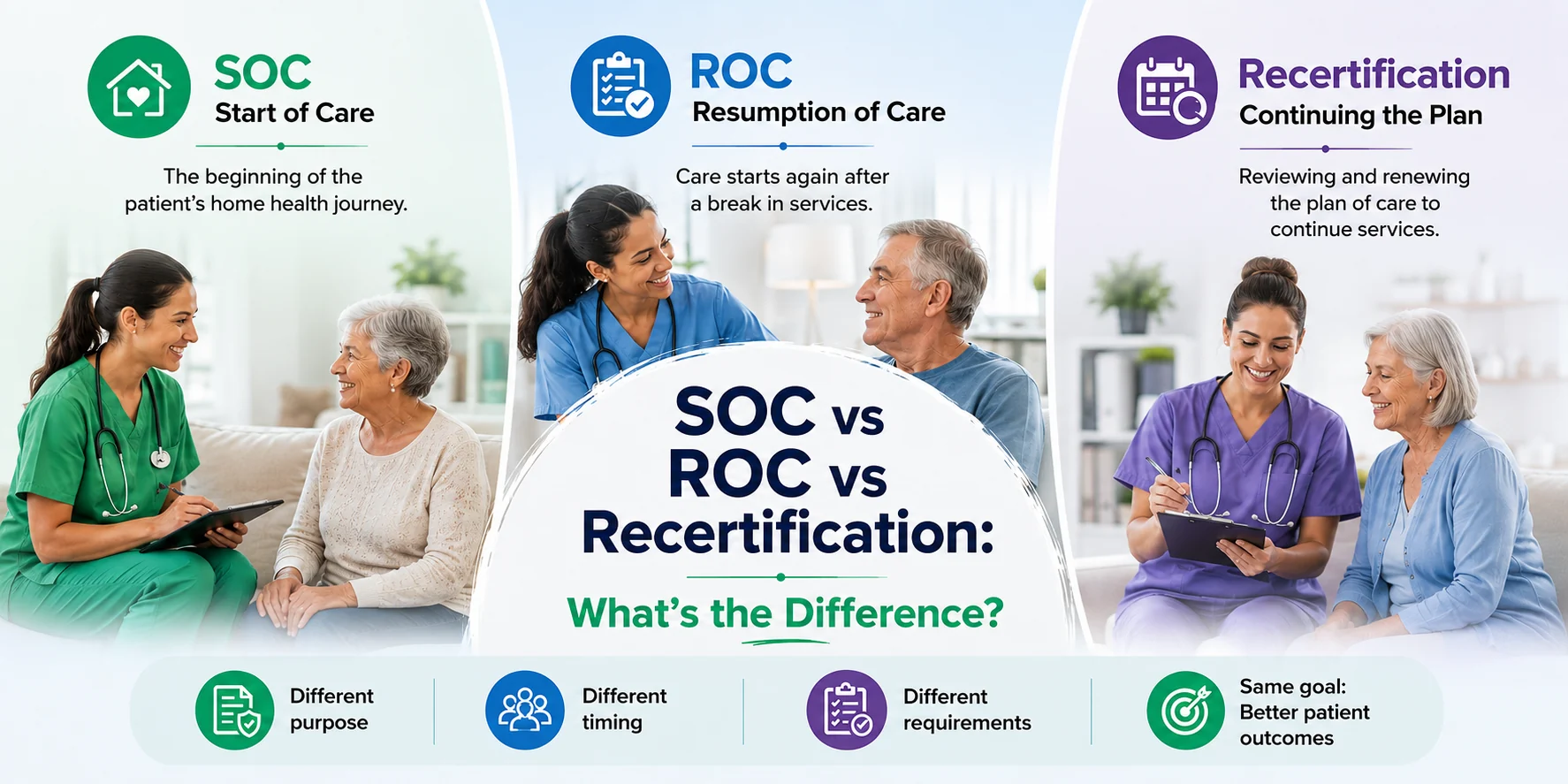
SOC starts the episode, ROC resumes it after an inpatient stay, and Recertification continues it, three assessments with different timing and requirements but the same goal.
What Is OASIS?
OASIS (Outcome and Assessment Information Set) is the standardized patient assessment required by the Centers for Medicare & Medicaid Services (CMS) for every Medicare-certified home health agency. Far more than a documentation form, OASIS serves as the operational backbone of home health.
The information collected through OASIS is used to measure patient outcomes, determine Medicare reimbursement under the Patient-Driven Groupings Model (PDGM), support quality reporting and Star Ratings, and guide care planning. Every comprehensive OASIS assessment captures detailed clinical information about a patient's medical condition, functional abilities, cognitive status, and skilled service needs.
What Is an OASIS Assessment?
An OASIS assessment is the structured clinical evaluation performed by a qualified home health clinician, typically an RN, PT, OT, or SLP, during specific time points in the episode of care. During the assessment, clinicians evaluate and document hundreds of clinical data points, including:
- Functional abilities (Section GG)
- Cognitive status (BIMS)
- Depression screening (PHQ-2/PHQ-9)
- Medication management
- Clinical diagnoses
- Wound status
- Cardiopulmonary assessment
- Fall risk
- Caregiver availability
- Social Determinants of Health (SDOH)
- Skilled service needs
Today's home health agencies increasingly use AI-assisted documentation, voice capture, and mobile charting to reduce manual data entry while improving accuracy. Once completed, OASIS data is submitted through CMS systems and becomes the foundation for reimbursement, quality reporting, and care planning.
OASIS Versions: E, E1, and E2
OASIS has continued to evolve alongside CMS quality initiatives. Recent versions include:
- OASIS-E (effective January 2023)
- OASIS-E1 (effective January 2025)
- OASIS-E2 (effective 2026)
Each version maintains the core OASIS framework while refining functional assessments, cognitive screening, Social Determinants of Health, and quality items. For a deeper look at the latest transition, see our guide to OASIS-E1 vs OASIS-E2.
When Is OASIS Required?
One of the biggest misconceptions is that OASIS is only completed during admission. In reality, CMS requires OASIS assessments at five specific time points across the episode of care:
- Start of Care (SOC): completed within 5 days of the patient's first skilled home health visit to establish the baseline assessment and initiate the episode.
- Resumption of Care (ROC): completed within 2 days after the patient returns home from an inpatient hospital or facility stay to reassess the patient's condition.
- Recertification (Follow-Up): completed during the last 5 days of each 60-day certification period to determine whether the patient continues to qualify.
- Transfer to an Inpatient Facility: completed when a patient is admitted to a hospital, SNF, or another qualifying inpatient setting.
- Discharge: completed within 2 days of the patient's final billable home health visit to document outcomes and the conclusion of the episode.
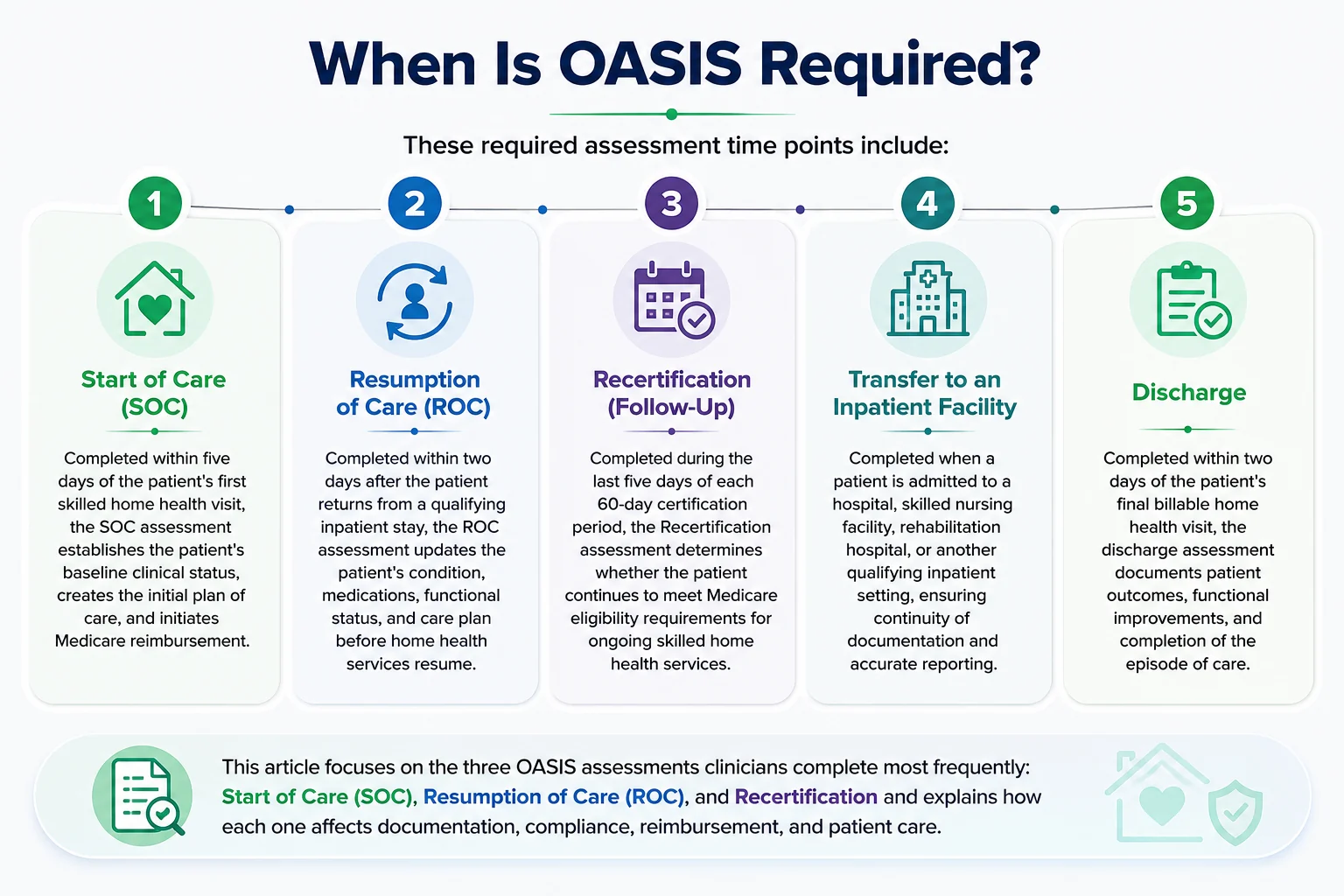
The five OASIS time points CMS requires across an episode of care. This guide focuses on the three clinicians complete most often: SOC, ROC, and Recertification.
This guide focuses on the three OASIS assessments clinicians perform most frequently: SOC, ROC, and Recertification, explaining how they differ and why each matters.
Why Understanding SOC, ROC, and Recertification Matters
Home health clinicians complete hundreds of assessments every year. While SOC, ROC, and Recertification may appear similar, Medicare treats each one differently. Every assessment has its own documentation requirements, timing rules, OASIS items, billing implications, and compliance standards.
Incorrectly selecting an assessment type or failing to complete it within CMS timelines can lead to payment delays, claim denials, reduced reimbursement, and increased administrative burden. That's why every clinician, QA reviewer, and agency leader should understand exactly when each assessment is required.
What Is a Start of Care (SOC)?
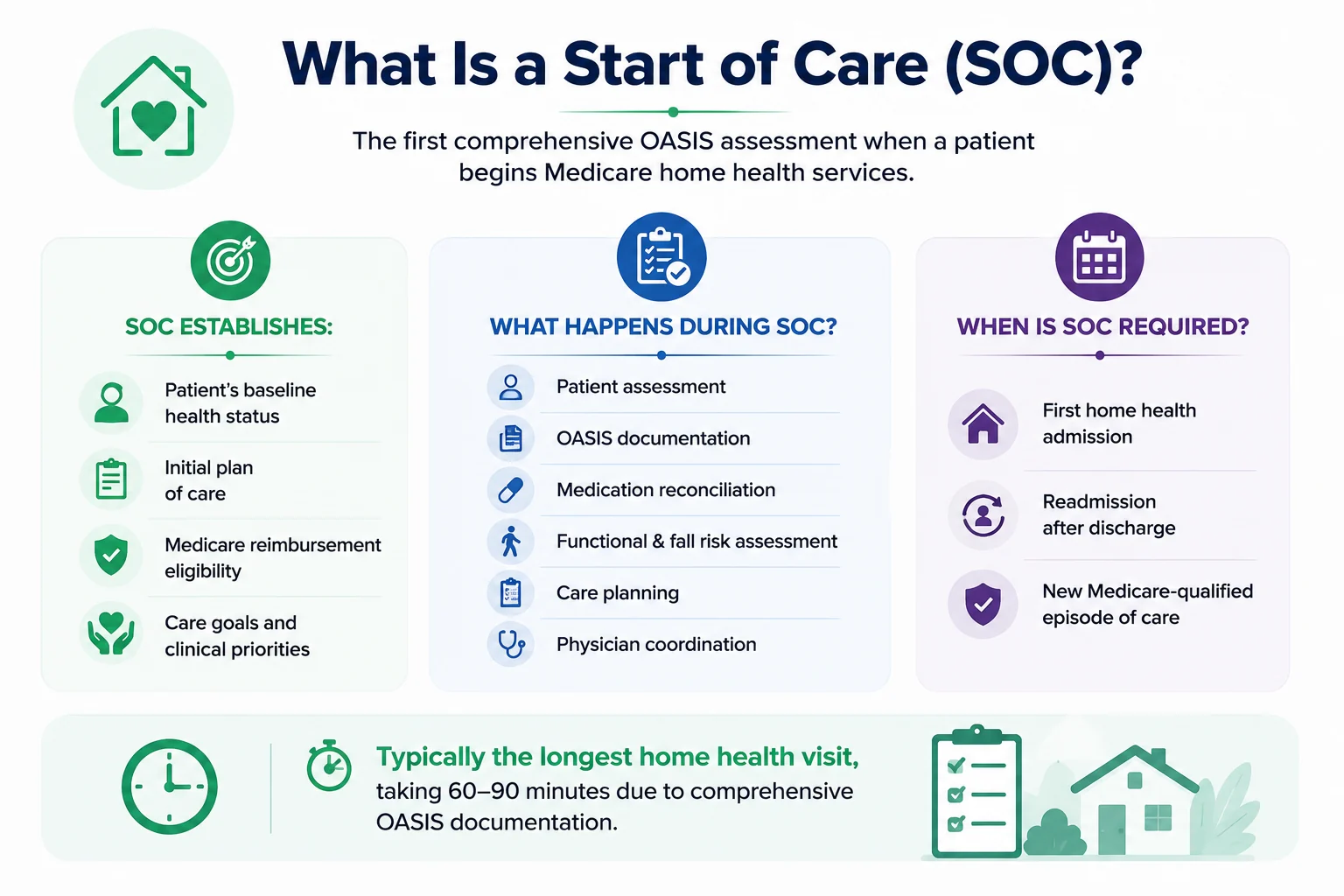
The Start of Care assessment establishes the baseline, creates the plan of care, and initiates reimbursement, typically the longest visit in home health.
A Start of Care (SOC) assessment is the comprehensive evaluation completed when a patient first becomes eligible for Medicare home health services. It establishes the patient's baseline health status and creates the foundation for the entire episode of care.
The SOC visit is often the most time-consuming visit in home health because clinicians must gather extensive clinical information, complete the OASIS assessment, develop the care plan, reconcile medications, identify risks, document functional status, and coordinate physician orders. A typical SOC assessment includes:
- Comprehensive patient assessment
- OASIS-E1 documentation
- Medication reconciliation
- Functional assessment
- Fall risk evaluation
- Skin assessment
- Care planning
- Homebound status documentation
- Physician communication
Many clinicians spend 60-90 minutes or more completing a Start of Care assessment because OASIS contains well over 100 data elements that affect payment and quality reporting.
When Is a Start of Care Assessment Required?
A SOC assessment is completed when a patient is admitted to home health for the first time, when a patient returns after being discharged from home health, when Medicare eligibility has been re-established, or when a new episode of home health care begins. Without a completed SOC assessment, Medicare home health services generally cannot proceed appropriately.
What Is Resumption of Care (ROC)?
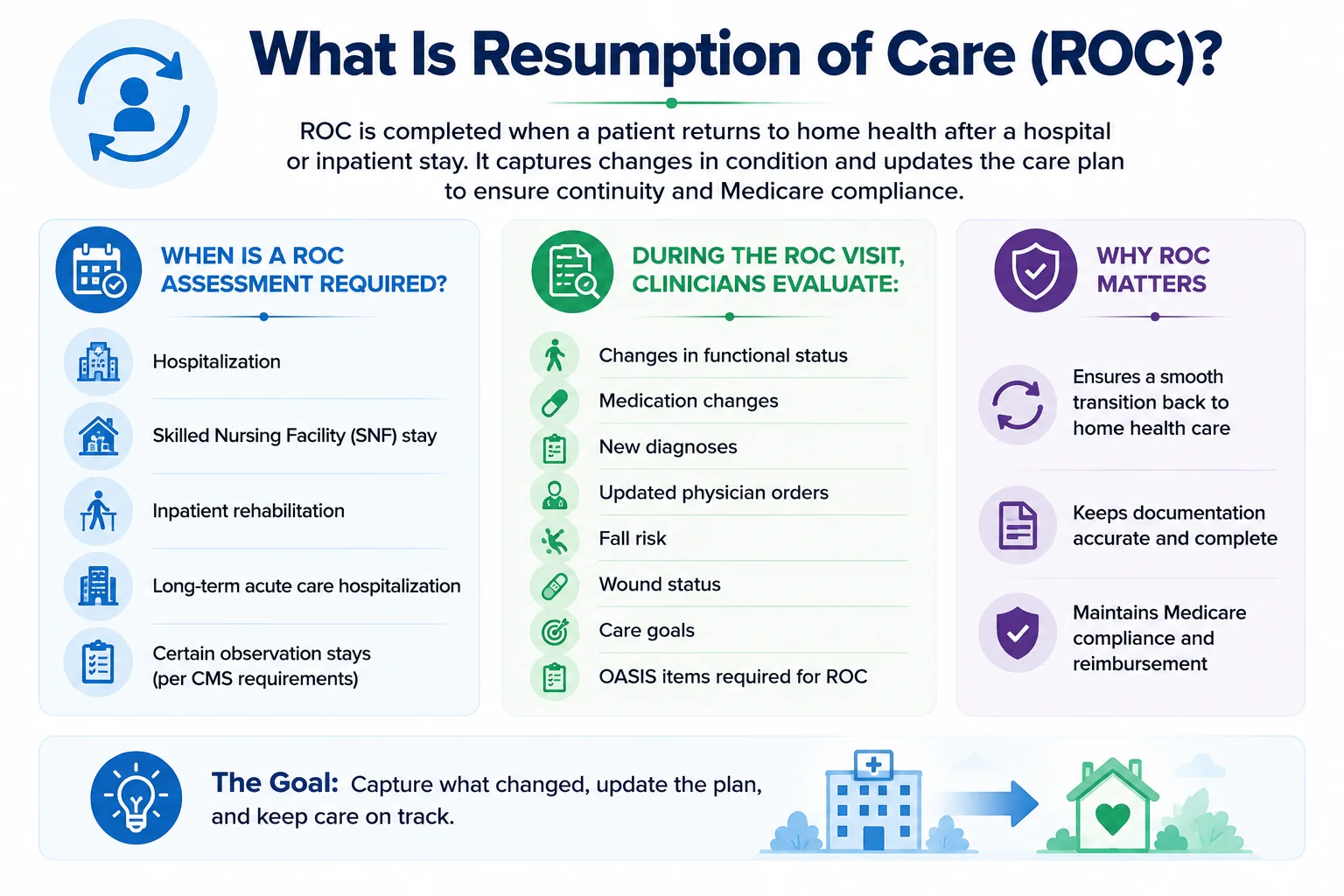
ROC resumes a paused episode after an inpatient stay, capturing what changed and updating the plan so care and reimbursement stay on track.
A Resumption of Care (ROC) assessment is performed when a patient temporarily stops receiving home health services because they were admitted to a hospital or inpatient facility and later returns to home health. Rather than starting over, the clinician documents how the patient's condition changed during the hospitalization and updates the care plan accordingly.
ROC documentation helps ensure continuity of care while keeping the patient's home health episode aligned with Medicare requirements.
When Is a ROC Assessment Required?
A ROC assessment is required after hospitalization, a Skilled Nursing Facility (SNF) stay, inpatient rehabilitation, long-term acute care hospitalization, and certain observation stays (depending on CMS requirements). During the ROC visit, clinicians evaluate changes in functional status, medication changes, new diagnoses, updated physician orders, fall risk, wound status, care goals, and the OASIS items required for ROC.
What Is Home Health Recertification?
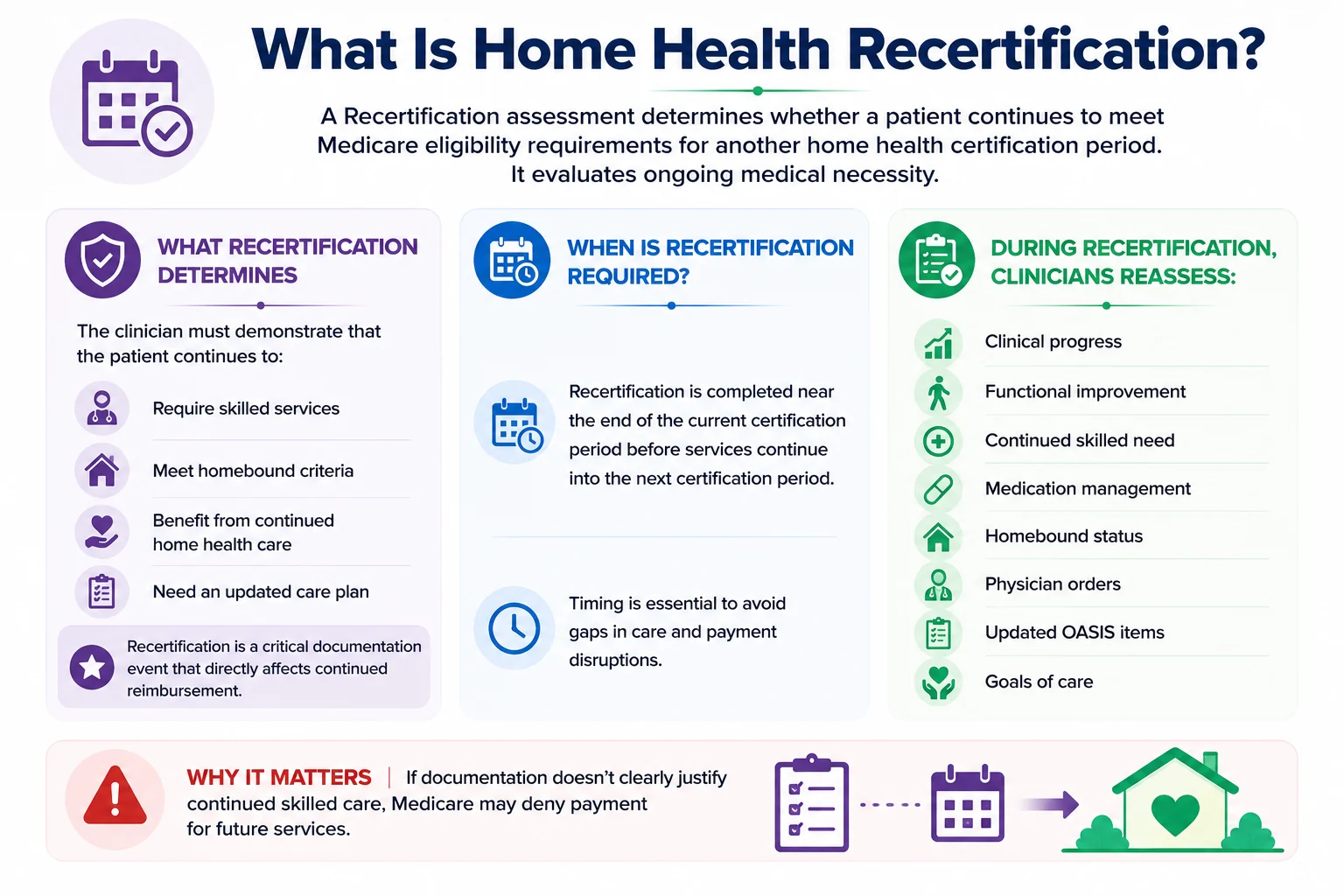
Recertification proves ongoing medical necessity to continue into the next 60-day period, a critical documentation event that directly affects continued reimbursement.
A Recertification assessment determines whether a patient continues to meet Medicare eligibility requirements for another home health certification period. Unlike SOC, which establishes care, Recertification evaluates ongoing medical necessity.
The clinician must demonstrate that the patient continues to require skilled services, meet homebound criteria, benefit from continued home health care, and need an updated care plan. Recertification is one of the most important documentation events because it directly affects continued reimbursement.
When Is a Recertification Assessment Required?
Recertification is completed near the end of the current certification period before services continue into the next certification period. During Recertification, clinicians reassess clinical progress, functional improvement, continued skilled need, medication management, homebound status, physician orders, updated OASIS items, and goals of care. If documentation doesn't clearly justify continued skilled care, Medicare may deny payment for future services.
SOC vs ROC vs Recertification: Side-by-Side Comparison
| Feature | SOC | ROC | Recertification |
|---|---|---|---|
| Purpose | Admit patient | Resume care after inpatient stay | Continue care |
| OASIS Required | Yes | Yes | Yes |
| Creates Care Plan | Yes | Updates | Updates |
| Medication Review | Yes | Yes | Yes |
| Medicare Impact | Starts payment | Resumes payment | Continues payment |
| Typical Duration | Longest visit | Moderate | Moderate |
| Documentation Complexity | Highest | High | High |
Common Documentation Mistakes
Even experienced clinicians make mistakes during SOC, ROC, and Recertification documentation. Common issues include:
- Choosing the wrong assessment type
- Missing required OASIS questions
- Incomplete medication reconciliation
- Inconsistent functional scoring
- Missing physician orders
- Poor documentation supporting homebound status
- Insufficient justification for continued skilled care
- Late documentation submission
- Missing Recertification deadlines
These mistakes frequently result in billing delays and additional QA review.
How SOC, ROC, and Recertification Affect Medicare Payment
These assessments directly influence Medicare reimbursement, PDGM payment calculations, quality reporting, Star Ratings, Value-Based Purchasing measures, clinical outcomes, and audit readiness. Incomplete or inaccurate documentation can reduce reimbursement while increasing administrative work.
Why Nurses Spend So Much Time Completing These Assessments
SOC, ROC, and Recertification visits involve much more than answering OASIS questions. Clinicians must simultaneously assess the patient, build rapport, educate caregivers, review medications, document functional abilities, coordinate with physicians, complete regulatory documentation, and ensure billing accuracy.
This administrative burden often extends beyond patient visits, contributing to after-hours charting and clinician burnout.
How AI Can Simplify SOC, ROC, and Recertification Documentation
Modern AI documentation platforms are helping home health clinicians spend less time typing and more time caring for patients. Healthcare-specific AI can assist with:
- Voice documentation
- Structured OASIS workflows
- Gap detection
- Clinical summaries
- Photo documentation
- Medication capture
- Human-reviewed documentation before EMR submission
- Direct integration with systems like WellSky (Kinnser)
The goal isn't to replace clinician judgment, it's to reduce documentation burden while maintaining accuracy and compliance.
🚀 See same-day SOC, ROC, and Recertification documentation. Copper Digital's AI Documentation Agent captures the visit by voice, photo, and tap, drafts the OASIS and visit note, runs hundreds of compliance checks, and keeps a nurse reviewing and approving every record before it reaches WellSky (Kinnser). Explore AI tools for home health nurses or book a demo.
📘 Free download: Go deeper with the Home Health Documentation Playbook, a 232-page guide to OASIS-E, Medicare compliance, PDGM, and AI-assisted documentation, with 150+ point-of-care checklists for SOC, ROC, and Recertification.
What Should I Document? 100 OASIS Situations Home Health Nurses Face Every Day
100 real OASIS scenarios, worked end to end — clinical situation, common mistake, better approach, and key takeaway. Built around OASIS-E2 (effective April 1, 2026) to turn what you assess into accurate, defensible documentation.
Bottom Line
SOC, ROC, and Recertification are three OASIS time points with one goal, keeping a home health episode compliant and paid, but very different purposes: SOC starts the episode and sets the baseline, ROC resumes it after an inpatient stay, and Recertification proves ongoing medical necessity for the next 60-day period. Choosing the right assessment and meeting CMS timing protects reimbursement, quality scores, and audit readiness.

Arvind Sarin is the founder of Copper Digital. For the past year he has spent three days a week inside a 500+ census Texas home health agency, building AI documentation that finishes OASIS and visit notes the same day, with a nurse reviewing and approving every note. He writes about home health documentation, OASIS, Medicare compliance, and applying AI responsibly in clinical workflows.
Frequently asked
Frequently asked questions
SOC stands for Start of Care. It is the initial comprehensive home health assessment completed when a patient begins receiving home health services.
Join the conversation
Leave a comment
Related reading
What Is OASIS-E? The Complete Guide for Home Health Agencies (2026)
OASIS-E is the CMS-required standardized assessment behind home health reimbursement, quality, and compliance. This complete guide covers what OASIS-E is, how it differs from D1/E1/E2, the five assessment time points, Section GG, PDGM impact, and documentation best practices.
OASIS Documentation Compliance Tips for Home Health Agencies
OASIS compliance isn't just filling in every field, it's making the assessment tell a consistent, clinically supported story that agrees with the rest of the record. This guide covers 12 practical compliance tips, 9 common errors, a pre-submission checklist, what's new in OASIS-E2, and where AI helps (and where it must not).
PDGM Documentation Strategies for Home Health Agencies
Under PDGM, documentation establishes the clinical picture that supports classification, medical necessity, coding, and payment. This guide breaks down 15 PDGM documentation strategies, a documentation-to-payment framework, weak-vs-strong examples, and a closed-loop workflow to keep charts consistent and audit-ready.