
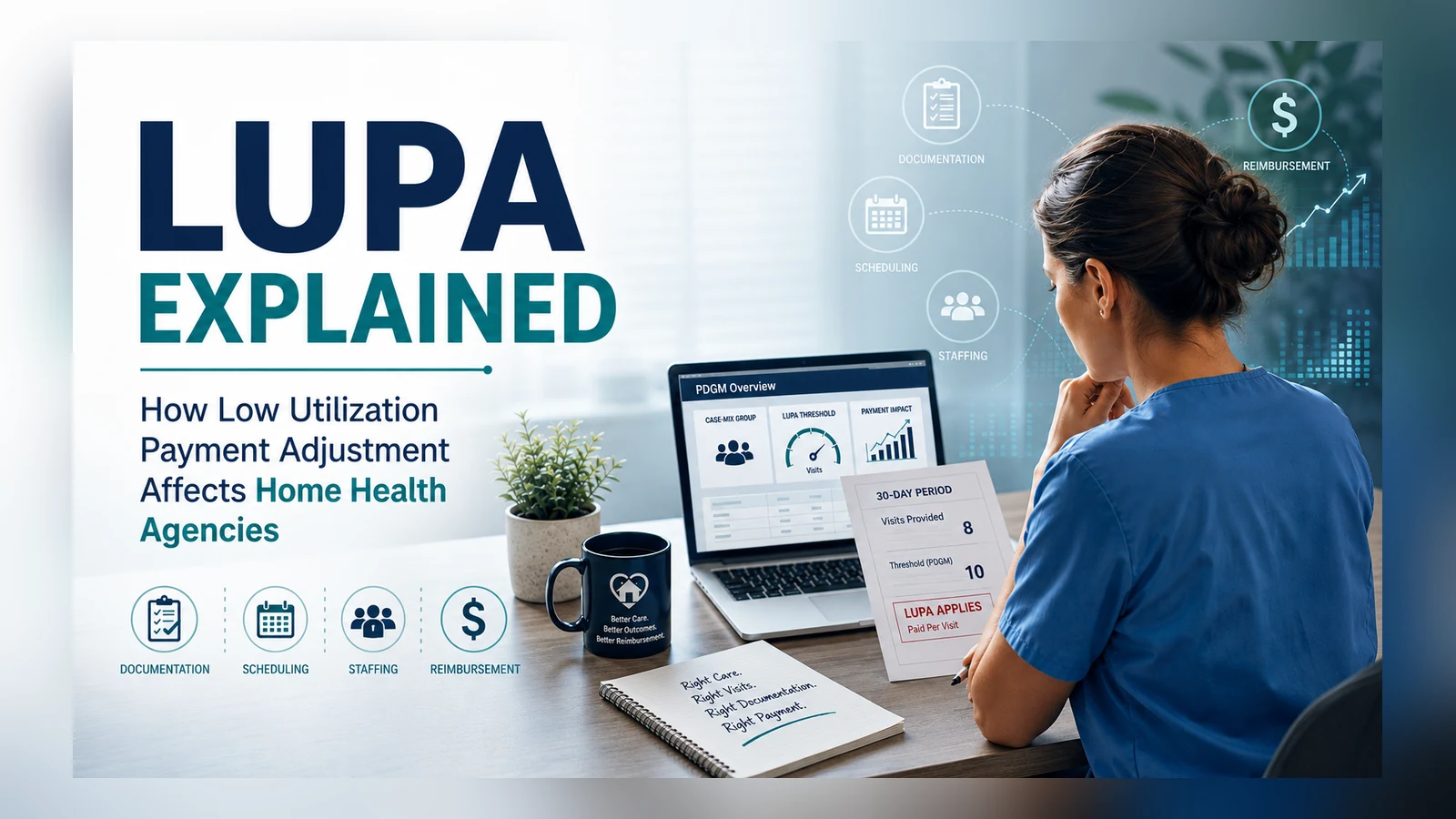
LUPA Explained: How Low Utilization Payment Adjustment Affects Home Health Agencies
LUPA — Low Utilization Payment Adjustment — kicks in when a 30-day home health period falls below its PDGM visit threshold, shifting payment from the case-mix-adjusted 30-day rate to per-visit. This guide explains how thresholds work, what causes avoidable LUPAs, and how to manage LUPA risk without chasing visits.
Key Takeaways
- LUPA (Low Utilization Payment Adjustment) applies when a 30-day period falls below its applicable PDGM visit threshold.
- There is no single LUPA threshold — it varies by PDGM case-mix group and payment year.
- LUPA generally changes the payment methodology to per-visit payment; it is not automatically a billing error or compliance violation.
- Some LUPAs are clinically appropriate — focus on reducing avoidable LUPAs, never on unnecessary visit volume.
- OASIS, assessment, documentation, scheduling, and real-time utilization monitoring all shape LUPA risk.
- Analyze frequent or unusual LUPA patterns for operational causes rather than watching the overall rate alone.
- CMS recalibrates thresholds (including for CY 2026), so always use current-year guidance.
💡 Quick Answer: LUPA — Low Utilization Payment Adjustment — is a Medicare payment adjustment under PDGM that applies when a 30-day home health period has fewer visits than the applicable threshold for its PDGM case-mix group. Instead of the case-mix-adjusted 30-day payment, the period is generally paid on a per-visit basis. Thresholds vary by case-mix group and payment year — there is no single number that applies to every patient.
For home health agencies, providing clinically appropriate care is only part of the reimbursement equation. Agencies also have to understand how patient characteristics, visit utilization, documentation, OASIS, PDGM, and billing work together. One important piece of that equation is LUPA.
Under the Medicare Home Health Prospective Payment System, a 30-day period of care can receive LUPA treatment when the number of visits falls below the applicable threshold for the patient's specific PDGM case-mix group. Instead of receiving the case-mix-adjusted 30-day payment, the agency is generally paid on a per-visit basis for the services furnished during the period — which can be a significant difference in reimbursement. But LUPA isn't simply a billing problem. It can reveal issues involving assessment, scheduling, staffing, documentation, utilization, care planning, and operational visibility.
⚠️ Important: LUPA thresholds, payment rates, and Medicare requirements can change. This article is an educational reference and should be used alongside current CMS, Medicare Administrative Contractor (MAC), and payer guidance.
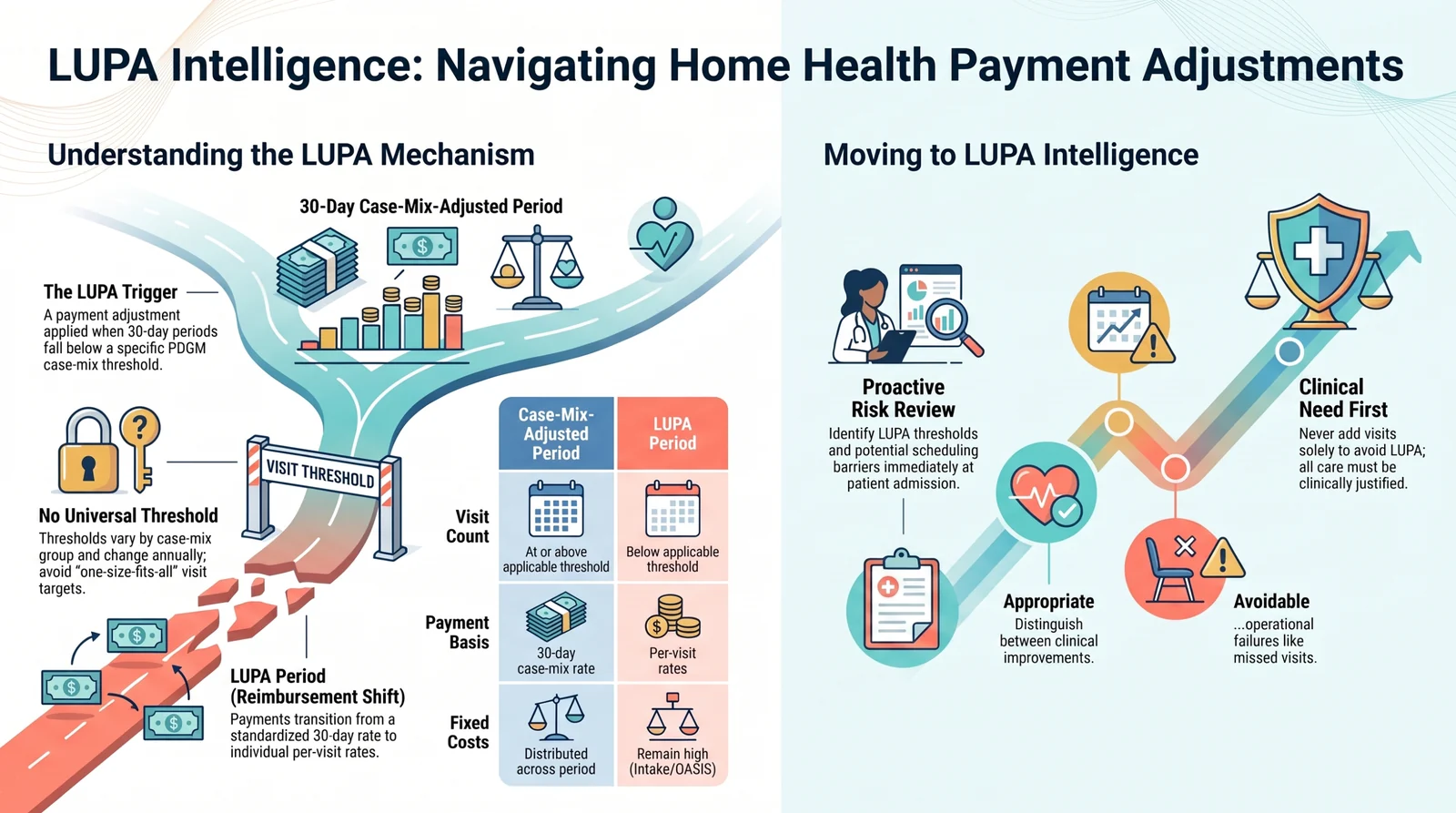
LUPA isn't a penalty — it's a payment-methodology shift. The goal is to separate clinically appropriate LUPAs from operationally avoidable ones.
What Is LUPA in Home Health?
LUPA, or Low Utilization Payment Adjustment, is a Medicare payment adjustment that applies when a home health 30-day period has fewer visits than the applicable threshold for its PDGM case-mix group. When a period falls below the threshold, Medicare generally pays the agency based on the individual visits furnished rather than the case-mix-adjusted 30-day payment. In simple terms:
- Below the applicable threshold → LUPA per-visit payment
- At or above the applicable threshold → case-mix-adjusted 30-day payment methodology
The important word is applicable. There is no single LUPA threshold that applies to every home health patient — it depends on the patient's PDGM case-mix group, and CMS updates payment parameters periodically.
How Does LUPA Work Under PDGM?
The Patient-Driven Groupings Model (PDGM) was implemented for Medicare home health on January 1, 2020, replacing the previous 60-day episode with a 30-day period of care. PDGM classification considers admission source, timing, clinical grouping, functional impairment, and a comorbidity adjustment to place each 30-day period into a case-mix group — and each case-mix group has an associated LUPA threshold.
The simplified process looks like this: patient admitted → clinical assessment and OASIS → PDGM case-mix classification → applicable LUPA threshold → visits delivered → payment determined. If the number of visits is below the applicable threshold, the period may receive LUPA treatment. If it meets or exceeds the threshold, it generally receives the case-mix-adjusted 30-day payment methodology, assuming other requirements are met.
What Is a LUPA Threshold?
A LUPA threshold is the visit threshold associated with a specific PDGM case-mix group. It determines whether a 30-day period is paid using the case-mix-adjusted 30-day methodology or the applicable per-visit LUPA methodology.
Is the LUPA threshold always the same?
No. There is no universal number of visits that automatically causes a LUPA. CMS establishes thresholds based on the applicable PDGM payment group, and they can change by payment year. That's why agencies should avoid statements like "a patient needs four visits to avoid LUPA" — that may be incorrect for a particular patient or year. Instead, identify the specific threshold for the applicable case-mix group and verify current CMS guidance.
What Happens If an Agency Is One Visit Short of the LUPA Threshold?
This is one of the most important practical questions for agencies. Suppose, for illustration, a patient's applicable threshold is 5 visits:
- 3 visits: below the threshold
- 4 visits: still below the threshold
- 5 visits: reaches the threshold
- 6 visits: above the threshold
If the patient receives four visits when the threshold is five, the period can receive LUPA treatment. But that does not mean the agency should automatically schedule a fifth visit — the additional visit must be clinically appropriate and supported by the patient's condition and plan of care. The right question is not "can we add one more visit?" It is "does this patient clinically require another skilled visit?" That distinction is essential for compliant LUPA management.
LUPA Is Not the Same as a Penalty
LUPA is often called a "payment reduction," but a more precise framing is a payment adjustment or methodology. When a period falls below the threshold, the methodology changes from the case-mix-adjusted 30-day payment to per-visit payment. A LUPA does not necessarily mean the agency did something wrong — a patient may genuinely require fewer visits: they may recover faster than expected, stabilize quickly, need only limited skilled intervention, discharge early, or have needs that legitimately result in low utilization. The goal should therefore be to identify avoidable LUPAs, not eliminate every LUPA.
How LUPA Affects Home Health Reimbursement
LUPA can have a significant financial impact. Under the case-mix-adjusted 30-day methodology, payment is based on the PDGM classification; when a period falls into LUPA, payment is generally calculated using per-visit rates for the services furnished — a substantial difference. Meanwhile, many of the same underlying costs remain: intake, referral processing, OASIS assessment, clinical oversight, scheduling, documentation, quality review, billing, administrative work, and care coordination.
Because so many fixed or semi-fixed costs remain even when reimbursement changes, frequent LUPAs can affect agency-level revenue, profitability, cash flow, revenue forecasting, staffing decisions, productivity, referral economics, and operational planning.
Why LUPA Matters to Home Health Agencies
LUPA is not a billing-department metric alone — a high or unexpected LUPA rate can prompt leaders to examine the whole organization:
- Clinical operations — are patients assessed accurately and do care plans reflect actual needs?
- Scheduling — are visits missed or delayed; are staffing gaps affecting utilization?
- Documentation — does the record support the patient's condition and care needs?
- Billing — are case-mix and claim details handled correctly?
- Financial performance — are LUPAs affecting expected reimbursement and margins?
- Referral strategy — are certain referral patterns tied to unexpectedly high LUPA rates?
The key is to understand why LUPAs are occurring.
What Causes LUPA in Home Health?
Not every LUPA is avoidable, but agencies can often spot operational or clinical patterns that contribute to it.
1. The patient naturally requires fewer visits
Some patients simply don't need a high volume of skilled services. If a patient improves quickly, a LUPA may be clinically appropriate — and agencies should never provide unnecessary visits solely to reach a payment threshold.
2. Inaccurate initial assessment
The initial assessment establishes the picture of the patient's condition and needs. If those needs aren't accurately identified, the agency may underestimate the level of care required, which is why accurate clinical assessment and OASIS documentation matter from the very beginning.
3. Changes in patient condition
Patients can improve or deteriorate during a 30-day period. One expected to need several visits may stabilize sooner; another may develop new needs. Agencies need processes that let clinicians communicate changes promptly.
4. Missed or delayed visits
Operational issues affect utilization too — staffing shortages, scheduling gaps, patient cancellations, unable-to-see situations, geographic challenges, communication breakdowns, and transportation or access issues. One missed visit doesn't automatically create a LUPA, but repeated disruptions can. These are the same gaps behind many incomplete visit notes.
5. Poor visibility into utilization
Some agencies don't identify potential LUPAs until the period is nearly over, when there's little opportunity to address legitimate scheduling or clinical issues. Real-time visibility helps surface problems earlier.
LUPA and OASIS: What's the Connection?
One of the most important relationships to understand is: OASIS → clinical characteristics → PDGM case-mix assignment → LUPA threshold. OASIS provides information about the patient's clinical and functional status that contributes to classification and payment. But this does not mean clinicians should document toward a desired payment category. The goal is accurate documentation of the patient's actual condition — accurate documentation supports accurate classification, which is very different from changing documentation to influence payment. Our OASIS documentation compliance tips go deeper on getting this right.
LUPA and Documentation: Why Accuracy Matters
Documentation is a foundation of compliant billing. The clinical record should clearly establish why the patient requires home health, why skilled care is necessary, relevant diagnoses and conditions, functional limitations, services provided, skilled interventions, patient response, progress toward goals, changes in condition, education provided, continued skilled needs, and communication with other providers. A reviewer should be able to follow why the patient needs home health, what the clinician did, why the service was skilled and necessary, how the patient responded, and the plan going forward. When documentation is incomplete or inconsistent, agencies face compliance and reimbursement risks beyond LUPA itself — see the top documentation errors in home health.
Can Documentation Prevent a LUPA?
No. Documentation itself does not eliminate a LUPA — a patient can have excellent documentation and still legitimately fall below the applicable threshold. But accurate documentation is critical because it supports patient eligibility, medical necessity, clinical classification, the plan of care, services provided, coding, billing, and payment review. Good documentation helps ensure the agency is paid accurately for the care actually provided.
Should Agencies Try to Avoid LUPA?
Agencies should try to reduce avoidable LUPAs — not eliminate every LUPA. If a patient clinically needs three visits, the agency should not add unnecessary visits to reach a threshold; that creates compliance, ethical, and quality concerns. Instead, focus on accurate assessment + appropriate care planning + reliable scheduling + strong documentation + proactive monitoring. The goal is the right care for the patient, not the right number of visits for reimbursement.
How Can Agencies Reduce Avoidable LUPAs?
1. Review LUPA risk at admission
LUPA management should begin early. At admission, review patient needs, the clinical assessment, OASIS information, PDGM case-mix information, the applicable threshold, expected visit frequency, potential scheduling barriers, and staffing requirements — so issues surface before they become month-end surprises.
2. Monitor visits throughout the 30-day period
Don't wait until billing. Track visits completed and scheduled, missed visits, days remaining, the applicable threshold, patient status, and upcoming scheduling gaps so leaders can identify legitimate issues earlier.
3. Connect clinical and billing teams
Clinical, scheduling, coding, and billing teams shouldn't operate in silos. A useful workflow is clinician → clinical leadership → scheduling → billing, with each team understanding how the previous step's information affects the next.
4. Track LUPA trends
Don't only review individual cases — analyze trends across referral sources, clinical groups, diagnoses, geographic areas, clinicians, branches, payers, admission types, and staffing patterns to reveal recurring operational problems.
5. Separate appropriate and avoidable LUPAs
This is one of the most useful metrics an agency can develop. A LUPA caused by a patient legitimately needing fewer visits is different from one caused by missed visits, scheduling failures, staffing gaps, documentation problems, communication breakdowns, or incorrect expectations at admission. Focus improvement efforts on the second category.
Can Frequent LUPAs Trigger Additional Scrutiny?
A LUPA by itself does not mean an agency did anything wrong or automatically trigger an audit. However, unusual utilization patterns, inconsistent documentation, or other anomalies may lead to additional review. Monitor patterns rather than just the overall LUPA percentage — for example, repeated LUPAs from a particular referral source, unexpectedly high rates within a clinical group, frequent missed visits, large gaps between planned and delivered care, or documentation that doesn't support the clinical picture. The objective isn't to hide LUPAs; it's to understand what's causing them.
LUPA Management Should Not Become "Visit Chasing"
A LUPA threshold should never become a clinical target. Instead of asking "we need one more visit to avoid LUPA — can we schedule one?", ask "does this patient's current clinical condition justify another skilled visit?" If yes, provide and document it appropriately. If no, don't create unnecessary utilization just to change the payment calculation. Patient care comes first.
LUPA vs. Case-Mix-Adjusted 30-Day Payment
| Feature | LUPA Period | Case-Mix-Adjusted 30-Day Period |
|---|---|---|
| Visit count | Below applicable threshold | At or above applicable threshold |
| Payment methodology | Applicable per-visit payment | Case-mix-adjusted 30-day payment |
| PDGM relevance | Case-mix group determines threshold | Case-mix group affects payment |
| Documentation | Must support care provided | Must support clinical/case-mix information |
| Financial impact | May result in lower reimbursement | 30-day payment methodology applies |
| Clinical standard | Appropriate care only | Appropriate care only |
The key takeaway: LUPA changes the payment methodology; it does not change the standard of care.
How LUPA Fits Into the Home Health Revenue Cycle
LUPA should be monitored alongside other revenue-cycle metrics — LUPA rate, claim denial rate, billing lag, documentation and OASIS completion, authorization status, days in accounts receivable, visit utilization, referral conversion, payer mix, payment variance, and outstanding claims. Looking at LUPA in isolation can mislead: a low LUPA rate isn't necessarily better performance if it's achieved by providing clinically unnecessary visits. The better question is: are we providing appropriate care while identifying and reducing operationally avoidable LUPAs? For the full picture, pair this with our home health billing cheat sheet.
LUPA and Home Health Profitability
For owners and administrators, LUPA is ultimately a financial metric — but the underlying causes are usually operational. Consider two agencies with similar census. Agency A: accurate admission assessments, clear documentation, proactive scheduling, real-time utilization monitoring, strong clinical-billing communication, and a low avoidable-LUPA rate. Agency B: manual utilization tracking, late documentation, frequent scheduling gaps, poor communication, missed visits, and LUPAs discovered after the period closes. The difference may not be that Agency A provides more care — it may simply have better operational visibility and control. (Small operational gaps compound; see how a single budgeting error can cascade.)
How Technology Can Help With LUPA Management
Technology can help agencies identify utilization and documentation issues earlier, providing visibility into visit utilization, scheduling, documentation completion, OASIS information, patient status, case-mix information, potential workflow issues, and billing status. AI can add another layer by spotting patterns across clinical and operational data — for example, flagging: "this patient is approaching the end of the 30-day period, has completed fewer visits than expected, and has an upcoming scheduling gap." That doesn't mean AI should automatically recommend another visit; it gives the clinical team the chance to ask whether the patient's current condition justifies additional skilled care. This keeps the clinician in control while improving visibility — the same human-in-the-loop principle behind PDGM documentation strategies.
A Practical LUPA Management Workflow
- Admission — assess the patient accurately and establish the appropriate plan of care.
- Classification — review OASIS and relevant information supporting the PDGM case-mix classification.
- Threshold review — identify the applicable LUPA threshold for the case-mix group.
- Scheduling — build an appropriate visit schedule based on clinical needs.
- Monitor — track visits, missed visits, patient changes, and remaining days.
- Escalate — investigate unexpected utilization or scheduling gaps.
- Clinical review — determine whether additional skilled services are clinically appropriate.
- Document — ensure services and patient status are accurately documented.
- Billing review — validate applicable claim and payment information.
- Analyze — track whether the LUPA was clinically appropriate or operationally avoidable.
LUPA Checklist for Home Health Agencies
At admission
- Confirm patient eligibility and referral information
- Complete the required clinical assessment accurately
- Complete applicable OASIS requirements
- Review clinical needs and establish an appropriate plan of care
- Determine applicable PDGM information and identify the LUPA threshold
- Build an appropriate initial visit schedule
During the 30-day period
- Monitor completed and scheduled visits
- Track missed and cancelled visits
- Review changes in patient condition
- Keep documentation current and communicate changes to the care team
- Monitor potential LUPA risk and address legitimate scheduling gaps early
Before billing
- Confirm required documentation is complete
- Validate visit information
- Review OASIS and supporting documentation
- Confirm coding consistency and applicable claim information
- Check for billing errors
Monthly leadership review
- Track the overall LUPA rate
- Separate clinically appropriate from potentially avoidable LUPAs
- Compare LUPA rates by referral source and clinical group
- Identify operational causes and review missed-visit patterns
- Create corrective action plans where appropriate
2026 Home Health LUPA Updates
LUPA rules are not static. For CY 2026, CMS finalized updates to the Medicare Home Health Prospective Payment System, including recalibrated PDGM case-mix weights and LUPA thresholds, using more recent utilization data. An agency should not assume that a LUPA threshold from an older year remains applicable today. Billing and operations teams should review the current CMS payment materials, verify current LUPA thresholds, update internal billing systems and training materials, review utilization dashboards, and confirm staff are using current references — and continue to monitor future CMS rulemaking, since payment parameters can change year to year.
The Bottom Line
LUPA is one of the most important payment concepts for agencies operating under PDGM — but managing it isn't about chasing visit counts. It's about understanding the relationship between patient needs → assessment → OASIS → PDGM → case-mix → LUPA threshold → visits → documentation → payment. The strongest agencies don't ask "how do we avoid every LUPA?" They ask "which LUPAs are clinically appropriate, which are operationally avoidable, and what can we learn from the difference?" That shift — from LUPA avoidance to LUPA intelligence — helps agencies improve operational visibility, protect appropriate reimbursement, and make better decisions without compromising patient care. LUPA isn't just a billing metric. It's a signal.
Sources & Further Reading
- CMS — Home Health Prospective Payment System
- CMS — Medicare Claims Processing Manual, Chapter 10: Home Health Agency Billing
- CMS — CY 2026 Home Health Prospective Payment System Final Rule & Fact Sheet
- CMS — PDGM Overview
- CMS — Home Health PPS Grouper Software
📝 Editorial/regulatory disclaimer: This article is for educational purposes only. It is not billing, coding, legal, compliance, or reimbursement advice. Medicare, Medicaid, Medicare Advantage, and commercial payer requirements may differ and can change over time. Always verify current requirements with CMS, the applicable Medicare Administrative Contractor, state Medicaid program, or individual payer before making billing or clinical decisions.
Home Health Documentation Playbook
The complete guide to OASIS-E, Medicare compliance, PDGM, and AI-assisted documentation. Learn how top agencies reduce documentation time without sacrificing compliance.
Bottom Line
LUPA is one of the most important PDGM payment concepts for home health agencies, but managing it isn't about chasing visit counts. It's about the chain from patient needs to assessment, OASIS, PDGM case-mix, threshold, visits, documentation, and payment. The strongest agencies don't ask how to avoid every LUPA — they ask which LUPAs are clinically appropriate, which are operationally avoidable, and what the difference teaches them. That shift from LUPA avoidance to LUPA intelligence protects appropriate reimbursement without compromising patient care.

Arvind Sarin is the founder of Copper Digital. For the past year he has spent three days a week inside a 500+ census Texas home health agency, building AI documentation that finishes OASIS and visit notes the same day, with a nurse reviewing and approving every note. He writes about home health documentation, OASIS, Medicare compliance, and applying AI responsibly in clinical workflows.
Frequently asked
Frequently asked questions
LUPA stands for Low Utilization Payment Adjustment. It applies when a 30-day home health period has fewer visits than the applicable threshold for its PDGM case-mix group. The period is generally paid using per-visit payment rather than the case-mix-adjusted 30-day payment methodology.
Join the conversation
Leave a comment
Related reading
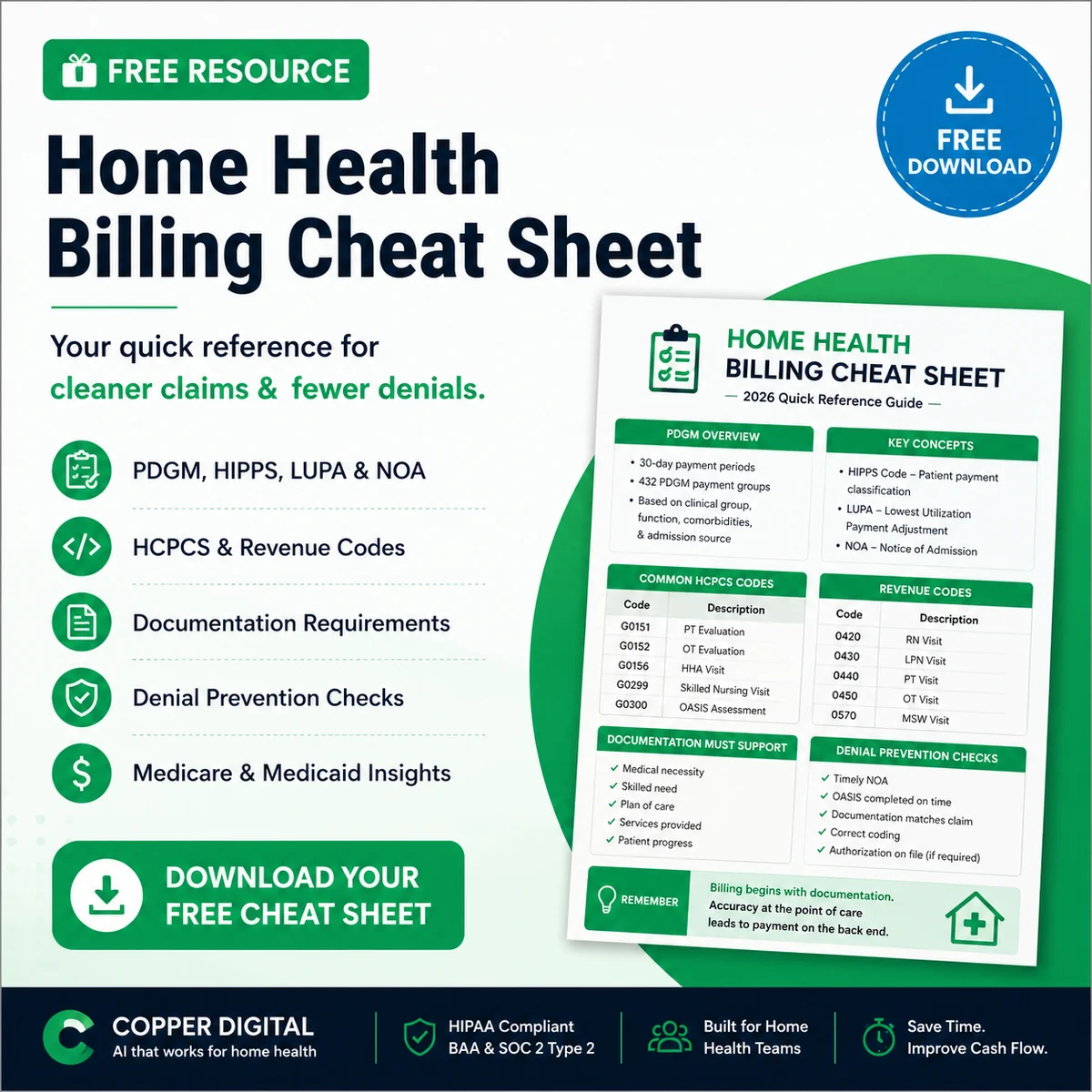
Free Home Health Billing Cheat Sheet
Home health billing gets complicated fast — PDGM, HIPPS, OASIS, NOA, LUPA, HCPCS and revenue codes, and payer rules all have to line up with the documentation. This guide walks through the essentials and gives you a free, downloadable cheat sheet your billing and clinical teams can actually use.
Why Medicare Home Health Claims Get Denied
Medicare home health claim denials are revenue leaks, not just billing issues. This guide breaks down the ten most common reasons claims get denied, from OASIS gaps and late NOAs to coding and medical-necessity problems, and how to prevent them to get paid faster.
ICD-10 Coding Best Practices for Home Health Agencies
Accurate ICD-10 coding shapes PDGM reimbursement, claim denials, and Medicare compliance in home health. This guide walks through the eight best practices every agency should follow, from selecting the correct primary diagnosis and capturing comorbidities to coding specificity, OASIS alignment, annual updates, audits, and using AI as a coding support tool.